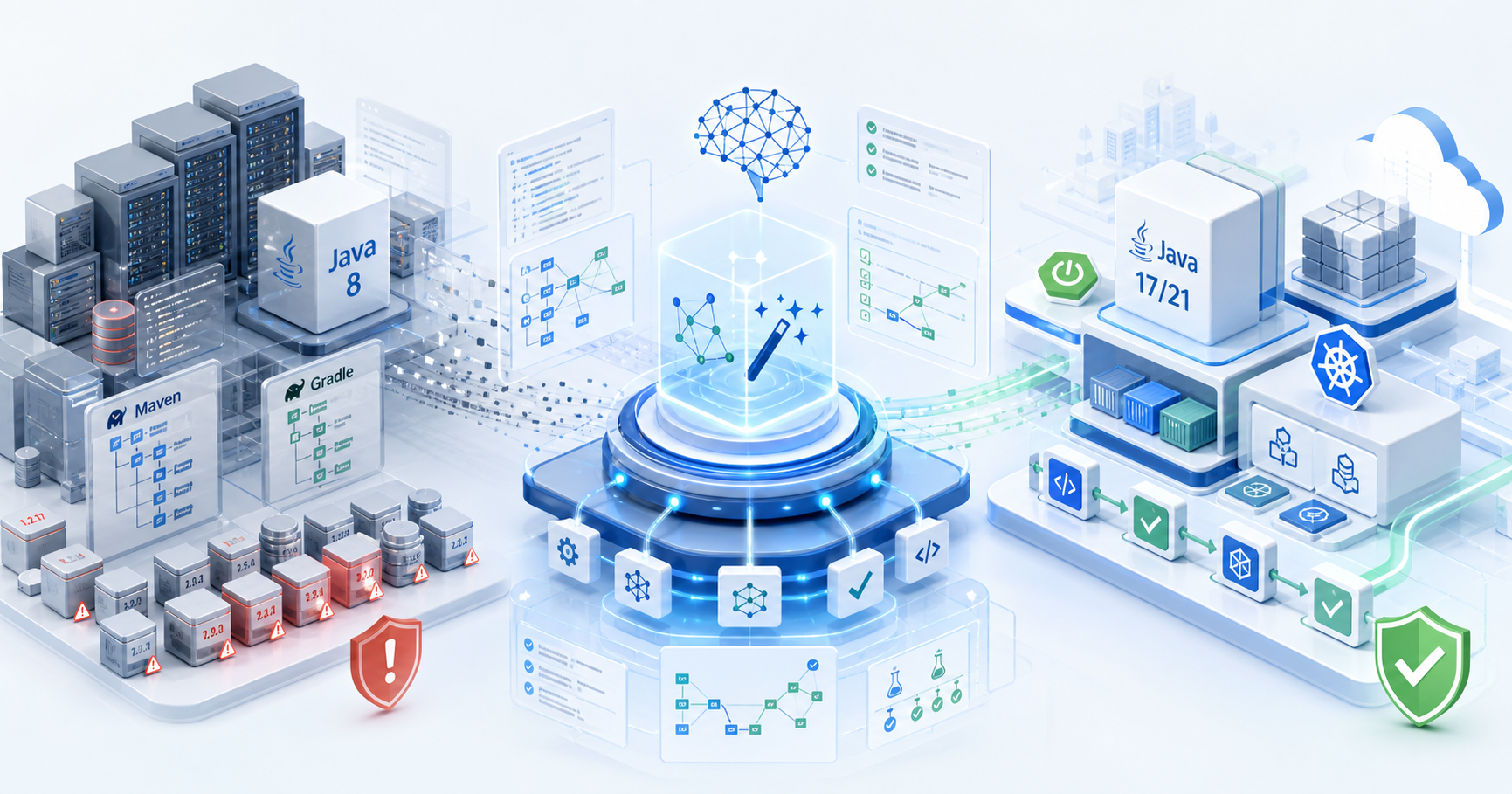
Still on Java 8?
Beyond 2031,
are you really prepared?

Migraty combines OpenRewrite + AI for both Maven and Gradle.
50% less effort at a fixed pricefor a reliable migration to the latest Java version.
Quality assurance measured on 4 million SLOC.

50%
Effort reduction
(measured results)
+45%
Design productivity
improvement
+55%
Development productivity
improvement)
Migration from Java 8 to Java 17/21 LTS using OpenRewrite and AI
Thay ảnh
The risks of staying on Java 8
CVE remediation directly increases paid vendor fees, adding costs every year
Unable to keep pace with Spring Boot 3 and Jakarta EE
An outdated environment deters Java 21 talent, making skilled recruitment harder
Java 8 is being deprecated in cloud environments such as AWS Lambda and Azure
✦ Measured Migraty performance
Effort reduction rate 50% reduction
Design productivity +45% improvement
Development productivity +55% improvement
Throughput improvement Up to +40%

The business risks
of staying on Java 8

Security, costs, recruitment, and cloud readiness: continuing to run Java 8 undermines business competitiveness on every front. Migraty addresses these issues with concrete evidence.

CVE remediation directly increases paid vendor fees
Free support for Oracle Java 8 has effectively ended. Annual paid license fees are required to obtain security patches, putting continuing pressure on your IT budget.
Unable to adopt Spring Boot 3 and Jakarta EE
Major frameworks now require Java 17+. Without upgrading, you lose access to new features and security fixes, allowing technical debt to accumulate.
Hiring skilled engineers becomes harder
Environments without modern Java features such as virtual threads, Records, and Sealed Classes deter engineers with Java 25 skills. Reduced hiring competitiveness directly creates business risk.
Cloud deprecation is advancing
Java runtimes such as AWS Lambda and Azure Functions recommend Java 25. Java 8 is increasingly deprecated, creating an obstacle to cloud-native adoption.
Lost opportunities from lower performance
Java 25 delivers over 40% higher throughput than Java 8 through GC improvements and virtual threads. Staying on an older environment only widens the performance gap with competitors.
Delaying LTS migration increases remediation costs
The earlier you start, the smaller the migration scope and the lower the fixed price. Longer delays accumulate technical debt, increasing migration difficulty and cost.
LTS migration evidence — The data behind Java modernization
Perspective Data and Evidence
EOL status Oracle Java 8 free support: scheduled to end in 2030 (security updates are available only with paid editions)
LTS comparison From Java 17 (through September 2026) to Java 25 (through September 2033), the current LTS. Java 8 is effectively a legacy platform.
Performance difference Java 25 delivers over 40% higher throughput than Java 8 through GC improvements and virtual threads
Recruitment risk Environments limited to Java 8/11 struggle to attract talent. This is a business issue that directly affects hiring skilled people.
Cloud Java runtimes such as AWS Lambda and Azure Functions recommend Java 17/21. Java 8 is increasingly deprecated.
Why act now? Reduce effort with OpenRewrite + AI50% reduction. Starting early secures long-term, stable support with LTS 21.

Powered by OpenRewrite + AI
50% less effort at a fixed price

Java code conversion, testing, and validation using OpenRewrite and AI
Thay ảnh
01

OpenRewrite + AI delivers a proven 50% reduction in effort

Combining Migraty's automated conversion tools with OpenRewrite has delivered measured productivity gains of +45% in design and +55% in development on a real 4-million-SLOC project. These effort savings are reflected in fixed pricing, eliminating budget risk.

Design +45% / Development +55% — Measured on 4 million SLOC
02

Supports Maven and Gradle, with optional Spring Boot upgrades

Plans S–L cover standard configurations through complex custom frameworks. A Spring Boot 2 to 3 migration can be added from JPY 1.5 million. We plan for multi-module configurations while fully preserving your existing build environment.

Standard Maven/Gradle, multi-module, and custom framework support
03

Fixed commitments: ±10% estimation accuracy and 4–12-week delivery

Our free AI assessment analyzes the codebase and improves estimation accuracy to ±10% (from the conventional ±30%). From Plan S (up to 50K lines, 4 weeks, JPY 2 million) to Plan L (up to 200K lines, 12 weeks, JPY 5 million), we commit to fixed deadlines and pricing with zero budget overrun risk.

±10% estimation accuracy — Precise scoping through automated AI analysis
04

Quality assurance: 80+ projects, zero critical incidents

With our Human-in-the-Loop approach, AI performs the initial conversion and senior engineers verify business logic. All 80+ projects achieved zero critical incidents. Migration to Java 21 LTS ensures long-term, stable operation through September 2031.

Zero critical incidents — Achieved across all 80+ projects
05

AI-generated tests reduce testing effort by 50%

AI generates JUnit 5 tests and automatically compares behavioral equivalence with the previous Java environment, ensuring 60–70% coverage. GC settings and JVM optimization parameters are tuned for Java 17/21, with measurable performance improvements.

60–70% coverage — AI-generated tests
06

Secure official support through 2033 with Java 25 LTS

After migration, official Java 25 LTS support continues through September 2033. Virtual threads, Records, Sealed Classes, and pattern matching improve the development experience. Operations and maintenance plans from JPY 150,000 per month support ongoing, stable operation.

Java 21 LTS — Official support through September 2031

Migration benefits
Thay ảnh
backed by measurable results

Results measured on a real 4-million-SLOC project. We present demonstrated ROI, rather than estimates.

50%
Effort reduction
Measured results from OpenRewrite + AI
+45%
Design Productivity Improvement
Measured on a 4-million-SLOC project
+55%
Development Productivity Improvement
Measured on the same project
+40%
Throughput improvement
Performance gains from Java 21 GC improvements and virtual threads
▲50%
Reduction in testing effort
Reduction through AI-generated tests

To Java 17/21/25 LTS
A six-step migration process

From AI assessment to production cutover, each phase delivers clear outputs for a transparent migration.

Week 1-2

AI Assessment — Analyze the entire codebase

OpenRewrite + Migraty AI analyzes your entire Maven/Gradle project. It identifies deprecated APIs, removed APIs, and Java version incompatibilities, checks every dependency library (JAR file), calculates risk scores, and provides a fixed quote with ±10% accuracy.

API compatibility report, dependency analysis, and fixed quote (±10%)
Week 2-4

Design & PoC — Create custom recipes

We customize OpenRewrite recipes for your project. Framework upgrades such as Spring Boot 2 to 3 are designed separately when needed. A PoC converts 20% of representative modules to measure conversion rates and quality, followed by an architecture design document.

OpenRewrite recipe set, PoC validation report, and architecture design document
Week 4-10

Automated AI conversion & Manual refinement — Convert the full codebase

OpenRewrite automatically applies repeatable conversions across the codebase. An LLM preserves business logic context while migrating to Java 17/21 features such as Records and Sealed Classes. Senior engineers manually refine and review the remaining 15–30%.

Converted source code, change history report, and static analysis results
Week 8-11

Testing & Performance validation — AI-generated tests

AI-generated tests provide comprehensive unit and integration testing and automatically compare behavioral equivalence with the previous Java environment (60–70% coverage). GC settings and JVM optimization parameters are tuned for Java 17/21 to quantify throughput gains.

Test results, comparative performance measurements, and JVM configuration recommendations

Author

Written by the Migration Services Team, GMO RUNSYSTEM Inc.

Operating Company

GMO RUNSYSTEM Inc.
Shibuya Fukuras 11F, 1-2-3 Dogenzaka, Shibuya-ku, Tokyo
TEL:03-5962-0056

Company Overview|Privacy Policy|Contact Us

Thay ảnh
Thay ảnh
Free AI assessment for .NET migration