Family site
Family site
Family site



You have been told software outsourcing will halve your costs, and told it will wreck your codebase. Both sources sounded certain. The software outsourcing pros and cons below are set out as a decision procedure, because the honest answer depends on things neither warning mentions.
Deloitte's Global Outsourcing Survey 2024, covering more than 500 executives, found that 70% had selectively insourced work that previously sat with a third party in the last five years. The same survey found 80% planning to maintain or increase their investment in third-party outsourcing.
Those two numbers are not a contradiction. Companies are pulling back scope they outsourced under the wrong engagement model and expanding scope they outsourced under the right one. Three things decide which of those you end up doing: what each benefit actually depends on, the control that answers each risk, and where the boundary sits around work that should never leave your team.
Software outsourcing means paying an external company to build or maintain software your own employees would otherwise build.
Outsourcing answers who does the work, and offshoring answers where it is done. They are independent axes, so all four combinations exist. Your own employees at home is in-house. Your own employees in a distant country is a captive centre, which is offshore without outsourcing anything. A multinational running its own research and development centre in Vietnam has changed geography and nothing else. An external company at home is onshore outsourcing. An external company in a distant country is offshore outsourcing.
That matters because the two axes fail differently. Time-zone friction and communication delay come from the offshore axis. Scope disputes, specification gaps and knowledge loss come from the outsourcing axis. Diagnosing the wrong axis is how a company replaces a perfectly good vendor in Poland with a worse one in Mexico, then finds the same scope disputes waiting for it. Staff augmentation belongs inside the outsourcing axis too, which is where the next distinction starts.
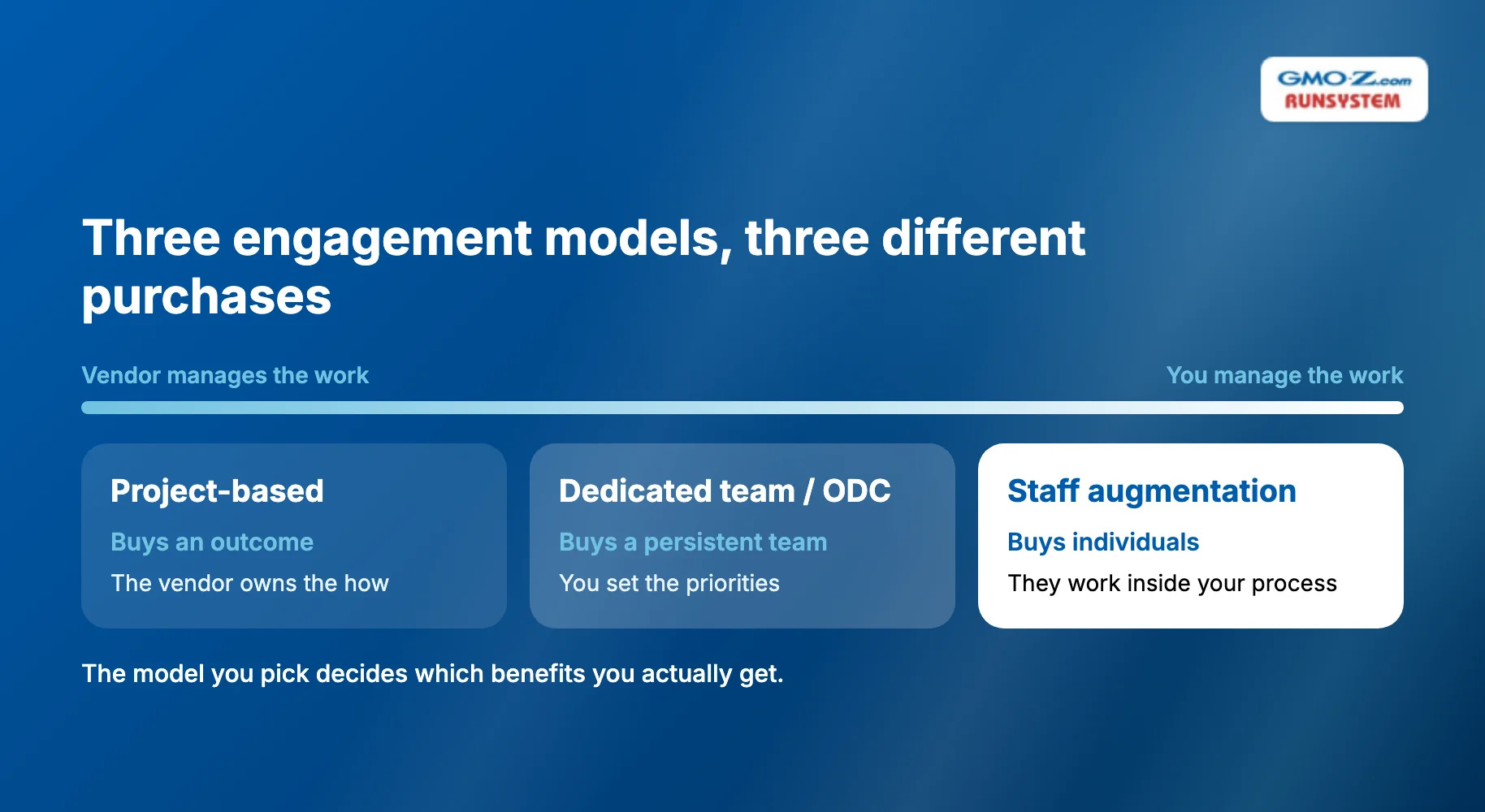
Three engagement models are on offer. Project-based outsourcing buys an outcome and the vendor owns the how. A dedicated team, or offshore delivery center (ODC), buys a persistent team whose priorities you set. Staff augmentation buys individuals who work inside your process. Which one you pick decides which benefits below you actually get; the full comparison, including contract-end behaviour, sits in the [software outsourcing guide]. Those three are not interchangeable, so read every benefit below as conditional.
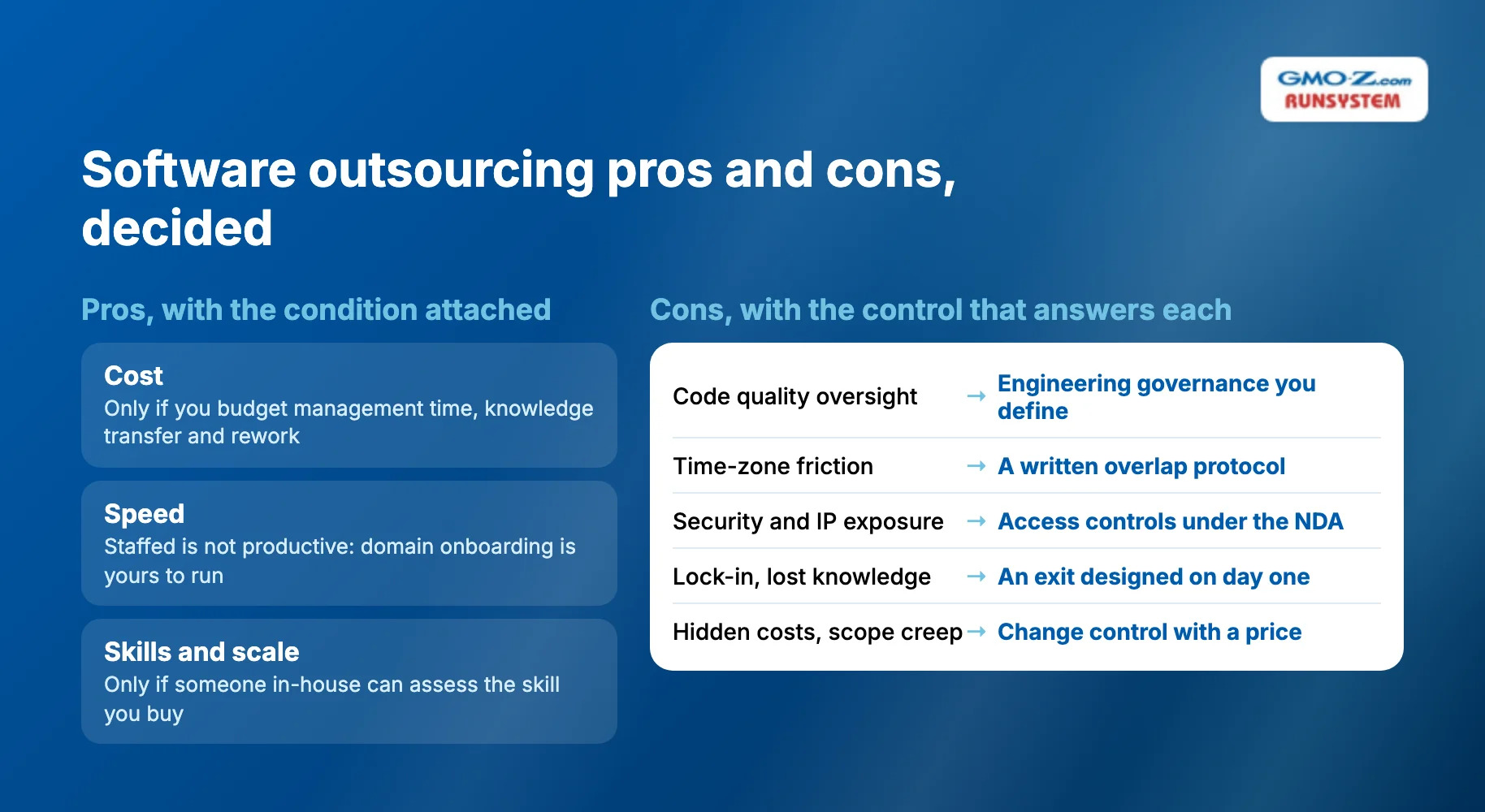
The pros of software outsourcing are real, and every one of them is conditional.
The saving comes from wage arbitrage plus the overhead you stop carrying, and not from cheaper engineering per unit of quality. Recruitment, benefits, equipment, office space and the management layer supporting them move onto the vendor's balance sheet. It is a real saving, and smaller than the rate gap suggests, because three costs survive the move.
Your own management time is the first. Somebody in-house writes the specifications, reviews the output and answers the questions, and no invoice records those hours. Knowledge transfer is the second, recurring every time the vendor rotates an engineer off your account. Last is rework caused by specification gaps, the largest of the three and the one nobody budgets.
A fourth effect reaches your chief financial officer before any of this does. Outsourcing converts fixed headcount cost into variable contract cost, and you can stop paying next quarter. That flexibility often matters more than the rate difference, though speed is what usually gets a vendor hired.
Vendors compress time-to-staffed because they hire ahead of demand and you do not. A senior in-house hire runs through search, interviews, an offer, a notice period and then ramp-up. A vendor draws from a bench that already exists, so the same headcount arrives in weeks.
The condition is that speed to staffed is not speed to productive. A team can be seated on Monday and still be guessing about your domain in week six. Domain onboarding is the lag and it is yours to run, because the knowledge that closes it lives in your building. Budget for it, or the weeks you saved return as rework, which is also what limits the next benefit.
Outsourcing turns a hiring impossibility into a procurement question. If your local market holds four people with production Kubernetes experience and three work for your competitor, no recruiting budget fixes that.
Scale works the same way in reverse. Reducing a vendor team is a contract amendment. Reducing an in-house team is redundancy, severance and legal exposure. The asymmetry is contractual, so it holds however well the engagement is going.
Both benefits share one condition that published guides leave out. You have to be able to assess the skill you are buying. A CV claiming five years of Kubernetes is worth nothing without your own technical assessment, and if nobody in-house can run one, what you bought is a claim about a skill. Every benefit above arrived with a condition, and those conditions, unmanaged, are exactly the disadvantages people warn you about.
Every well-documented con of software outsourcing is a failure of engagement model, contract clause or technical control, rather than a property of outsourcing itself. That is why two companies buying the same service from the same vendor get opposite outcomes. The five risks below are the ones every guide lists. The controls beside them are the part the guides leave out.
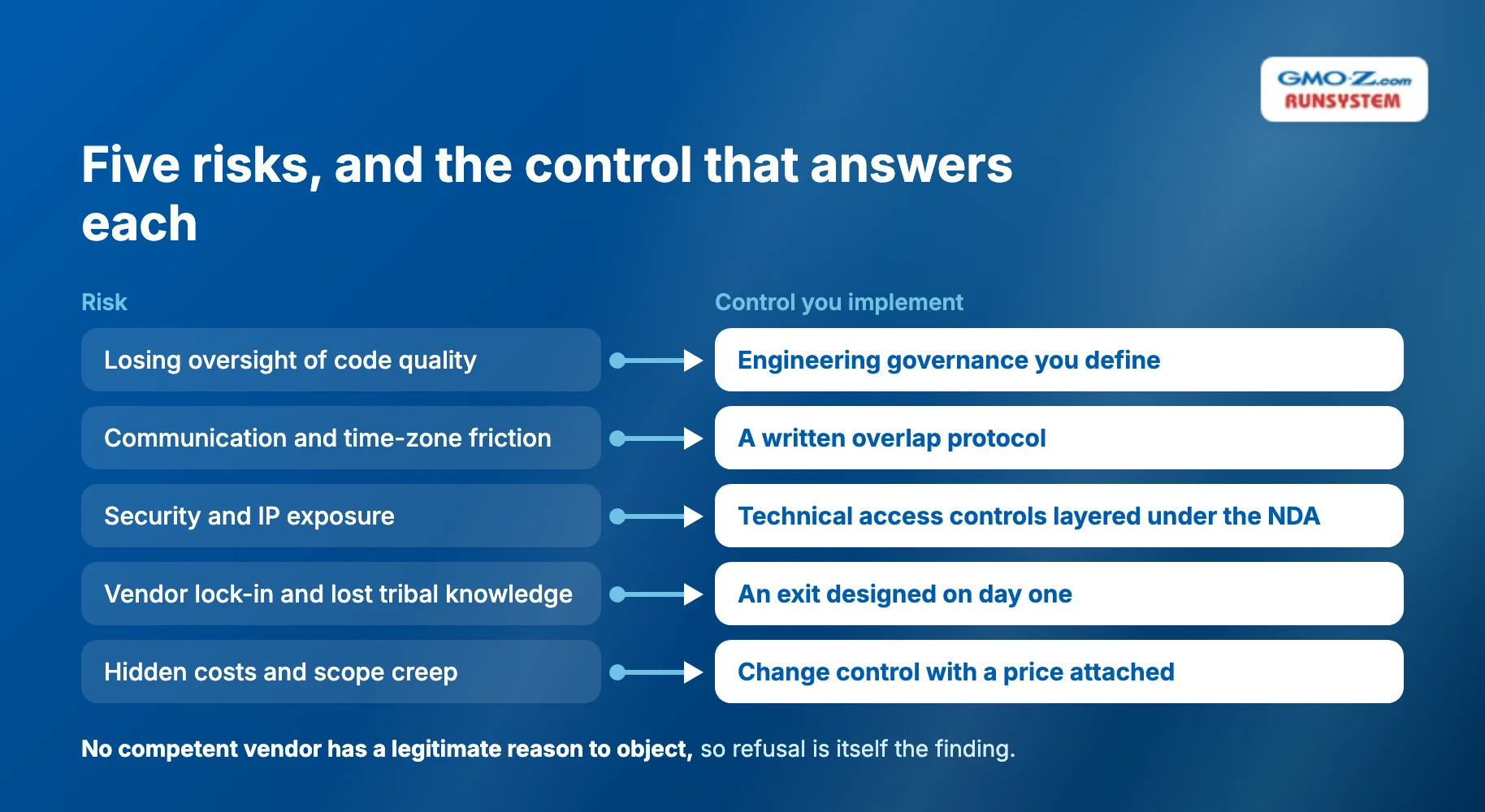
Risk | The control that answers it |
Losing oversight of code quality | Engineering governance you define |
Communication and time-zone friction | A written overlap protocol |
Security and intellectual property exposure | Technical access controls layered under the non-disclosure agreement (NDA) |
Vendor lock-in and lost tribal knowledge | An exit designed on day one |
Hidden costs and scope creep | Change control with a price attached |
Two things hold across every row. The control is implementable by you, inside your own systems, without the vendor's cooperation. And no competent vendor has a legitimate reason to object to any of it, so refusal is itself the finding.
Each control has a metric and a threshold behind it, and configuring them is a separate job from deciding whether to outsource at all. If you are already outsourcing and it is going wrong now, the configuration detail sits in [IT outsourcing challenges]. GMO-Z.com RUNSYSTEM publishes ISO 9001 certificate VN-10012-QMS and ISO 27001 certificate VN-10012-ISMS, both issued 28 July 2023, alongside a CMMI Level 3 appraisal recertified on 19 July 2024 by RSA Consulting PTE, which is what the governance layer looks like once a vendor has built it. Each of those controls is a line item somebody pays for, and that is why the headline hourly rate is not the number that decides this.
Software outsourcing costs more than the rate you are quoted, and the gap between the two is knowable in advance.
Offshore developer rates differ by region because local salaries do, and the distance between salary and quoted rate is what published tables hide. Grand View Research valued the IT services outsourcing market at USD 744.6 billion in 2024, forecasts USD 1,219.3 billion by 2030 at 8.6% compound annual growth, and has Asia Pacific growing fastest at 11%.
Two primary sources let you build the comparison yourself. ITviec's Vietnam IT Salary and Recruitment Market Report 2025–2026, from 1,839 respondents, puts a high-seniority back-end developer at a median 54.9 million VND per month, about USD 2,100 at 26,130 VND to the dollar on 2 September 2026. The Bureau of Labor Statistics put the median United States software developer wage at USD 135,980 in May 2025; its March 2026 employer cost release shows wages at 69.9% of what private-sector employers pay per hour worked, which puts the all-in figure near USD 194,500.
Every regional rate table in circulation is compiled by a company that sells offshore development, so read them as ranges. Between salary and rate sit recruitment, benefits, facilities, management, bench time and margin, and that stack is what the hourly number conceals.
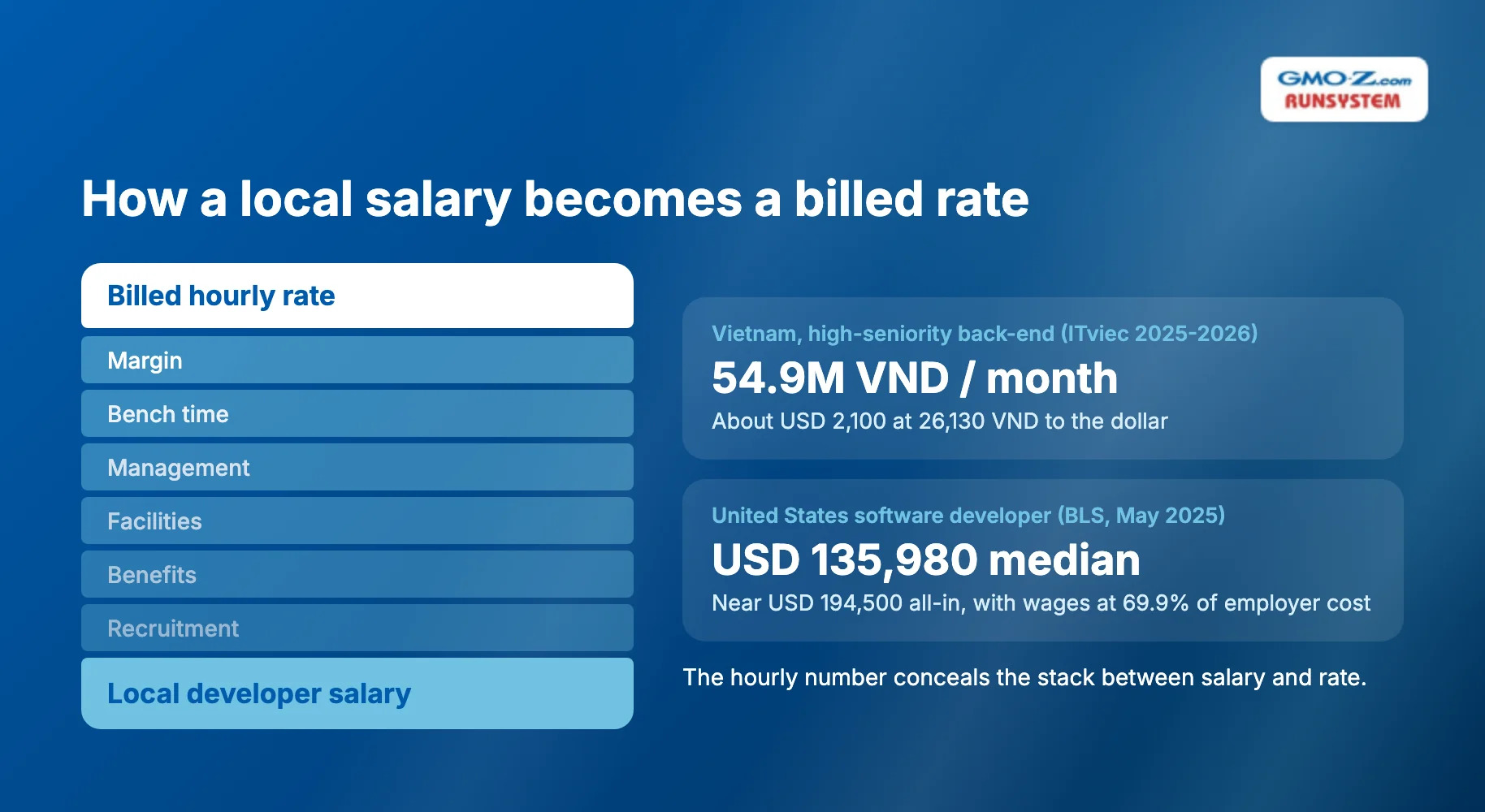
Total cost of ownership is billed rate times hours, plus your management time, onboarding and knowledge transfer, the controls above, and the contracted transition cost. Priced that way, rankings invert. A cheap vendor needing heavy oversight lands above an expensive one that arrives with process maturity already built, so compare on cost per accepted, deployed feature.
Deloitte found 83% of executives using AI inside outsourced services, while fewer than half report productivity gains and only 25% see lower vendor service cost. Hourly billing prices the input while you are buying the output. Ask how AI-assisted delivery shows up in the rate card and who owns the gain. Deloitte also found 70% saying their vendor management function is not fully mature, so your own governance is the bigger cost risk. With a real total cost in hand, the question becomes what that budget should never buy.
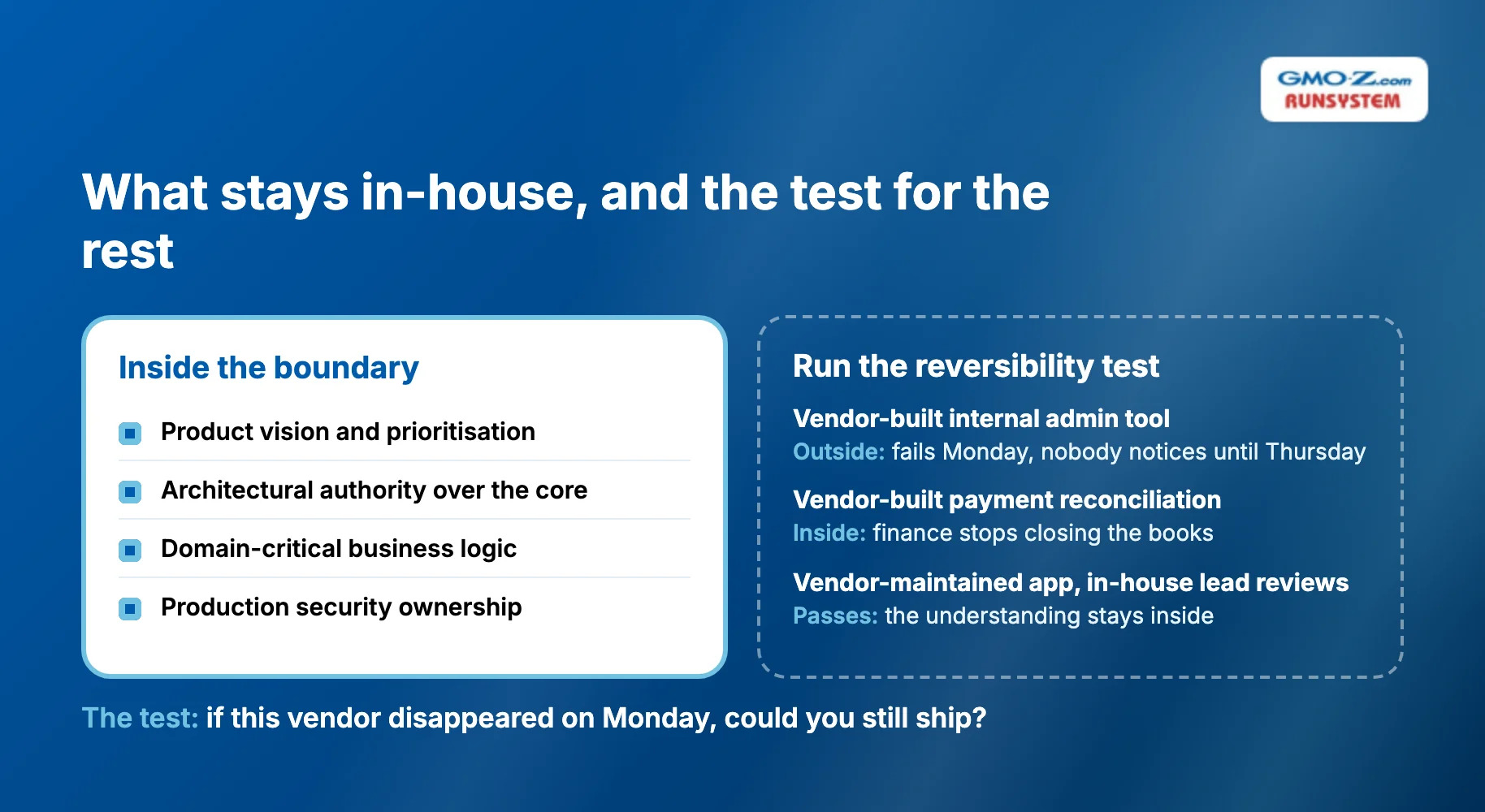
Four functions stay in-house regardless of which engagement model you choose, and one test tells you whether anything else has drifted across the line.
Product vision and prioritisation stays, because a vendor optimises against the specification you wrote. If the specification is wrong, they will build the wrong thing efficiently, on time and on budget. The delivery report stays green the whole way.
Architectural authority over the centre of the system belongs to someone whose employment is not limited by a contract term, which keeps core engineering leadership in-house. A vendor architect makes locally correct decisions and carries no stake in what those decisions cost you three years out.
Then there is domain-critical business logic: pricing engines, matching algorithms, underwriting models, ranking logic. Most guides reach for intellectual property theft as the reason to keep it. The real reason is iteration speed. The loop on that logic is your product loop, and outsourcing it puts a contract boundary, a change request and a two-week turnaround in the middle of your fastest feedback cycle.
Last, production security ownership. A vendor can implement every control you specify, and accountability for the incident does not transfer with the implementation. Regulators, customers and your board hold you responsible regardless of who wrote the code. None of that tells you where the line falls in your own system, which is what the next test is for.
The test is one question: if this vendor disappeared on Monday, could you still ship? Anything that fails is inside the boundary. Three cases show how it works.
A vendor-built internal admin tool fails on Monday and nobody notices until Thursday. Outside the boundary.
A vendor-built payment reconciliation service fails on Monday, finance stops closing the books, and nobody in-house knows why. Inside the boundary, and most teams find this out the hard way.
A vendor-maintained mobile application with an in-house lead who reviews every architectural decision passes. The work is outside; the understanding is inside.
That third case is the point. The boundary is drawn around where knowledge lives, not around who types. A function can sit entirely with a vendor and still fall inside the line, provided you kept the understanding deliberately. Run the test annually, because systems migrate across the boundary as vendors take on more and nobody notices the crossing while it happens. Where the work outside the line needs specialist depth, that is what [technical expertise across AI, cloud and enterprise systems] is for. Once the boundary is drawn, the only decision left is who sits on the other side of it.
Region sets your rate band and your overlap window, and the vendor sets everything else.
Three regions carry most offshore engineering work, and they differ on four axes: rate band, time-zone overlap with your own working day, English working proficiency, and depth of talent in the skills you need.
Southeast Asia, mostly Vietnam and the Philippines, sits at the lowest rate band. Overlap with Japan, Singapore and Australia is strong; overlap with United States Pacific hours is poor. The engineering pool is deep and still growing.
Eastern Europe, meaning Poland, Romania and Ukraine, holds the highest offshore rate band, strong overlap with European working hours and considerable senior depth.
Latin America sits mid-band, distinguished by genuine overlap with United States working hours. For a United States buyer it is nearshore, meaning offshore but close enough to share a working day.
Region narrows a shortlist and does not select a vendor. Variance between vendors inside one region is wider than variance between regions, which is what the checklist below exists to handle.
Ask for evidence in five groups, one for each risk above.
Two answers disqualify. A vendor who will not work inside your repository and your continuous integration pipeline is telling you where the code will actually live. A vendor who cannot produce a past transition plan has never run a clean exit.
GMO-Z.com RUNSYSTEM publishes certificate numbers, issue dates and appraisal dates, and that is the level of specificity to demand of any vendor you shortlist. If a dedicated team is the model you land on, the [offshore development center] page sets out how one is structured. When you have the checklist and want it run against a real engagement, scope an engagement with our delivery team. Most buyers arrive here with the same six questions still open.
Back to topIs outsourcing software development worth it?
Outsourcing is not worth it when you cannot write the specification down, when nobody in-house can technically assess the output, or when the work is the domain-critical logic your advantage rests on. It is worth it when the scope is definable, you have someone who can judge the result, and you have chosen the engagement model that matches the work.
What is the difference between outsourcing and staff augmentation?
Staff augmentation is a form of outsourcing in which individuals join your existing team and follow your process, while project-based outsourcing hands an entire outcome to an external company that owns the method. The practical difference is who manages the work day to day and where the knowledge stays afterwards.
What are the biggest risks of outsourcing software development?
The five that recur are loss of oversight over code quality, communication and time-zone friction, security and intellectual property exposure, vendor lock-in with the loss of undocumented knowledge, and hidden costs from uncontrolled scope. Each has a specific contractual or technical control, and each becomes a real risk only where that control is missing.
Does outsourcing software development reduce code quality?
Outsourcing does not reduce code quality by itself; it removes your visibility into quality until acceptance, by which point the debt is merged and paid for. Keep the pipeline, the repository and merge authority on your side, set an automated coverage and static-analysis gate that fails the build, and the visibility comes back.
What happens to your code and knowledge when an outsourcing contract ends?
The code is yours if the intellectual property assignment clause was drafted correctly and is valid in the vendor's jurisdiction; the reasoning behind the code is not, unless documentation was written in as an acceptance criterion. Architecture decision records, service runbooks and a contracted transition period priced at signature are what preserve it.
Should startups outsource software development?
Startups should outsource work that is well specified and peripheral, and keep the product logic they are still discovering. Early-stage products change specification weekly, and a fixed-scope contract prices that change every time. Staff augmentation or a dedicated team handles it better than project-based work.
This decision is not yes or no. You are choosing an engagement model, a set of controls and a boundary.
Which model you buy decides which benefits reach you and how much knowledge leaves at the end. Which controls are contracted at signature decides what they cost, because the same controls negotiated during a breakdown cost many times more. Where your in-house boundary sits is settled by one question: could you still ship on Monday without this vendor?
Region and total cost of ownership follow from those three, which is why the software outsourcing pros and cons end as a purchase decision. We publish our certificate numbers and appraisal dates for the same reason we would tell you to ask for anyone else's.
Back to top