Family site
Family site
Family site



You have probably opened several lists of the best offshore development companies and found the same problem: each one has a different definition of “best,” and many are published by companies that also appear on the list.
So this guide takes a different approach. It gives you 12 credible vendors grouped by what you are actually buying, then shows you how to verify the shortlist through rate composition, team continuity, security scope, access control, exit terms and delivery quality.
The goal is not to tell you which company is number one. It is to help you narrow the market to three credible candidates, ask better questions, and use a paid pilot before you commit to a long engagement.
Back to topThe table below is organised by what you need to buy, not by rank. Use the first two columns to narrow your shortlist; use the later sections to verify the vendors before you compare commercial proposals.
Company | Best fit for | Engineering footprint | Engagement model | Rate | Certification / trust signal |
EPAM | Large engineering programmes | Eastern Europe, India, LATAM | Enterprise delivery | Quote required | Verify current scope |
Accenture | Multi-region transformation | Global | Managed delivery / project | Quote required | Verify current scope |
Thoughtworks | Modernisation + consulting | Global | Consulting-led delivery | Quote required | Verify current scope |
N-iX | Dedicated product teams | Eastern Europe + global presence | Dedicated team | Quote required | Verify current scope |
ELEKS | Long-run engineering | Eastern Europe | Dedicated / project | Quote required | Verify current scope |
ScienceSoft | Regulated, full-cycle delivery | Global | Dedicated / project | Quote required | ISO 9001, ISO 27001, ISO 13485 |
BairesDev | US-aligned delivery | LATAM + distributed | Staff augmentation / dedicated / outsourcing | Quote required | Verify current scope |
FPT Software | Large APAC programmes | Vietnam + global | Enterprise delivery | Quote required | Verify current scope |
Saigon Technology | Cost-efficient delivery | Vietnam | Dedicated / project | Quote required | ISO-certified |
GMO-Z.com RUNSYSTEM | Japan / APAC delivery | Vietnam + Japan | Offshore development | Quote required | ISO 27001, ISO 9001, CMMI Level 3 |
Netguru | Product, design and commerce | Poland + global | Product squads | Quote required | Verify current scope |
Algoscale | Data and AI builds | India | Specialist delivery | Quote required | ISO 27001 |
Simform | Cloud and co-engineering | India + US/EU alignment | Dedicated / co-engineering | Quote required | Microsoft Azure Expert MSP |
Published rate bands are indications, not quotes. Certification should also be read as a scope question, not a logo check. Where a current certificate was not re-verified for this article, the table deliberately says so.
That gives you the shortlist. The next question is why each vendor belongs in its category.
Back to topA buyer looking for a dedicated product team is not making the same purchase as a company running a multi-country transformation. Grouping vendors by purchase type makes that difference visible.
Choose this group when procurement, geographic coverage and consulting capability matter as much as engineering capacity.
EPAM is suited to large engineering programmes with delivery across Eastern Europe, India and LATAM. Its documented long-running work with Liberty Global shows the type of enterprise engagement it can support. The trade-off is scale: smaller mid-market buyers may find the minimum engagement less practical.
Accenture fits organisations that need a global delivery network rather than one offshore engineering hub. Its strength is multi-region coverage and the ability to combine engineering with broader transformation work. The trade-off is that the delivery system is much larger than the individual team you will work with.
Thoughtworks is a stronger choice when modernisation, architecture and engineering-practice change are part of the brief. Its consulting-led model is useful when the problem extends beyond implementation. The trade-off is simple: if you only need engineering capacity, you may be paying for capability you do not need.
Action: Choose this group only if your programme genuinely needs enterprise-scale delivery or consulting alongside engineering.
A dedicated team works when you need reserved engineering capacity, while your organisation retains control of priorities and product direction. This model becomes more useful as the team grows and the engagement runs longer.
N-iX is positioned around dedicated engineering teams for product companies and ISVs. One useful continuity signal is a development centre it has operated for a telecom client since 2014. The trade-off is geographic resilience, which should be tested directly during diligence.
ELEKS has more than 30 years of delivery history, with a large Eastern European engineering base and hundreds of projects. Its delivery footprint has also shifted toward Poland and other European locations, making resilience worth discussing rather than assuming.
ScienceSoft is a strong fit for full-cycle work where process and regulated-industry requirements matter. Its published certifications include ISO 9001, ISO 27001 and ISO 13485. The trade-off is that additional process discipline becomes part of what you are paying for.
A dedicated team also has a practical minimum. If you need only one or two engineers, you may be paying for team overhead without getting meaningful team autonomy.
Action: Use a dedicated team when you need roughly four or more engineers working as a continuing unit; otherwise compare it against staff augmentation.
Nearshore and offshore are not interchangeable. Nearshore prioritises working-hour overlap. Offshore can prioritise engineering capacity and rate, provided the team has a reliable handover process.
BairesDev is built around LATAM delivery and offers US working-hour alignment across staff augmentation, dedicated teams and outsourcing. That makes it relevant when your engineers and product owners make frequent synchronous decisions. The trade-off is that overlap has a cost, and it is wasted if your team mostly works asynchronously.
Follow-the-sun delivery creates the same trap. A time-zone difference does not create a second shift by itself. Without written specifications, clear ownership and disciplined handover, the difference simply becomes a delay.
Action: Pay for time-zone overlap only when your workflow depends on synchronous decisions; otherwise compare the vendor on rate and handover quality.
APAC is the biggest gap in the current search results. None of the 10 pages analysed for this article treats APAC as a distinct buying context, even though Japan, Korea, Singapore and Australia can require different delivery arrangements.
The companies below are listed alphabetically, because one of them is our own company.
FPT Software fits large enterprise programmes that need substantial delivery capacity across Vietnam and international markets. Its scale is a procurement advantage, but it also creates a trade-off: a large vendor may give your account less organisational attention than a specialist provider. Published headcounts for FPT vary across ranking pages, so use FPT's own current figure rather than a directory figure.
Saigon Technology focuses on offshore development from Vietnam, with a published team of 350+ developers, 900+ projects and named enterprise clients including Standard Chartered Bank and Abbott. Its positioning is stronger around cost-efficient delivery than consulting-led transformation.
GMO-Z.com RUNSYSTEM operates delivery centres in Vietnam and a Tokyo office, with Japanese-group ownership and published ISO 27001, ISO 9001 and CMMI Level 3 credentials. Its fit is strongest when Japan or APAC is part of the delivery context; a US-only buyer with no APAC requirement may have better time-zone options elsewhere.
Vietnam's relevance to Japan is not incidental: VINASA identifies Vietnam as Japan's second-largest software outsourcing partner after China.
Action: If Japan or APAC is part of your roadmap, evaluate language, documentation, working hours and contract model before comparing vendors on rate.
Specialists make sense when one technical capability dominates the engagement.
Netguru is a Poland-based, design-led product company with strong positioning in marketplace, retail and B2B digital experiences. It is particularly relevant to commerce-heavy product work. The trade-off is time-zone overlap: CET works well for Europe but is less convenient for US West Coast teams.
Algoscale focuses on data and AI delivery from India, with ISO 27001 certification and a focus on startups and mid-market analytics-heavy builds. Its leaner model can be an advantage for focused work, but it may have less capacity to absorb major scope growth.
Simform provides India-based co-engineering teams with US and European overlap and holds Microsoft Azure Expert MSP status. It is also included here despite publishing a competing offshore-company list for this keyword. That conflict is worth stating rather than hiding.
Action: Choose a specialist when one technical axis dominates the work; reconsider the model as soon as you need a second major capability.
Back to topA regional offshore rate is useful for orientation, but it is too coarse to build a budget. A senior data engineer and a QA engineer in the same country are not the same purchase.
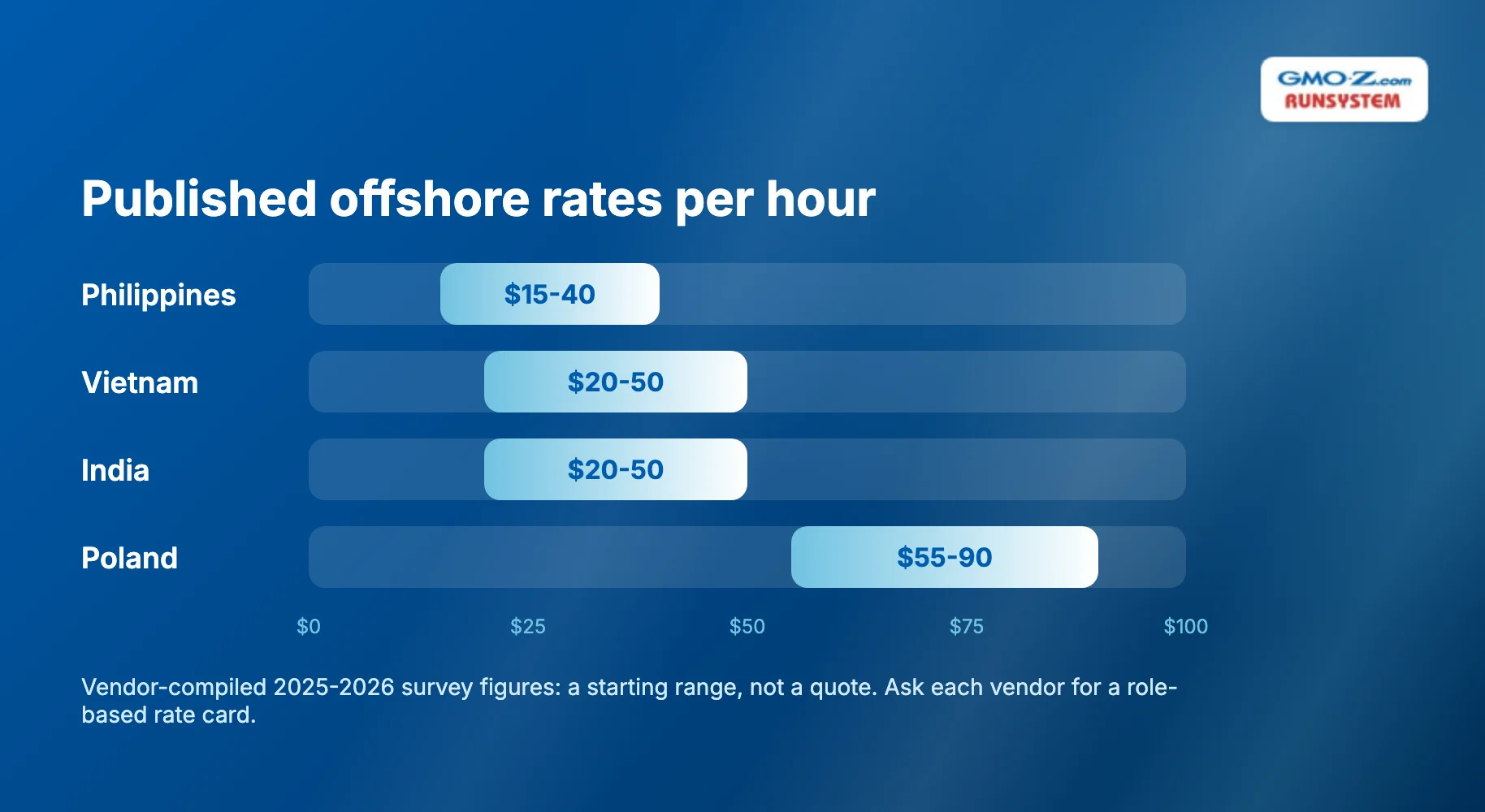
Published 2025–2026 vendor surveys put Vietnam around $20–50/hour, India around $20–50/hour, the Philippines around $15–40/hour and Poland around $55–90/hour in one 2026 comparison. Another source gives wider ranges, including $49–210/hour for North America. These figures are vendor-compiled market indications, not independent price benchmarks.
The stronger independent reference is the US Bureau of Labor Statistics, which reported median annual pay of $135,980 for software developers in May 2025. That is an employment benchmark, not an outsourcing rate, so it should not be compared directly with a vendor's hourly quote.
The important point is not which country is cheapest. It is that a rate difference becomes a saving only after you account for management time, ramp-up, rework and other delivery costs.
Action: Use regional rates to set an initial range, then ask every vendor for a role-based rate card.
Start with a mid-level backend engineer at 1.0×. Use that as your internal baseline, then adjust the budget for senior backend engineers, tech leads, QA, DevOps and AI/ML roles.
ITviec's 2025–2026 salary data provides a local reference point: median monthly pay is VND 37.8 million for back-end engineers, VND 54.9 million for senior back-end engineers, VND 51.8 million for tech leads and VND 28.8 million for QA. These are salary medians, not vendor rates, so use them to understand relative role cost rather than to predict an invoice.
AI/ML should be treated separately because its premium is more volatile. Also budget for the costs a rate card usually leaves out: your management time, ramp-up and rework. One vendor-published benchmark puts offshore ramp time at 4–8 weeks to full productivity. That is a benchmark, not an industry average.
Action: Build your budget from role mix and productive capacity, not from the vendor's headline country rate.
Back to topA shortlist tells you who to talk to. It does not tell you who will still be reliable after six months. These four checks are designed to be completed before signing and treated as pass/fail questions.
Do not ask for the vendor's overall retention rate. Ask what happened to teams similar to yours.
Turnover costs more than replacement headcount. You lose context, sprint velocity and decisions that were never fully documented.
Ask:
“What was your account-level annual attrition for teams of our size last year, and how do you define it?”
The definition matters because vendors may treat internal transfers differently. Then move from measurement to continuity: require notice before replacing key people, a named replacement process and a shadowing period before someone rolls off.
One published vendor recommendation uses less than 10% turnover as a threshold, but it comes from a single competitor source and should not be treated as an industry benchmark.
Action: Put the attrition definition, key-person notice and shadowing requirement into the vendor questionnaire and contract.
ISO 27001 is evidence that an information security management system has been certified and maintained by an accredited registrar. It does not prove that every repository, environment or delivery team is covered. Ask for the certificate and its scope.
SOC 2 Type II is an attestation report covering the operating effectiveness of controls over a defined period. It is not technically correct to call a company “SOC 2 certified.” Ask for the report and audit period rather than a logo.
Then ask a more uncomfortable question: who else can access the code?
If subcontractors are allowed, require written approval, equivalent security obligations and audit rights. Otherwise, you may verify the controls of one company while another company is actually performing the work.
Action: Request the certificate or SOC 2 report, scope, audit period and subcontractor policy before treating a security claim as evidence.
Certification gives you evidence of a process. It does not stop an individual from copying your repository.
The practical controls are straightforward:
For a physical delivery centre, also ask about badge access, clean-desk rules and whether project laptops can leave the building.
Action: Map every person, repository, environment and deployment permission before granting production access.
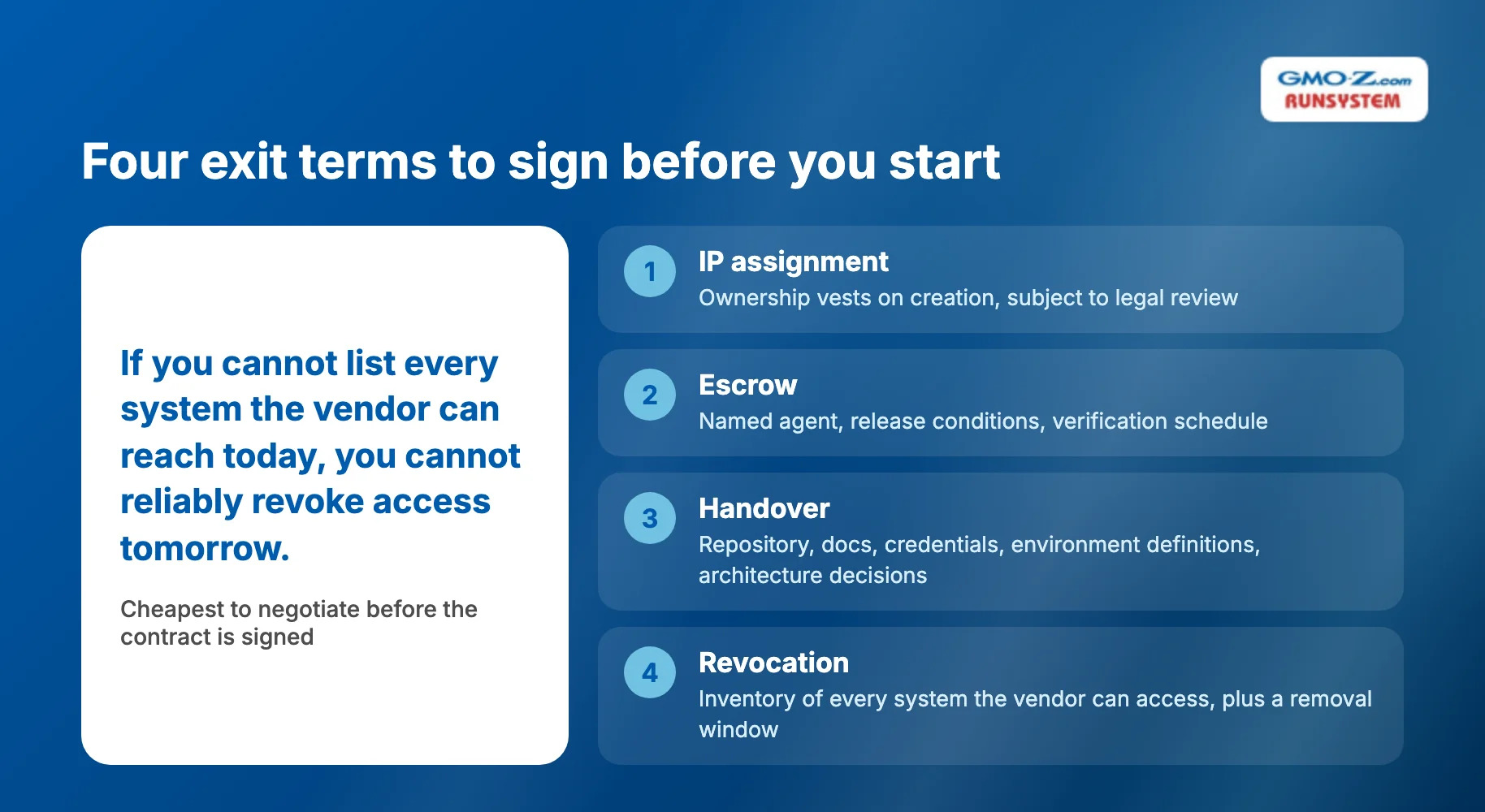
Most vendor evaluations focus on how to start. Exit terms are just as important, and they are cheapest to negotiate before the contract is signed.
Cover four points:
The simplest test is this: if you cannot list every system the vendor can reach today, you cannot reliably revoke access tomorrow.
Action: Draft IP, escrow, handover and revocation terms alongside the commercial contract, not after a dispute begins.
 Back to top
“Quality-first” is not a measurable requirement. A contract needs metrics that tell both sides what acceptable delivery looks like.
Metric | What it measures | How to use it |
Defect leakage | Production defects as a share of total defects found | Set a maximum acceptable level |
Changed-line test coverage | Test coverage of the code changed | Agree a conventional threshold |
Change failure rate | Deployments causing production failure | Track per release |
Failed-deployment recovery time | Time to recover from a failed deployment | Track per incident |
Sprint scope variance | Committed work that moves during the sprint | Set an agreed tolerance |
Decision latency | Time a blocking question waits for resolution | Set a response target |
Defect leakage is especially useful because it tests the team's quality gates rather than how much effort it claims to spend on QA.
For test coverage, measure the changed lines rather than the whole codebase. DORA's current framework uses five delivery metrics, and failed-deployment recovery time has replaced the older use of MTTR in this context.
Not every threshold above is a research benchmark. Some are conventional measures, while decision latency is a recommendation from this guide. Label the difference when you put them into your SLA.
Action: Agree the metrics, thresholds and reporting cadence before the pilot begins.
Back to topA Japan-facing engagement can require a different operating model from a typical US offshore engagement. The current search results do not treat this as a distinct buying context, even though the contract structure and delivery roles can differ.
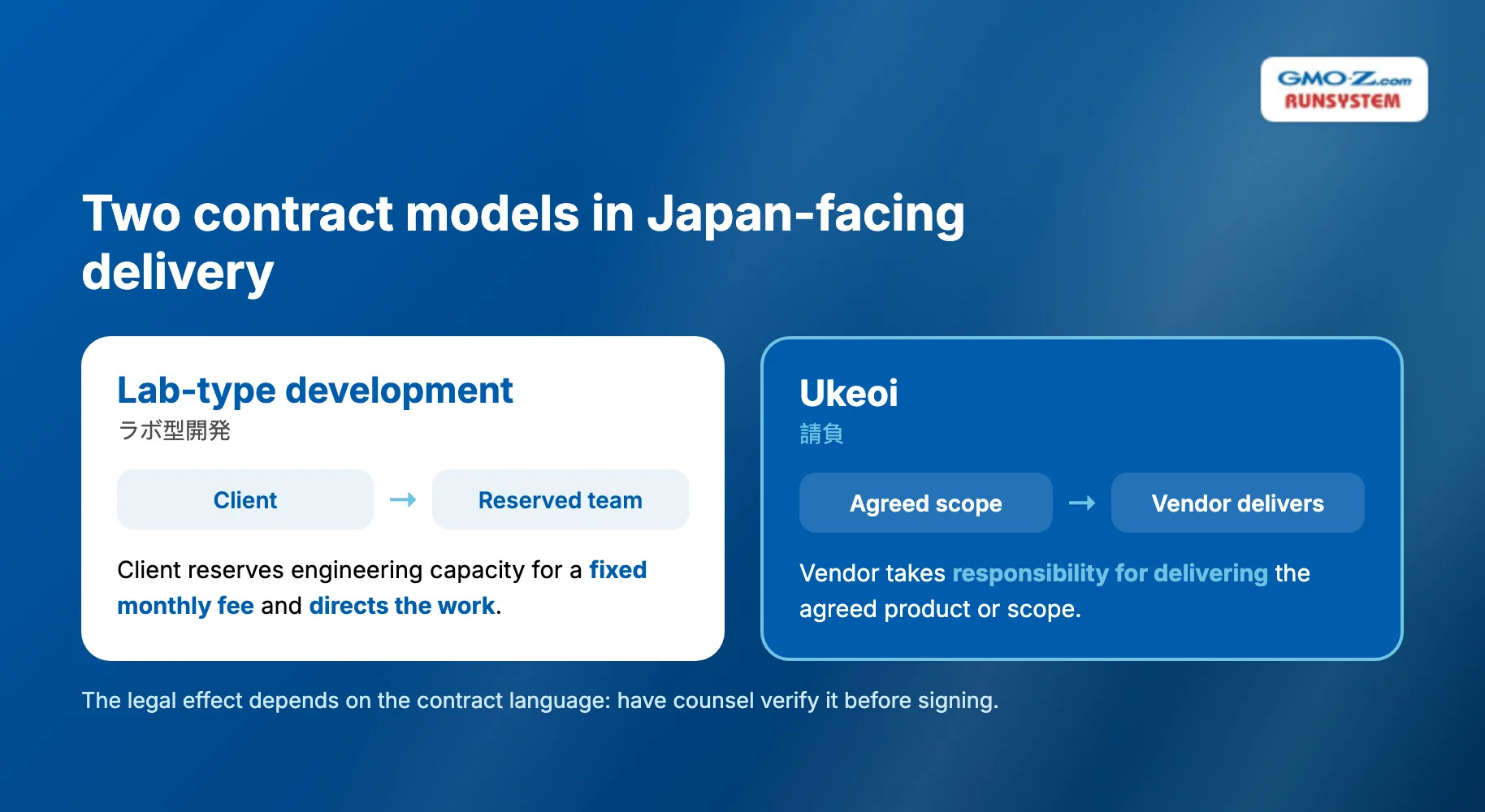
One important model is lab-type development, or ラボ型開発. In the model described by Japanese-market vendor sources, the client reserves engineering capacity for a fixed monthly fee and directs the work. It differs from ukeoi, 請負, where the vendor takes responsibility for delivering the agreed product or scope. Because these distinctions can have legal and contractual consequences, have counsel verify the actual contract language before signing.
The BrSE, or Bridge System Engineer, is another important role. The BrSE sits between specification and implementation, often bridging language, requirements and documentation conventions. A 2026 TopCV recruitment report places the role among the hardest engineering positions to fill in Vietnam, which means you should verify the vendor's actual BrSE bench rather than assume the capability is standard.
Japanese-market delivery can also require more detailed specifications and documented test evidence than a typical Western agile engagement. Treat that as a process and budget requirement, not as a cultural stereotype.
The same caution applies to monozukuri. It is a Japanese manufacturing philosophy; applying it to software is an analogy. What you can actually evaluate is whether the vendor uses disciplined specification, traceability, quality checks and continuous improvement.
For buyers considering Vietnam, GMO-Z.com RUNSYSTEM provides one example of a Vietnam-based vendor with long-running Japanese-market delivery.
Action: For a Japan or APAC engagement, evaluate contract model, BrSE availability, documentation requirements and acceptance criteria before comparing vendor rates.
 Back to top
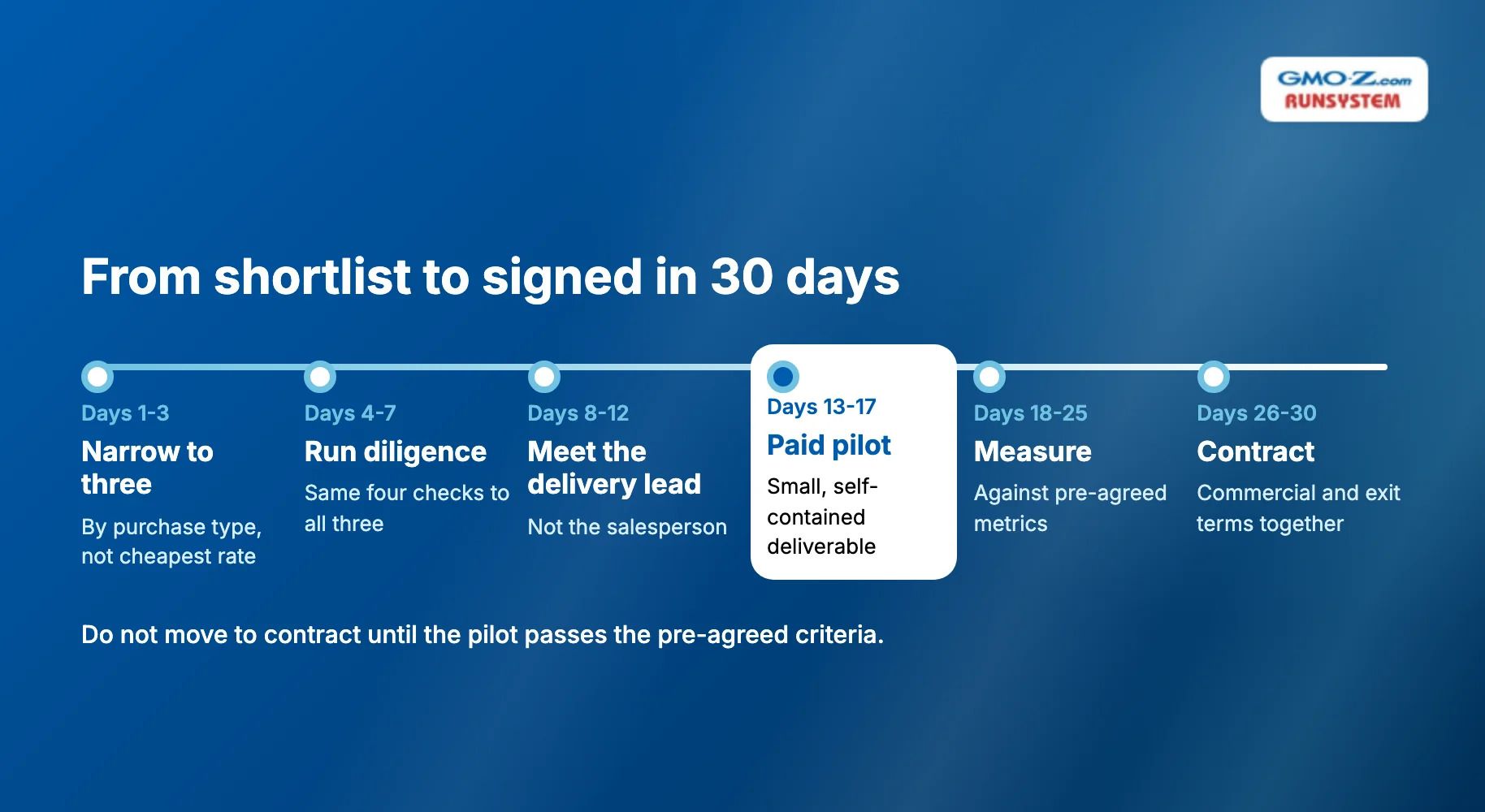
The order matters. If you interview vendors, fall in love with one and only then start diligence, your negotiating position has already changed.
Days 1–3: Narrow to three. Use the purchase type from the comparison table, not the cheapest rate.
Days 4–7: Run diligence. Send the four checks from this article to all three vendors at the same time. Compare the answers, not the sales presentations. Their response time is also data.
Days 8–12: Meet the actual delivery lead. Do not make the salesperson your technical reference. Ask the person who would run the team to explain a design decision they got wrong and what it cost.
Days 13–17: Run a paid pilot. Give the team a small, self-contained deliverable that would be useful if completed. A free pilot can simply put the vendor's best available people on your account for two weeks. A paid pilot tests the engagement you are actually considering.
Days 18–25: Measure the pilot. Use the quality metrics agreed before work started.
Days 26–30: Contract. Finalise commercial terms and exit terms at the same time.
A failed pilot is not necessarily a failed process. Two weeks and a small fee can be a much cheaper outcome than discovering the same problem after a year.
GMO-Z.com RUNSYSTEM follows the same principle this article recommends: the useful standard is not what a vendor says about itself, but what a buyer can verify before committing.
Action: Book the 30-day sequence on your calendar and do not move to contract until the pilot passes the pre-agreed criteria.
 Back to top
Offshore development makes sense when you need engineering capacity, specialist skills or a delivery team that is difficult or expensive to build locally. It works best when requirements, ownership and communication are clear enough to manage distributed delivery.
There is no single offshore rate. Published regional figures are useful for creating an initial range, but the actual quote depends on role, seniority, engagement model, location, team composition and contract length. Use the rate section above as a starting point, not a quote.
Time-zone difference matters most when your work depends on synchronous decisions. If the team can work from written specifications and asynchronous reviews, a larger time difference can be manageable. Follow-the-sun delivery also requires disciplined handover.
Common models include staff augmentation, dedicated teams, project-based outsourcing and offshore development centres. Staff augmentation gives you more direct control over individual engineers. A dedicated team gives you a stable delivery unit. Project-based outsourcing transfers more delivery responsibility to the vendor.
Use both contractual and technical controls. Contractually, cover IP ownership, subcontracting, confidentiality, handover and revocation. Technically, use individual accounts, client-owned repositories, least-privilege access, protected branches, managed secrets and logged production access.
Lab-type development reserves engineering capacity for a fixed monthly fee while the client directs the work. A fixed-price or ukeoi arrangement is structured around delivery responsibility for an agreed scope. The exact legal effect depends on the contract, so have counsel review the terms before signing.
Back to topDo not start by asking which offshore development company is the best. Start by deciding what you need to buy: enterprise transformation, a dedicated product team, time-zone overlap, APAC delivery or specialist capability.
Then narrow the market to three vendors and verify them in the same way. Check account-level attrition, certification scope, subcontracting, access controls and exit terms. Put measurable quality requirements into the pilot and contract. For Japan or APAC, add the contract model, BrSE capability and documentation requirements to the evaluation.
The best offshore development companies are not necessarily the ones at the top of a ranking. They are the ones that survive your verification process and perform against the terms you agreed.
Back to top