Family site
Family site
Family site


Mainframe modernization means changing how your mainframe applications, data, and operations are built, connected, and run, one workload at a time. It's rarely a simple stay-or-leave choice.
In Kyndryl's 2025 State of Mainframe Modernization Survey of 500 senior leaders at mainframe-using enterprises, only one respondent planned to move entirely off the mainframe. Yet 98% were moving some applications to other platforms. That gap is the decision you actually face.
Hyperscalers (large cloud providers such as AWS and Google Cloud) tend to pitch migration, while the IBM ecosystem tends to pitch modernizing in place. Each is right for some workloads and wrong for others. This guide compares the approaches, then gives you a scoring worksheet and a decision tree to route each workload on its own merits.
Back to topMainframe modernization is the process of updating mainframe applications, data, and operations so they cost less to run, change faster, and connect with cloud and AI services. The methods include API (application programming interface) enablement and DevOps (automated build, test, and release practices). They also include replatforming (moving code to a new runtime), refactoring (converting code to a modern language), and migration to another platform.
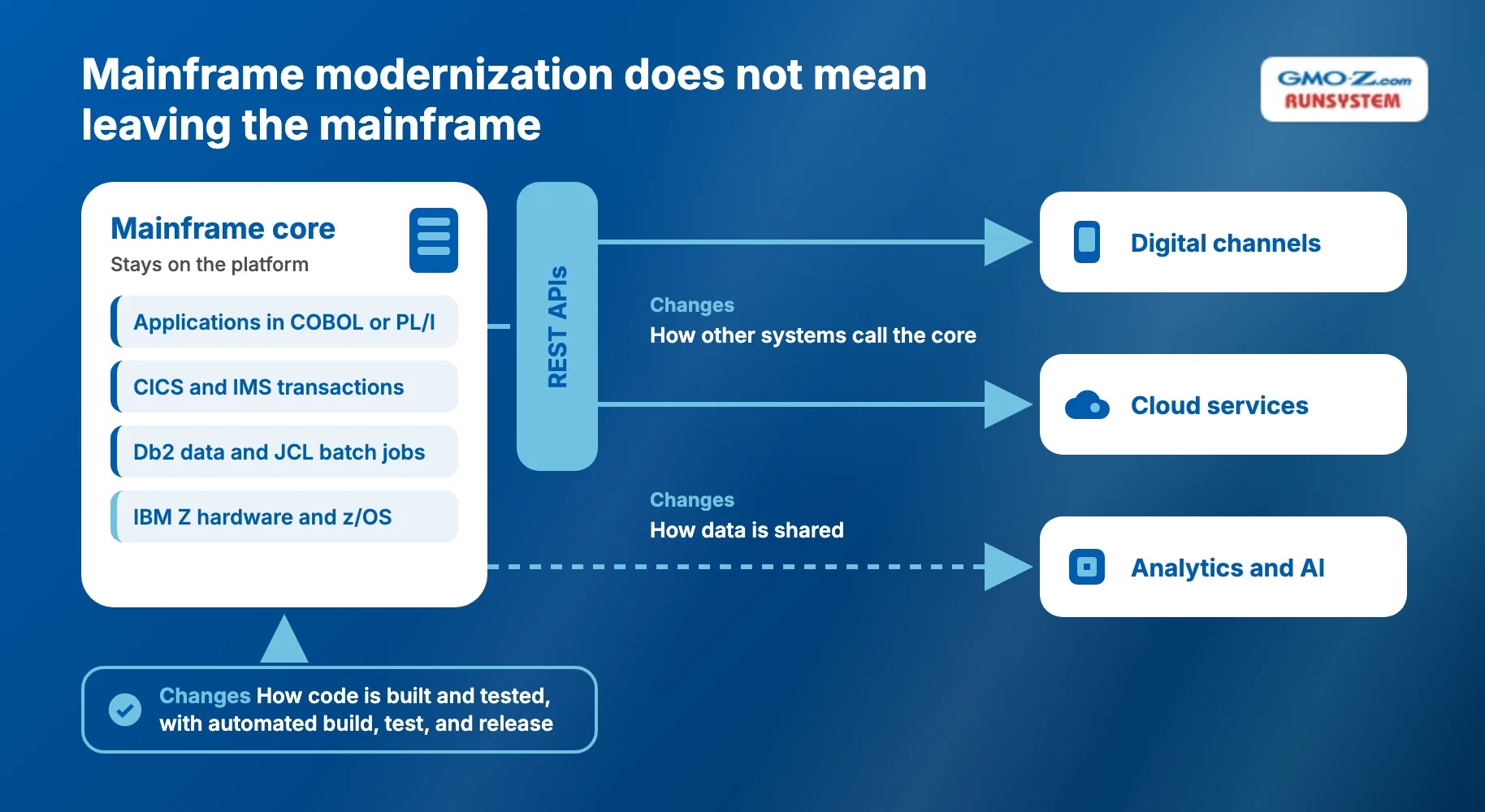
Modernizing doesn't have to mean leaving. Many programs keep the IBM Z hardware and z/OS, IBM's mainframe operating system. What changes is everything around them, from how code is built and tested to how data is shared and how other systems call the core.
The term gets used loosely, so separate two scopes:
Scope sets your budget and your risk. IBM notes that mere code translation often fails to address the real problem; in IBM's view, successful projects also handle data architecture, runtime replacement, and transaction processes. Convert only the code, and you can still inherit a slow batch window (the time slot reserved for bulk batch processing) and a brittle data model.
Back to topNo. IBM is still building new mainframes, and its hardware roadmap stayed active through 2025 and 2026:
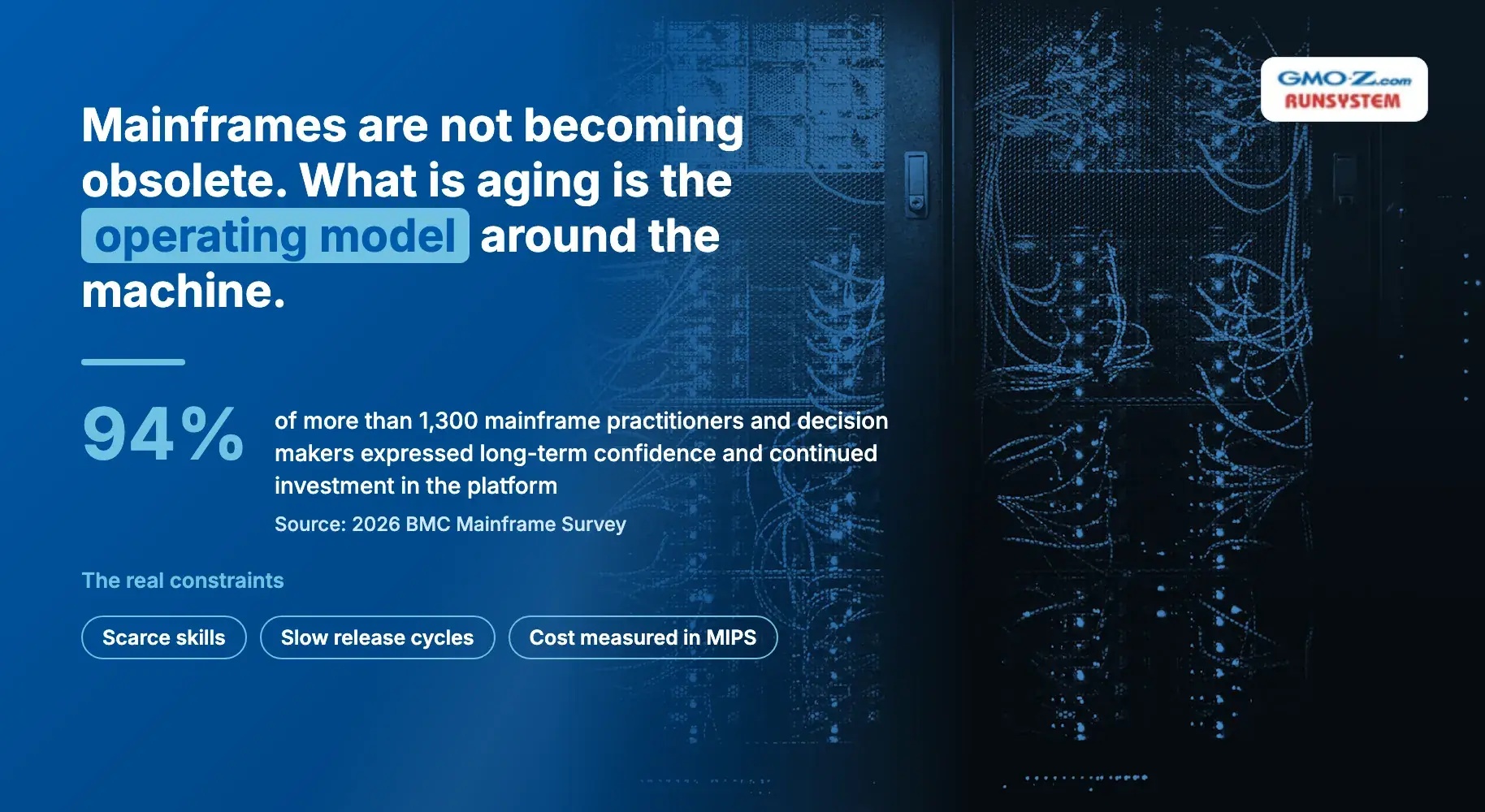
Customers aren't walking away either. In the 2026 BMC Mainframe Survey of more than 1,300 mainframe practitioners and decision makers, 94% expressed long-term confidence and continued investment in the platform.
What's aging is the operating model around the machine. Respondents in Kyndryl's 2026 State of Modernization Report say nearly half of their mainframe environments are more than ten years old.
The real constraints are scarce skills, slow release cycles, and cost measured in MIPS (millions of instructions per second), the capacity unit many teams budget against. Mainframes won't disappear soon. The way you staff, build, and connect them, though, has to change.
 Back to top
Enterprises are modernizing now because five pressures have converged, and each one lands on a different workload. Kyndryl's 2025 survey puts numbers on most of them:
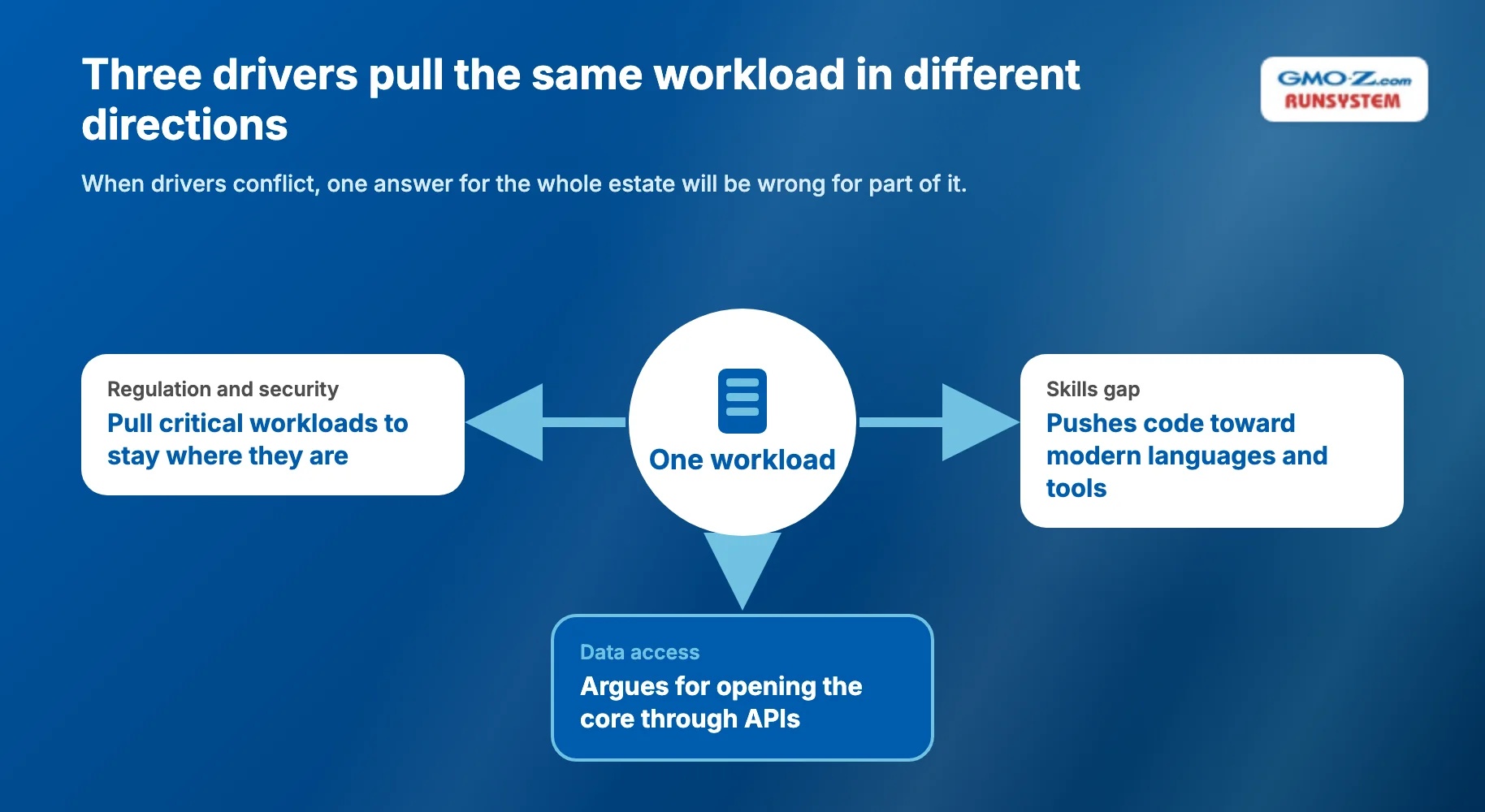
Three of these drivers pull in opposite directions:
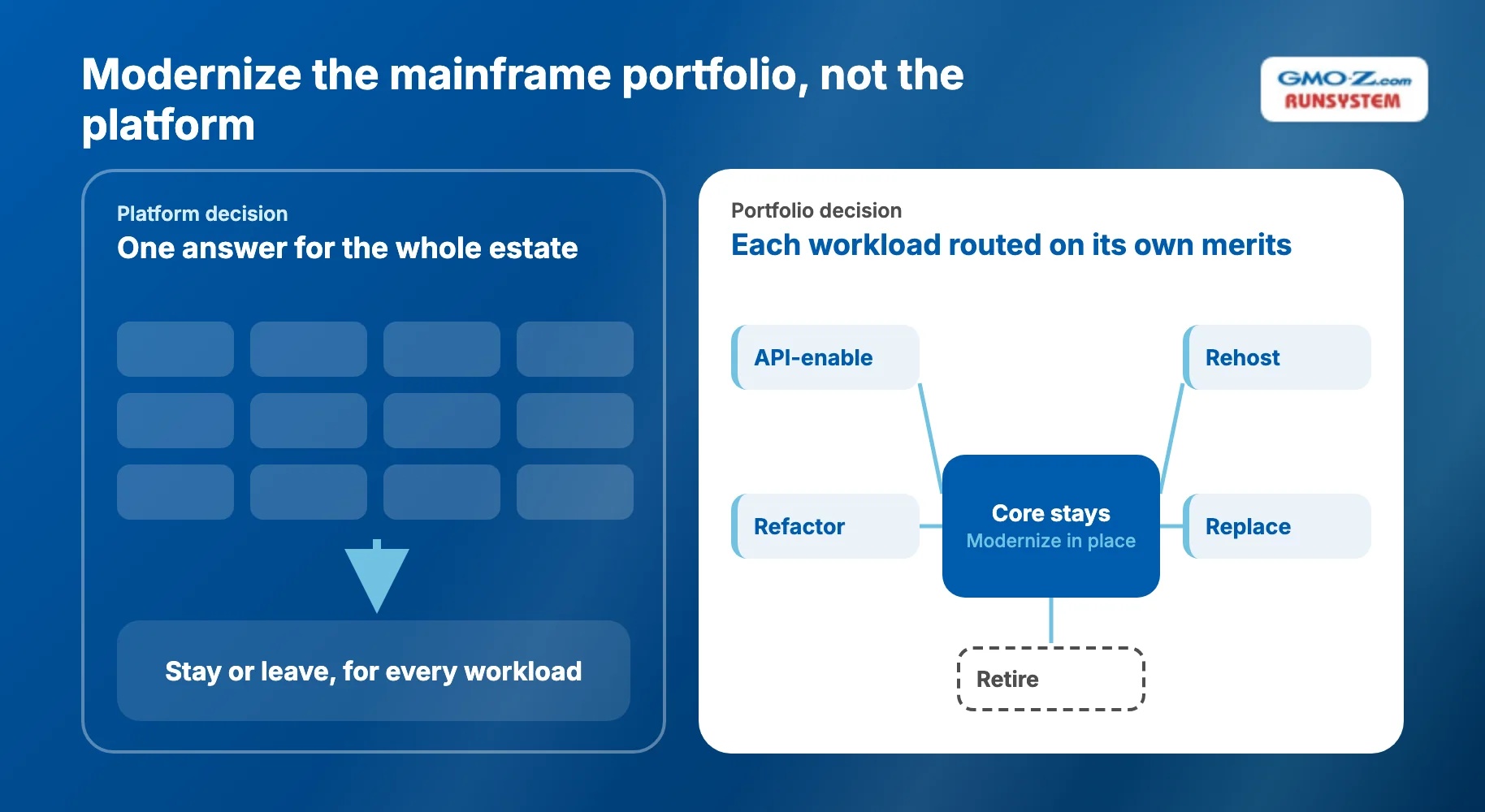
With drivers in conflict, any one answer for the whole estate will be wrong for part of it. Deciding per workload avoids that trap.
 Back to top
Six approaches cover most programs, and each can pay back when it fits the workload. Kyndryl's 2025 respondents reported return on investment (ROI) of 288% for modernizing on the mainframe, 297% for integrating with cloud, and 362% for moving workloads off. They're self-reported, so read them as evidence that no path is a dead end, not as a ranking.
The table rates the six approaches against each other, not in absolute terms:
Approach | Speed to first value | Delivery risk | Cost reduction potential | Skills needed | Keeps mainframe? |
Modernize in place | Fast | Low | Low to medium | Mainframe plus DevOps | Yes |
API-enable and integrate | Fast | Low | Low | API and integration | Yes |
Rehost or replatform | Medium | Medium | Medium | Cloud operations plus COBOL | No |
Refactor | Slow | High | High | COBOL, Java, test automation | No, or partly |
Replace | Medium to slow | High | Medium to high | Business analysis, package setup | No |
Retire | Fast | Low | High for that application | Data archiving | No |
Modernizing in place keeps the code and platform but changes how you work on them, through Git-based source control, automated testing, and newer hardware. IBM says COBOL Elevate for z/OS, scheduled for availability from September 18, 2026, optimizes COBOL programs without source code changes or recompilation.
Best when: the workload is stable, critical, and dependent on mainframe service levels and security.
Trade-off: you still depend on scarce mainframe skills and mainframe costs.
API enablement wraps existing CICS or IMS transactions in REST APIs (standard web interfaces), so digital channels can call the core without anyone changing its code. You end up with a hybrid setup, where the core stays on the mainframe and newer systems call it.
Best when: digital channels need mainframe data or transactions quickly.
Trade-off: the application keeps its technical debt (the cost of past shortcuts in its code), and the API layer becomes one more system to run.
Rehosting or replatforming moves COBOL applications onto a compatible runtime on cloud or commodity servers (standard, non-mainframe hardware), with little code change.
Best when: you want to exit the hardware but keep proven code.
Trade-off: the language and architecture stay the same, so the skills problem moves with the code.
Refactoring converts COBOL or PL/I into Java or another modern language, usually in stages. AI tools now shorten both the conversion and the testing.
AWS Transform for mainframe claims it compresses multi-year timelines into months. On the testing side, IBM watsonx Code Assistant for Z generates unit tests that compare the new Java service with the original COBOL.
Best when: business logic changes often and you need developers who can work on it.
Trade-off: converted code can drift from the original logic, so you need functional-equivalence testing (proof that new code returns the same outputs for the same inputs).
Replacing swaps a custom application for a software-as-a-service (SaaS) product; retiring switches it off. Retirement is often the cheapest first step. Bridgestone decommissioned unused applications before migrating its four truly critical ones.
Best when: a commodity product does the same job, or the application has little remaining value.
Trade-off: replacement forces business process change, which is often harder than the technical work.
Back to topWorkloads on the same mainframe differ in risk, change rate, and value, so decide one workload at a time. Legal & General shows what that looks like.
According to an OpenLegacy case study, the insurer separated "softcore" ancillary systems such as document management from "hardcore" systems such as claims processing. It then moved the softcore applications to modern platforms and kept the hardcore systems on the mainframe behind APIs.
This matrix maps common workload profiles to the approach that usually fits:
Workload profile | Likely approach |
High-volume core transactions, strict service levels | Keep on mainframe and modernize in place |
Core logic needed by digital channels | API-enable (hybrid) |
Batch reporting, low change frequency | Rehost or move to cloud |
Frequently changing business logic | Refactor incrementally |
Duplicates a commodity SaaS function | Replace |
Rarely used, low value | Retire |
Real profiles blur, so use the two tools below for the in-between cases.
Score each workload from 1 (low) to 5 (high) on these five criteria:
Criterion | Question to ask | Score (1 to 5) |
Business criticality | What breaks if this is down for an hour? | |
Change frequency | How often does the business ask for changes? | |
Data gravity | How many other systems read or write this data? | |
Regulatory constraint | Are there data residency or audit rules? | |
Skills available | Do you still have people who understand it? (5 = yes) |
Then combine the scores into two numbers and read them with these rules of thumb:
Here is an illustrative example for three workloads at a fictional insurer. Treat the thresholds as starting points to tune, not industry standards:
Workload | Criticality | Change | Data gravity | Regulation | Skills | Stay pressure | Change pressure | Reading |
Claims processing | 5 | 4 | 5 | 5 | 2 | 15 | 8 | Hybrid: keep core, API-enable, refactor what changes |
Document management | 2 | 2 | 2 | 3 | 2 | 7 | 6 | Tree: SaaS exists, so replace |
Internal reporting batch | 2 | 1 | 3 | 2 | 3 | 7 | 4 | Tree: logic rarely changes, so rehost |
Use the decision tree for any workload the scores leave unclear:
Is the workload still needed? ↓ No → Retire ↓ Yes Does a commodity SaaS do the same job? ↓ Yes → Replace ↓ No Does it need near-zero downtime and mainframe-grade throughput? ↓ Yes → Keep and modernize in place, or API-enable ↓ No Does the business logic change often? ↓ Yes → Refactor incrementally ↓ No → Rehost / replatform
Most portfolios end up hybrid. Kyndryl's 2025 data reflects this: 99% of respondents operate hybrid environments, and organizations expect to move 28% of their applications off the mainframe on average.
Back to topNo. AI can't replace the mainframe or the people who understand it, but it is changing how fast you can modernize. AI tools now read legacy code, write documentation, convert languages, and generate tests.
AWS reports that Itaú Unibanco cut reverse-engineering time, the work of recovering business rules from existing code, by more than 90%. The bank used AWS Transform for that step and the Kiro coding agent for forward engineering, which builds the new application.
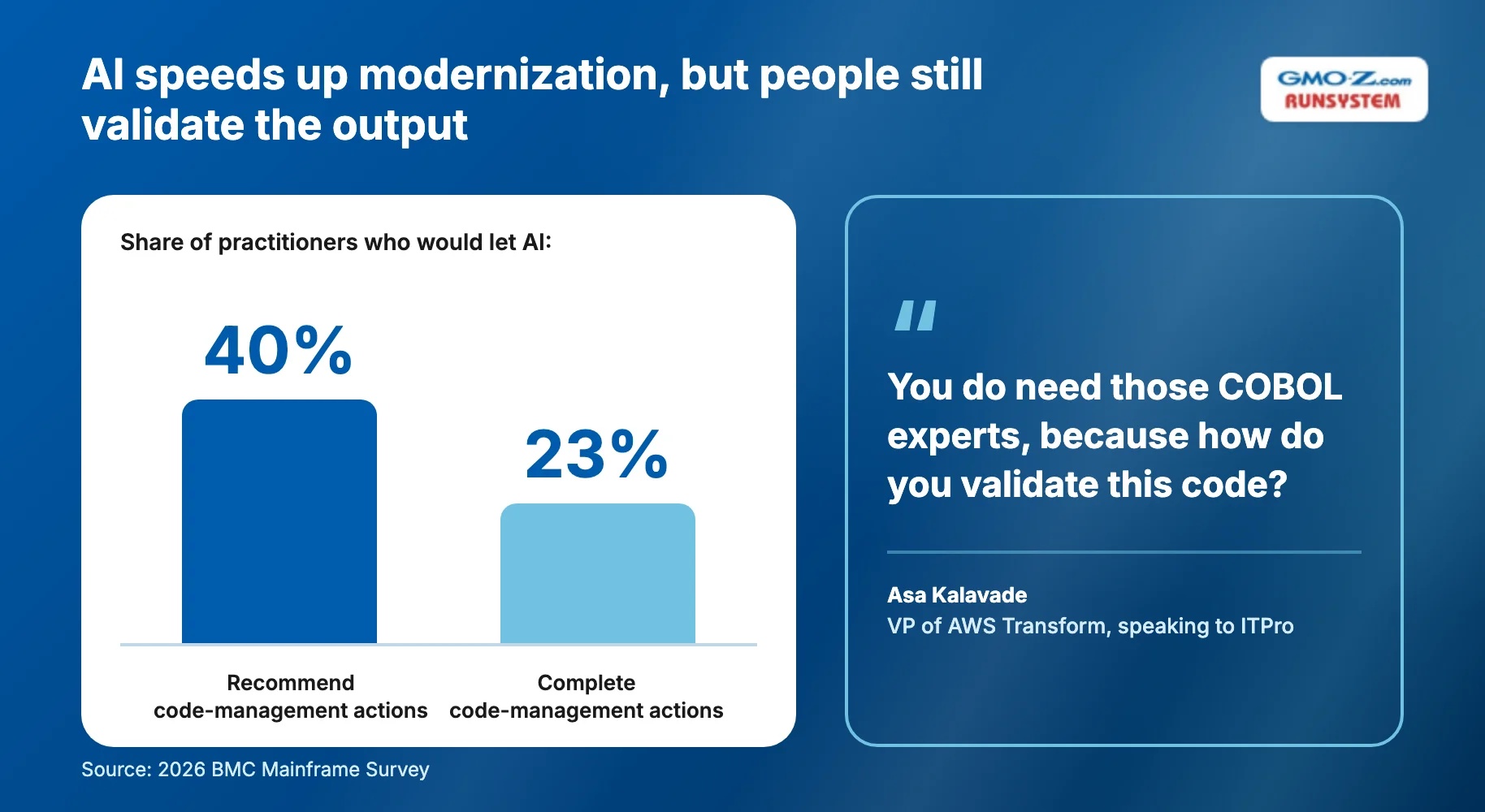
Even AWS, which sells these tools, says humans stay in the loop. Asa Kalavade, VP of AWS Transform, told ITPro: "You do need those COBOL experts, because how do you validate this code?"
Practitioners are cautious too. In BMC's 2026 survey, 40% would let AI recommend code-management actions, but only 23% would let it complete them.
Four trends are shaping mainframe modernization in 2026:
Five risks recur in troubled mainframe programs, and each one has a specific control.
Business rules hide in decades of patches, and the people who wrote them have often retired. In Kyndryl's 2026 survey, just 9% of 1,000 application and network modernization respondents, not only mainframe shops, had fully mapped their application dependencies.
Control: run code analysis before you commit to an approach. Tools such as Google's Mainframe Assessment Tool extract business rules and group assets by call and data dependencies. Then interview your subject-matter experts (SMEs) and write the rules down before any conversion starts.
Mainframe data rarely maps cleanly to a relational database. EBCDIC encoding (the mainframe character set), packed decimal fields, and hierarchical IMS structures all need conversion. Some errors can surface only in month-end or year-end batch runs, long after cutover (the switch from the old system to the new one).
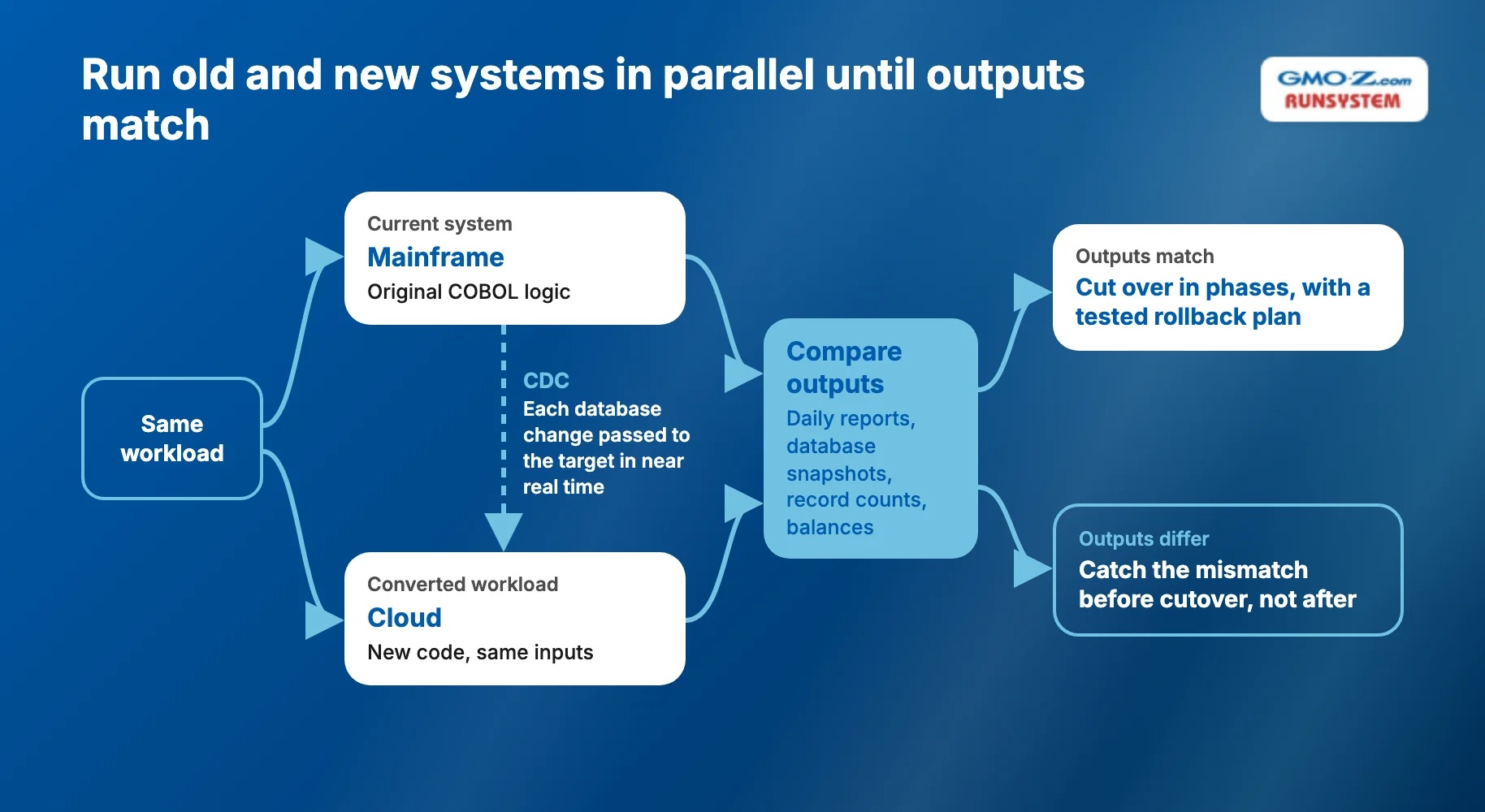
Control: move workloads in phases and replicate data continuously with change data capture (CDC), which passes each database change to the target in near real time. Before every cutover, reconcile record counts and balances automatically.
Converted code can compile and pass unit tests yet still differ in rounding, date handling, or rare edge cases.
Control: require functional-equivalence testing and a parallel run for every workload you convert. Google Cloud's Dual Run runs workloads on the mainframe and the cloud at the same time and compares outputs such as daily reports or database snapshots.
A cutover can fail even when the data moves correctly. In April 2018, UK bank TSB migrated its customer data to a new IT platform.
According to the Bank of England, the data migrated successfully, but the platform immediately experienced technical failures. TSB took until December 2018 to return to business as usual, and regulators later fined it £48.65 million.
Control: cut over in phases by workload or customer segment, keep a tested rollback plan, and run old and new systems in parallel until outputs match.
The SMEs you depend on are the same people retiring or being recruited away mid-program. Kyndryl's 2025 survey found 70% of organizations already struggle to find multi-skilled talent, and a multi-year program only raises that exposure.
Control: keep your SMEs on retention terms through decommissioning, and pair each of your mainframe engineers with a cloud engineer so knowledge transfers during the work.
Back to topA phased roadmap lets you prove value early and change course without starting over. You'll likely need that room, because 80% of organizations in Kyndryl's 2025 survey shifted their modernization strategy within a single year.
Five phases cover most programs, each with a clear exit point:
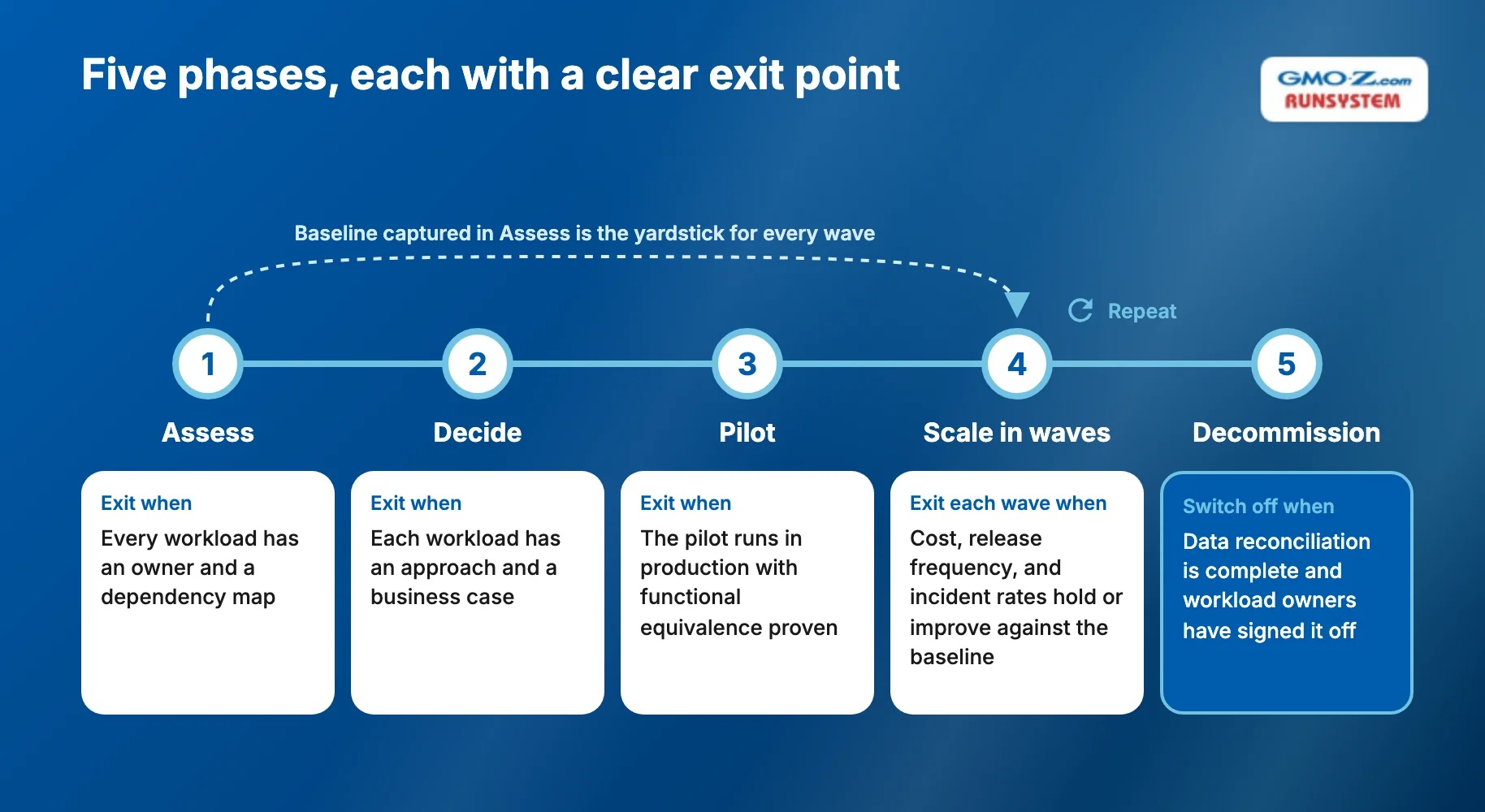
Budget for surprises in the assess and pilot phases. A CTO quoted in Kyndryl's 2026 report said around 25% of the original effort sometimes shifts into data cleansing, dependency mapping, and automated regression testing.
Back to topChoose partners by workload, not by brand, because each partner type leans toward one answer. Outside help is common, too. In Kyndryl's 2025 survey, 74% of respondents rely on third-party providers.
Here is where each partner type is strong and what to watch for:
Partner type | Strength | Watch out for |
Hyperscaler programs (AWS, Google Cloud) | Tools and migration funding | Bias toward moving off the mainframe |
IBM and the mainframe vendor ecosystem | Deep platform expertise | Bias toward staying |
Global systems integrator (SI) or specialist modernization firm | End-to-end program delivery | Cost and senior staffing levels |
Application and cloud engineering partner | Surrounding apps, APIs, data pipelines, testing | Should not claim mainframe expertise |
Hyperscaler funding is real. The AWS Migration Acceleration Program offers investment incentives for mainframe modernization, and you should weigh that money against the bias that comes with it.
Before you sign, ask every partner three questions:
Hybrid programs also create substantial work that never touches COBOL, such as the APIs, cloud services, and test automation around the core. If that surrounding layer is where your team lacks capacity, an application engineering partner such as GMO-Z.com RUNSYSTEM can take it on.
That partner can handle system migration, application development, and testing for those workloads, while you keep the mainframe-side work with a specialist.
Back to topMainframe modernization works when you treat it as a portfolio of workload decisions, and the survey evidence points that way. In Kyndryl's 2025 data, only one of 500 respondents planned a full exit, 98% were moving something, and all three broad paths reported positive returns.
Three mistakes undo many programs:
This quarter, build a workload inventory, score each workload with the worksheet, and run the unclear ones through the decision tree. The resulting short list tells you which partners you need, and in what order.
Bring that scored list to every vendor meeting. When a hyperscaler or an IBM partner pitches one answer for the whole estate, the list turns a platform debate into a workload-by-workload conversation. That's where the real savings and risks sit.
Back to topThe six main strategies are modernize in place, API-enable, rehost or replatform, refactor, replace, and retire. Most programs combine several. In Kyndryl's 2025 survey, 98% of respondents were moving some applications off the mainframe, but only 1 of 500 planned a full exit.
Yes. IBM announced the z17 on April 8, 2025, and it became generally available on June 18, 2025. IBM announced single-frame and rack-mount z17 models in July 2026 and previewed a dual-architecture IBM Z and Arm processor for future systems.
Expect months for a focused scope and years for a full estate. AWS reports that Bridgestone moved four critical applications to its cloud in about seven months. AWS's Asa Kalavade says such projects have typically taken two, three, or five years.
Mainframe migration moves workloads off the mainframe to another platform, such as the cloud. Modernization is broader. It can keep workloads on the mainframe while changing how they're developed, connected, and operated, for example through APIs or DevOps.
Back to top