ファミリーサイト
ファミリーサイト
ファミリーサイト



Most guides to hiring offshore developers start with region and rate. Start with the engagement model instead, because it's the choice that decides everything downstream: which regions make sense, what your real cost structure looks like, and how much risk you're actually taking on. The four options are a freelancer, a staff-augmentation hire, a dedicated offshore team, or a full outsourcing partner.
This guide walks through that decision first, then the steps that follow from it: picking a region, scoping the work, vetting vendors on process rather than portfolio alone, and locking in the legal terms that protect you before work starts. First, what "hiring offshore developers" actually covers, since the term gets used for four very different deals.
Back to top
Hiring offshore developers means engaging software engineers based in a different country, and usually a different time zone, from your own. That's distinct from nearshore hiring (a neighboring or nearby time zone) and onshore hiring (same country).
It's also not one deal. A single freelancer. A staff-augmentation hire who reports into your existing team. A dedicated offshore team. A fully outsourced project. All of it gets called "offshore hiring," but each is a different level of commitment.
Most guides get the framing wrong here. They treat offshore hiring as a cost decision first. It isn't; it's an engagement-model decision, and the model you choose determines the cost range, not the other way around. Two companies can hire in the same region for the same skill set and still end up with meaningfully different total costs, purely because one chose staff augmentation and the other chose full outsourcing. Model first, region second. Everything else is downstream of that.
Back to topBefore contacting a single vendor, confirm two things are true inside your own organization. Skip this and no engagement model saves you.
You're ready when you have a scoped need for more engineering capacity or a specific skill set your current team lacks, plus at least one internal technical owner who can direct the work and review output. That person doesn't need to write code daily; they do need enough technical fluency to catch a bad architecture decision before it ships.
You're not ready if any of this sounds familiar: no internal technical oversight at all, work that demands daily in-person collaboration with zero tolerance for async handoffs, or a project too small or short-lived to justify the onboarding overhead. Fix these first.
Here's the part most guides skip: the real risk in offshore hiring isn't the region you pick. It's a mismatch between your engagement model and your internal management capacity. A company with no technical oversight will struggle with any offshore model, including a full in-house hire made locally. Offshore hiring doesn't create that risk. It just exposes it faster, because distance removes the option of patching a management gap through a hallway conversation.
Back to top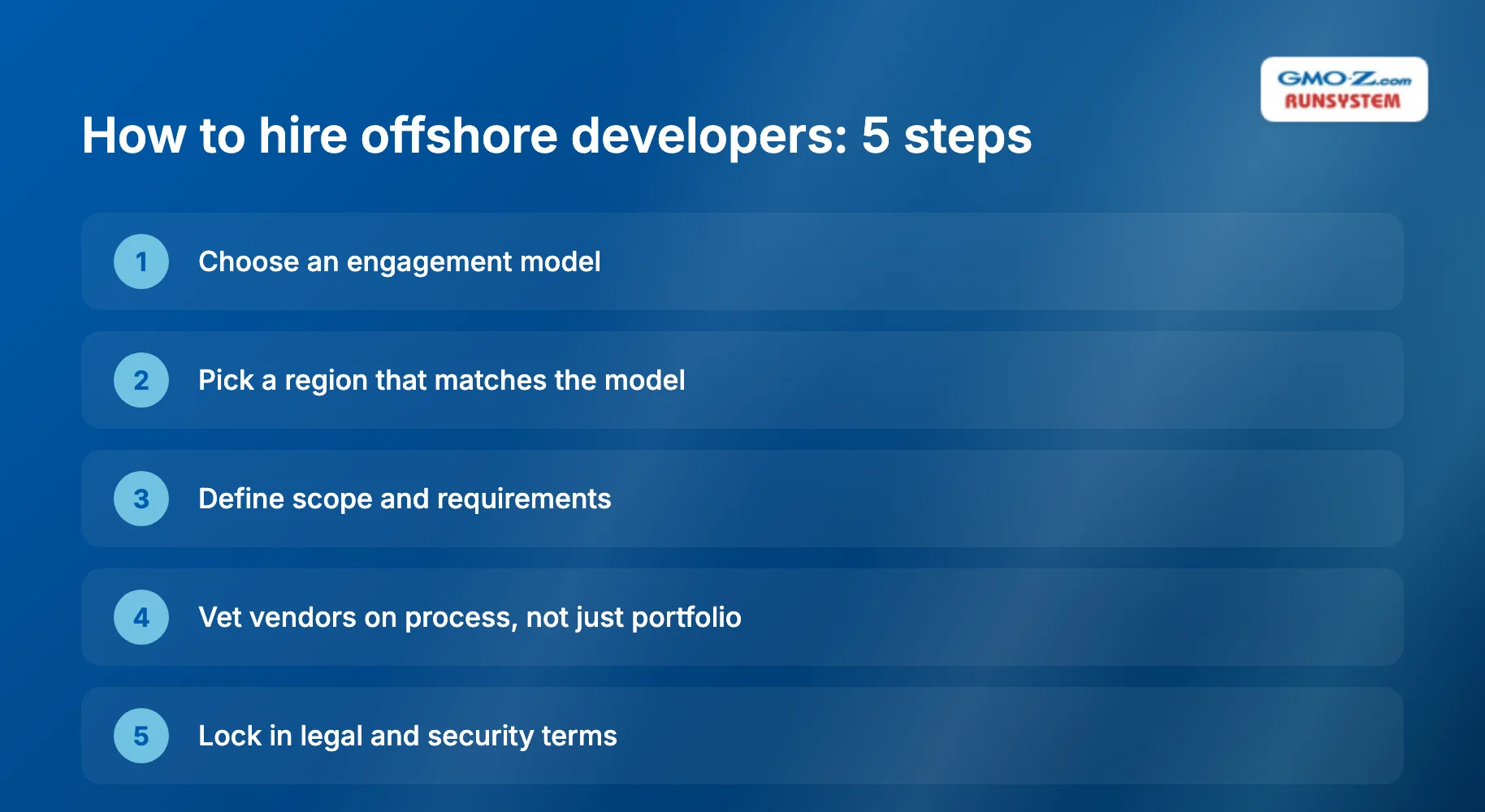
Five steps get you from "we need offshore developers" to a signed, scoped engagement. They run in this order because each one constrains the next. Skip ahead to picking a region before choosing a model, and you'll optimize for the wrong variable.
Region, cost, and contract structure all follow from this one choice. Make it deliberately, not by defaulting to whatever a first vendor pitches you.
To make the trade-offs concrete, the table below compares all four models by the four factors that actually differ:
Engagement model | Management overhead | Cost predictability | Best-fit company stage | Continuity risk |
Freelancer/marketable | High (you manage each individual) | Low (hourly, scope creep-prone) | Early-stage, one-off tasks | High (single point of failure) |
Staff augmentation | Medium (you still direct the work) | Medium (headcount-based) | Has engineering management, needs more hands | Medium (vendor replaces individuals, but you re-onboard) |
Dedicated offshore team | Low (vendor manages the team) | High (blended monthly rate) | Scaling a product long-term | Low (vendor owns continuity) |
Full outsourcing | Lowest (vendor owns delivery) | Medium-high (scope/milestone-based) | No in-house technical leadership | Depends entirely on vendor's own turnover management |
RunSystem's IT Outsourcing service offers an offshore delivery center model built around the third and fourth rows above: a dedicated offshore team embedded in your process, rather than a loose freelancer arrangement. It's aimed at companies that want that continuity without building an internal offshore-management function from scratch (scope and pricing vary by engagement; contact RunSystem for a quote).
Region choice should follow from the model you picked in Step 1, not the other way around. A dedicated offshore team can absorb a larger time zone gap through structured async handoffs. Staff augmentation can't as easily; it depends on daily sync with your internal team, so it benefits far more from timezone overlap.
Region is still a second-order decision, though. Locking it in before the engagement model is the sequencing mistake that shows up most often in offshore hiring.
Write down the tech stack, project scope, timeline, and budget range before your first vendor call. Vague requirements, not vendor quality, are the single biggest cause of mismatched proposals.
Decide your team structure at the same time: one developer, a small pod of two to three, or a full cross-functional team with its own QA and DevOps coverage. Pick one before the call. A vendor can't propose the right model-region combination if you haven't defined what "done" looks like for this engagement.
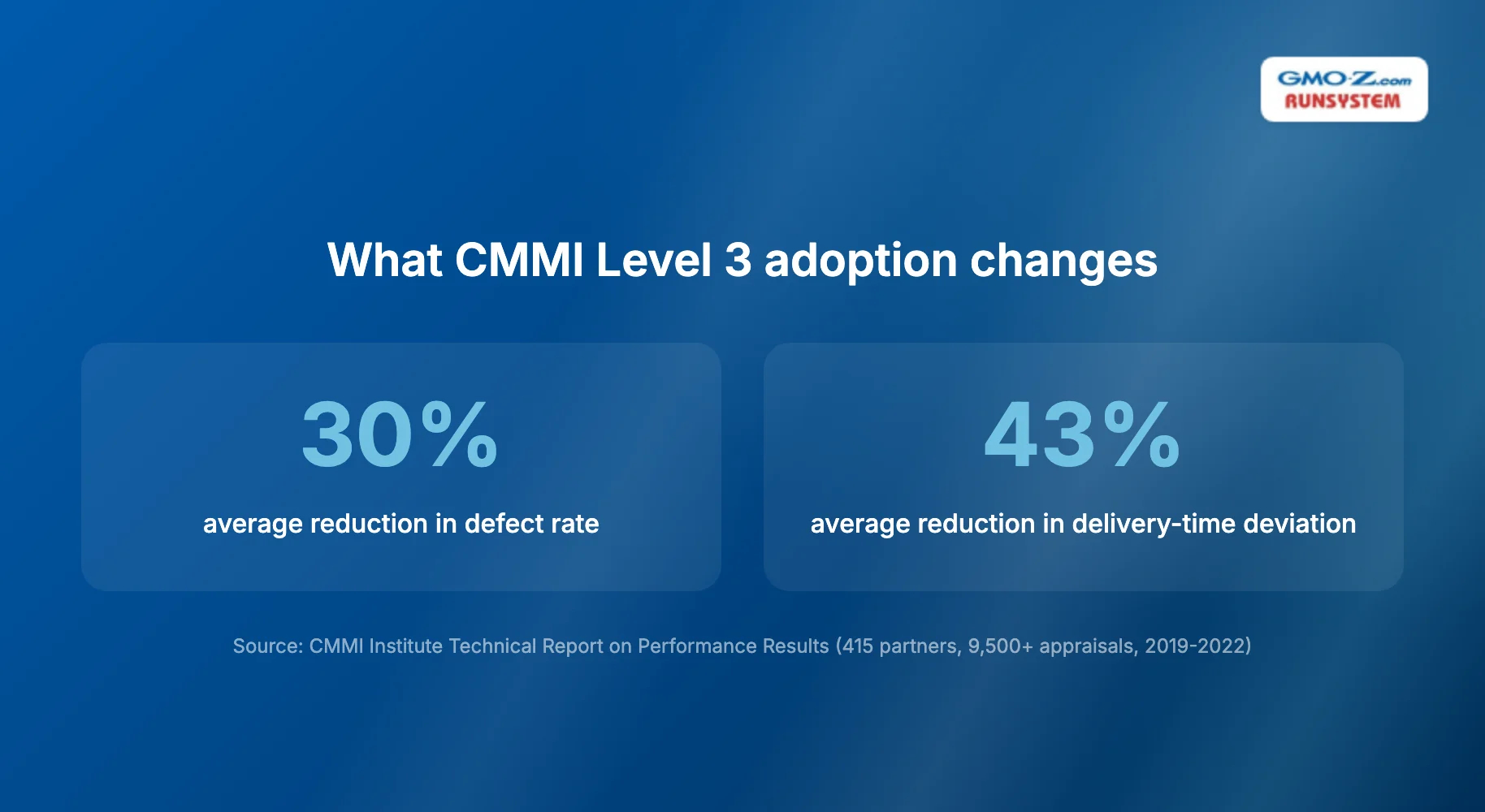
A strong portfolio tells you a vendor can execute one project well. It says nothing about whether they can hold that quality across a 12-month engagement, through staff turnover, scope changes, and stretches where your own team isn't available to answer questions. Process maturity certifications actually measure that, which is why they should outweigh portfolio review in your vetting:
Hold both, and a vendor is signaling it's built for sustained engagements, not a one-off project.
Certifications only tell you the process is sound on paper. They say nothing about whether the specific engineers you'll work with can execute against your codebase. Validate at the individual level too; most hiring guides skip this part entirely:
RunSystem's IT Outsourcing service, delivered through models including its Offshore Delivery Center, holds CMMI Level 3, ISO 9001, and ISO/IEC 27001 certifications. That's the kind of process-maturity proof this section argues you should ask for before signing (scope and pricing vary by engagement; contact RunSystem for a quote).
Three contract elements protect you no matter which model or region you choose. Skip any of them, and the mistake tends to surface only after something's already gone wrong, right when it's expensive to fix.
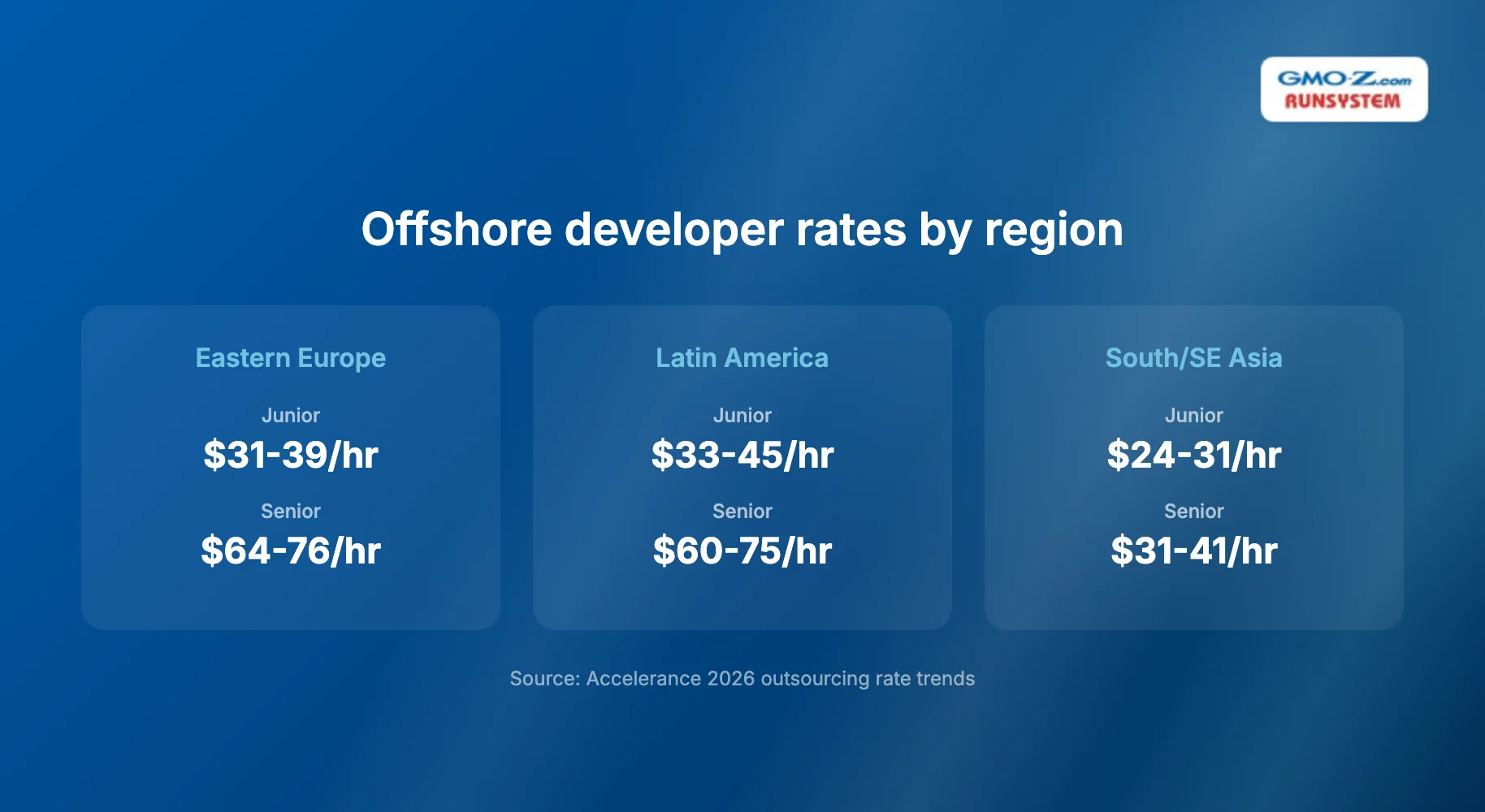
Offshore developer rates vary by region and by engagement model, but the model matters more than most buyers assume. As covered above: Eastern Europe runs $31-39/hr junior and $64-76/hr senior, Latin America $33-45/hr junior and $60-75/hr senior, and South/Southeast Asia $24-31/hr junior and $31-41/hr senior. Vietnam and India both span a wide range within Asia across junior to senior levels. Treat every figure here as a directional estimate—actual pricing depends on scope, seniority mix, and vendor, not on region alone.
Model changes your cost structure more than region does. Freelancers bill hourly with no overhead built in. Dedicated teams bill a blended monthly rate covering management and continuity, which reads as more expensive per hour but often isn't once you factor in the coordination time a freelancer arrangement demands from your own team. Full outsourcing bills against scope or milestones instead, shifting delivery risk onto the vendor.
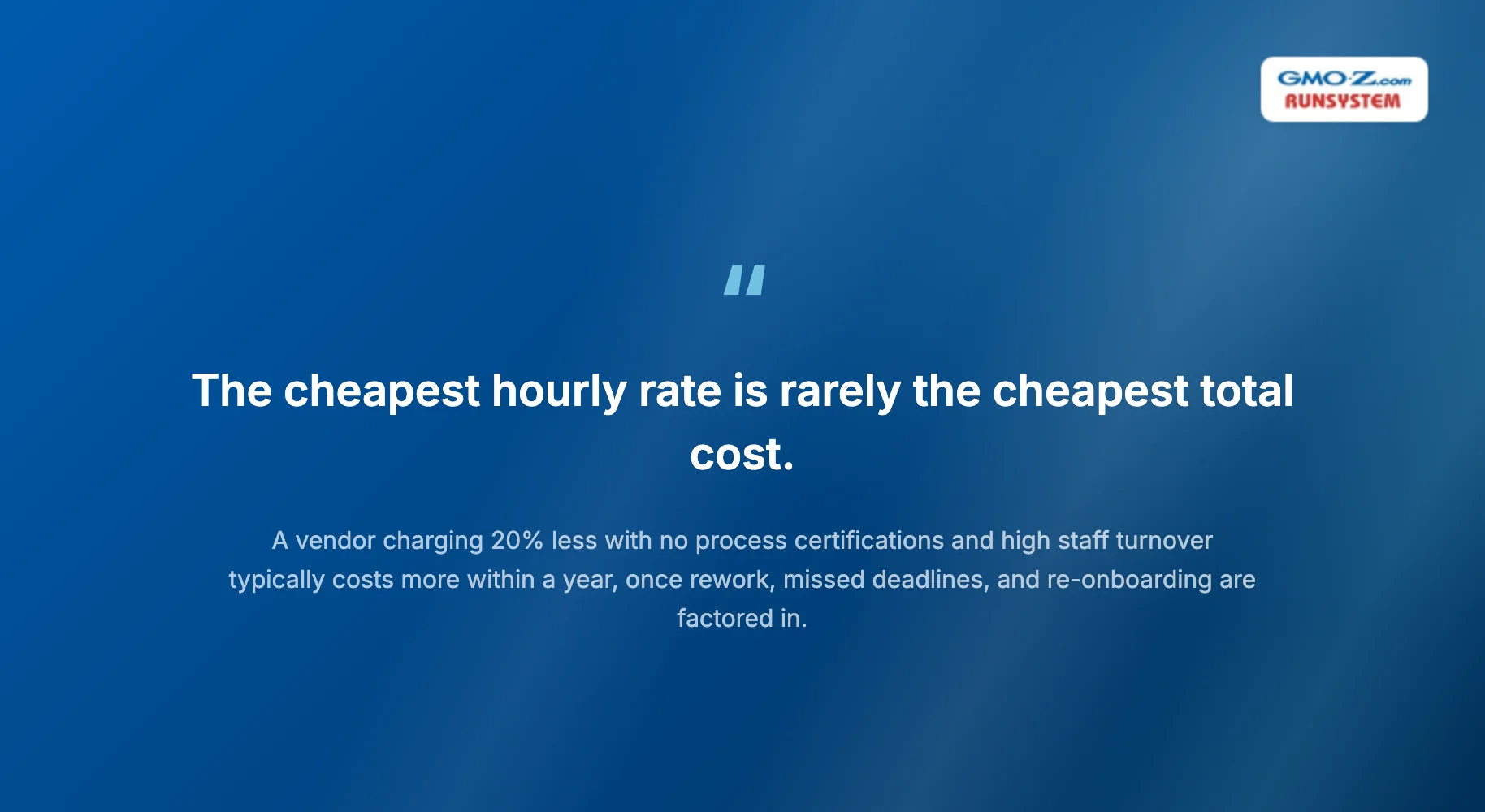
Most cost sections in competing guides stop at the headline rate comparison. That's the miss: the cheapest hourly rate is rarely the cheapest total cost. A vendor charging 20% less, with no process certifications and high staff turnover, typically costs more within a year, once rework, missed deadlines, and re-onboarding a replacement developer get factored in. The rate is only part of the bill. The rest is what you pay when the low number turns out to have been subsidized by weaker process discipline.
Back to top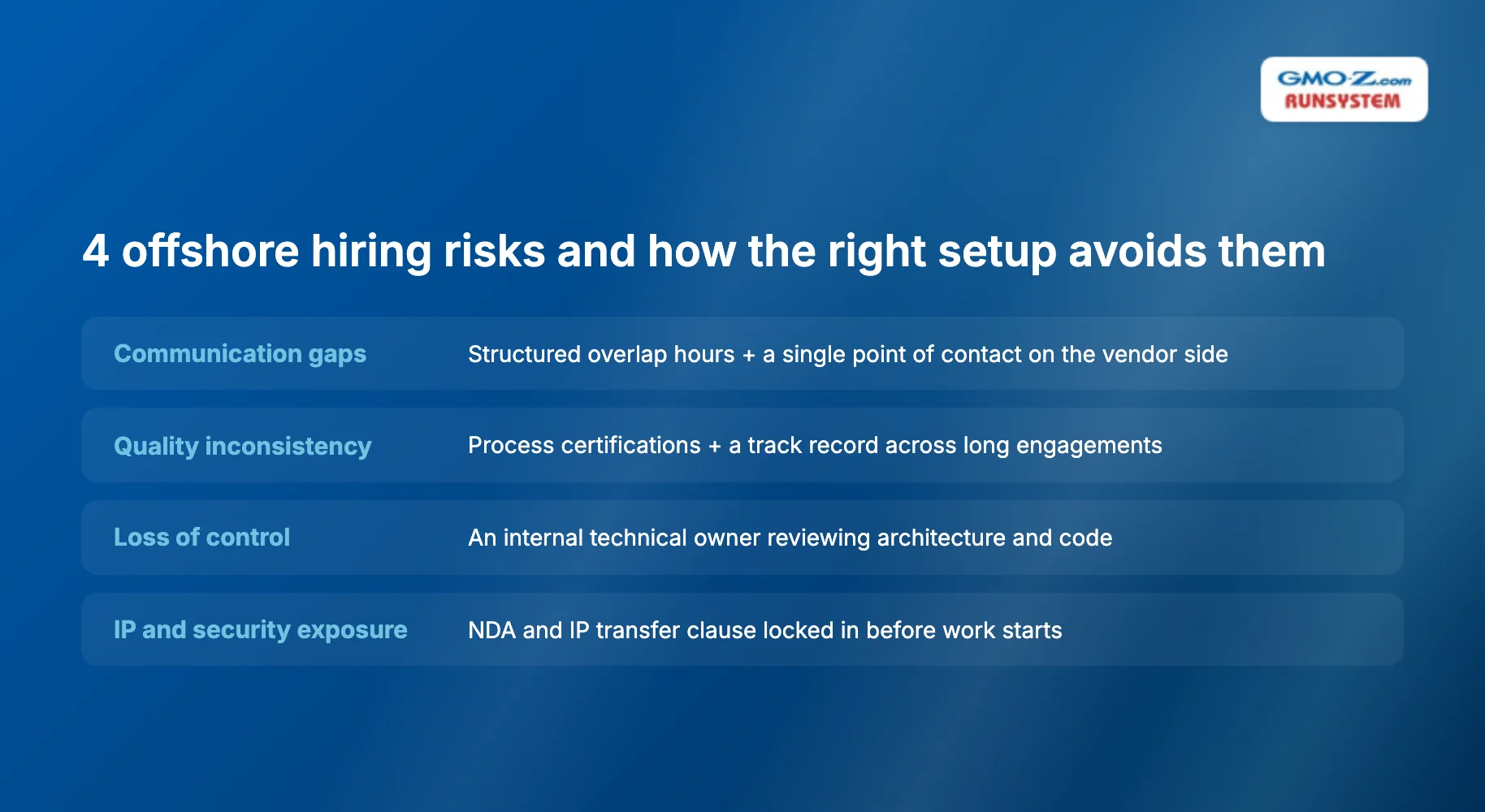
Every risk below maps back to a decision you already made in the steps above. None of them need a new framework. Just follow through on the choice you already made.
Treat the offshore team as an extension of your internal team, not a vendor managed at arm's length. Shared tools, shared standups, and the same definition of "done" you'd use with a local hire.
Cadence should match the engagement model from Step 1. Staff augmentation needs tighter daily sync, since developers are executing directly against your existing process. A dedicated team with a defined roadmap can run lighter—a daily async standup plus a weekly demo—because continuity and process ownership already sit with the vendor.
Hold delivery quality to the same standard you'd apply to an internal hire, not a lowered offshore standard. If weak code review, thin testing coverage, or missing documentation would be a blocker for a local engineer, it's a blocker here too.
Done piecing together freelancers one at a time? If you're ready to scope a dedicated offshore team instead, RunSystem's IT Outsourcing team can walk through your requirements and where they fit the model.
Back to topYes, when the vendor holds relevant security certifications like ISO/IEC 27001, and the contract includes a signed NDA plus an explicit IP transfer clause. Get both in place before sharing any technical detail.
Two to four weeks, typically, for a vetted developer from an established partner- signed agreement to active sprint. A from-scratch freelancer search takes longer and carries more variance, since no vendor is managing the pipeline for you.
Cost versus predictability, mostly. A freelancer costs less per hour but carries a higher management burden and weaker continuity if they leave mid-project. A development company costs more per hour on average, but the vendor manages continuity, so you get higher predictability with less day-to-day oversight.
Depends on region and engagement model. Structured overlap hours bridge most gaps for a dedicated team working async. Staff augmentation needs daily sync, so it benefits more from a region closer to full overlap - Latin America for US clients, for example.
Check for process certifications like CMMI Level 3 and ISO/IEC 27001, ask for client references specifically from engagements lasting a year or more, then run a paid trial task scoped to real backlog work before you commit to anything longer.
No, but they've changed which offshore roles are worth hiring for. AI is displacing low-priority, repetitive work like basic QA scripts and data entry, while demand shifts toward offshore engineers who can direct AI tools and own outcomes end to end. Specialized talent has overtaken cost as the top driver for outsourcing decisions — 59% of executives now cite access to specialized expertise as a key benefit, according to Deloitte's Global Outsourcing Survey.
Back to top