ファミリーサイト
ファミリーサイト
ファミリーサイト



A software development partner is a vendor that takes ownership of outcomes across multiple release cycles, not a single closed scope. But "partner" itself is not a certified status, so the label on a proposal tells you nothing. Three yes-or-no questions tell you what matters: who holds the backlog, who absorbs the cost of a wrong estimate, and whether the same team stays on the project between cycles.
Here's how to put those three questions to work, starting with what actually separates a partner from a contractor.
Back to topA contractor delivers a defined task and hands it off. A partner keeps ownership of outcomes across multiple release cycles, not just a fixed scope of work, and that difference shows up in three places: who controls the backlog, who absorbs the cost when an estimate is wrong, and whether the same team stays on the project between cycles.
Here's what the vendor-comparison articles ranking for this topic won't tell you. No standards body issues the word "partner." No audit confirms it. Nothing stops a staffing agency from printing it on a homepage the day after it starts filling contractor seats.
So the label on a contract is worth exactly nothing. What matters is what the contract and the working relationship it sets up actually do.
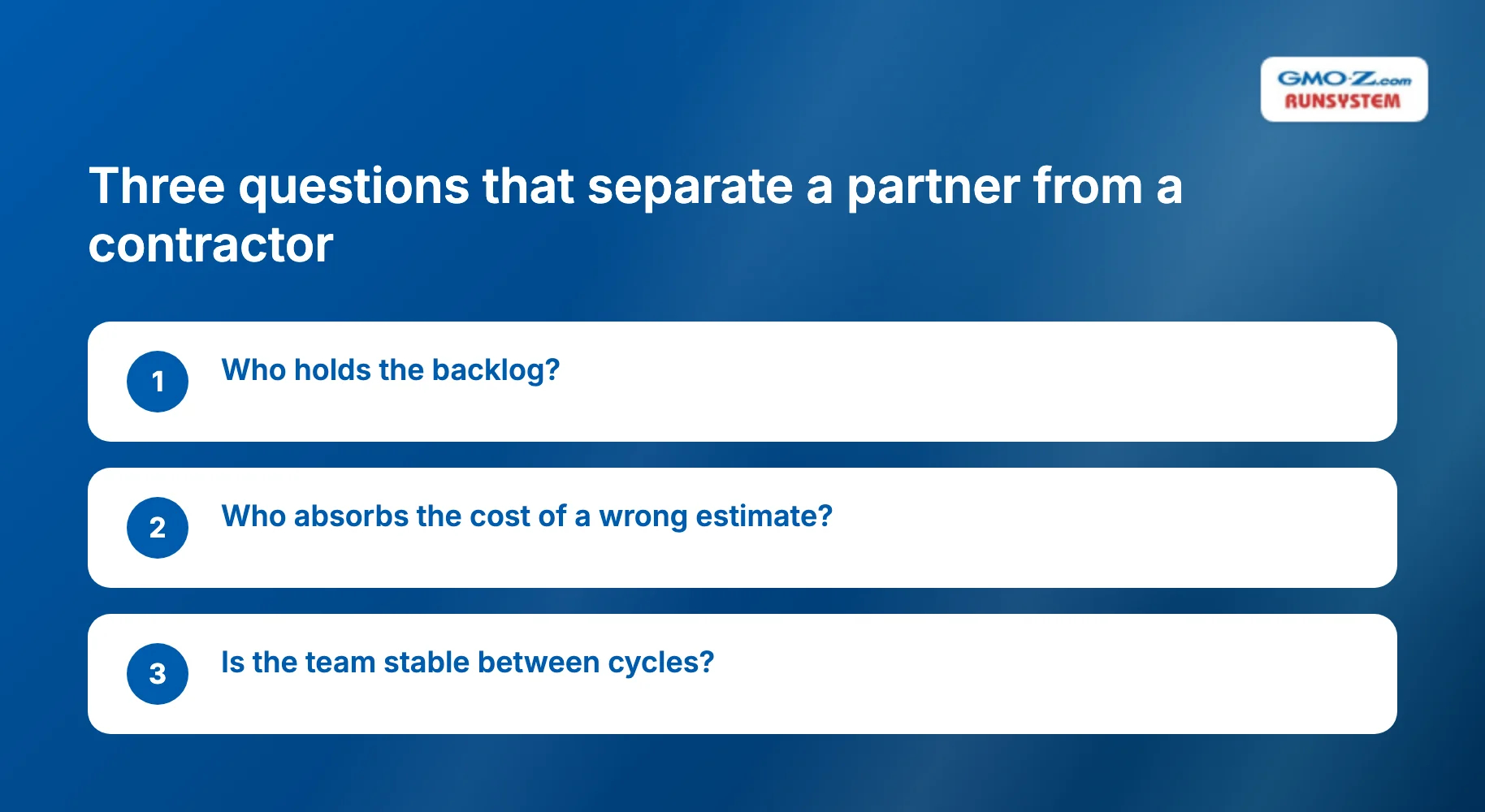
Three questions separate a partner from a contractor, and each one has a yes-or-no answer:
If the honest answer to all three is "no," you're looking at a contractor, regardless of what the proposal calls itself.
Vendor type shapes each of those three answers differently, and the difference is worth comparing directly. The table below sets four common structures side by side on backlog ownership, estimation risk, who pays for PM/BA/QA roles, team continuity, default code ownership, and when each one actually makes sense.
Structure | Backlog owner | Estimation of risk | Who pays for PM/BA/QA | Team stable between cycles | Default code ownership | When it fits |
Freelancer | You | You | You (if used at all) | No, single individual | Negotiated per contract | A small, well-defined task with a fixed deadline |
Staff augmentation | You | You | You | Depends on individual retention | Typically you, via contract terms | You already have a PM/BA/QA function and just need engineering hands |
Project vendor (fixed scope) | Vendor, for the life of the project | Vendor, within the fixed price | Vendor | No, team often reassigned after delivery | Usually you, on final payment | A closed-scope build with a clear finish line |
Development partner (dedicated team) | Shared, negotiated | Shared | Vendor, bundled into the rate | Yes, by design | Governed by the chain-of-title clause (see the contract section below) | Ongoing product work spanning multiple release cycles |
The table already answers the three questions above for all four structures, so there's no need to restate them. Notice the language: the useful comparison points are contractual terms (who owns the backlog, who pays for QA), not adjectives like "flexible" or "dedicated" that every vendor uses to describe itself.
Back to top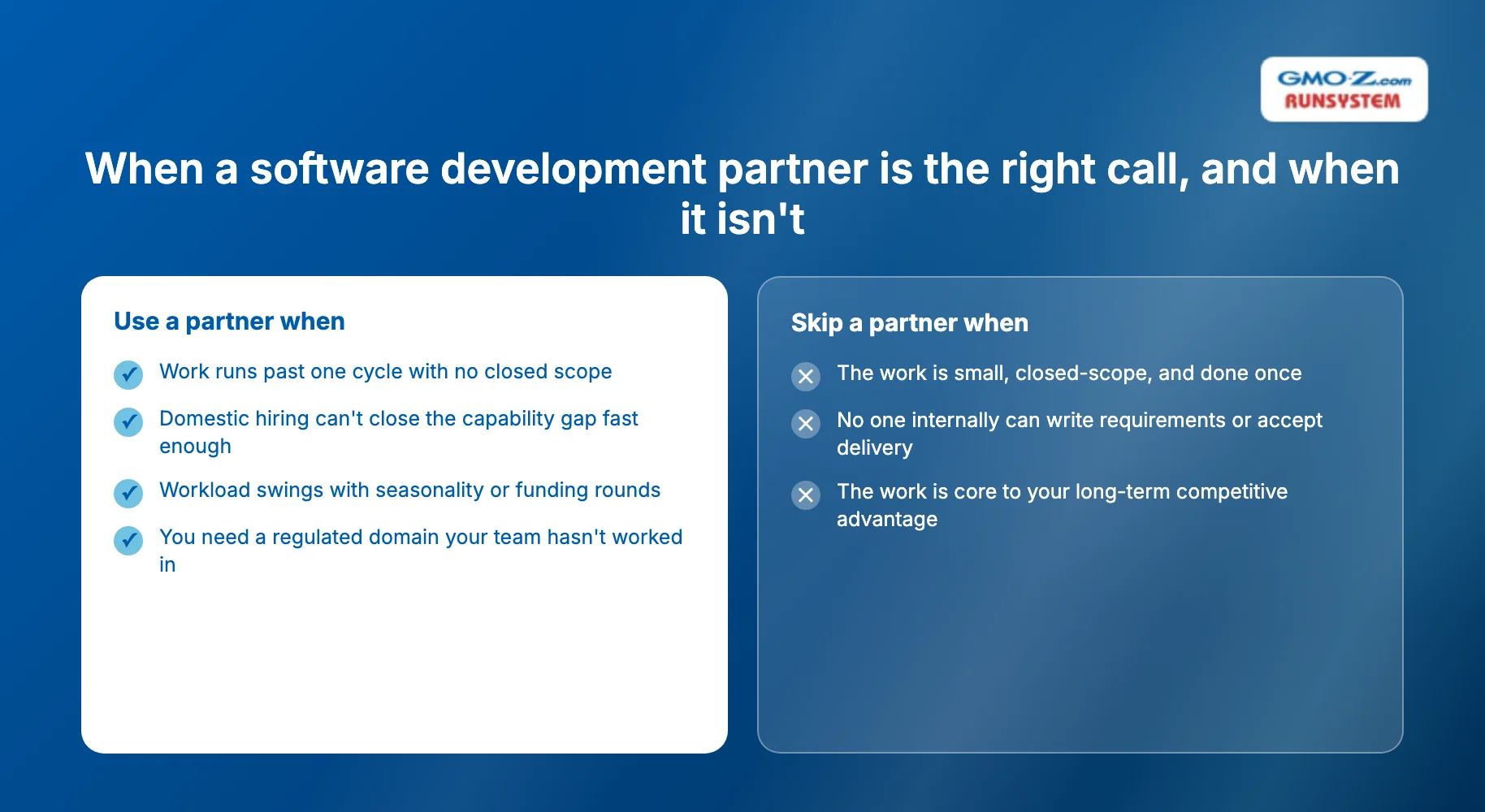
A software development partner earns its cost in four situations, each with a concrete signal you can check against your own project today.
The clearest one: work that runs past one release cycle with no closed scope. If your backlog keeps generating new tickets after every delivery instead of shrinking toward zero, you're not buying a project. You're buying ongoing capacity, and a partner model matches that shape better than a fixed-scope vendor does.
Then there's the capability gap domestic hiring can't close fast enough. A senior engineering hire in most local markets realistically takes 60 to 90 days from job posting to signed offer. If the work can't wait that long, a partner with an existing bench closes the gap in weeks instead of months.
Workload that swings with seasonality or funding rounds is the third case, and it's an expensive one to solve any other way: a team that needs to double for a Q4 push and shrink back in Q1 is costly to staff permanently and slow to staff on demand. A partner absorbs that elasticity without you carrying idle headcount.
Last is a regulated domain your team hasn't worked in before. Banking, healthcare, and insurance each carry compliance and integration knowledge that takes months to build from zero, and a partner that already has that context skips the learning curve you'd otherwise pay for internally.
A partner is the wrong call just as often, and three situations rule it out:
Hourly rates for outsourced development cluster by region: Vietnam runs $30 to $50 an hour, India $35 to $65 for senior teams, Poland and Central Europe $50 to $90, and Latin America $33 to $45 at the lower tier and $60 to $75 for senior engineers, according to Accelerance. Those figures are the numbers every comparison article leads with. They're also the least useful numbers for budgeting, because the rate doesn't say what it includes.
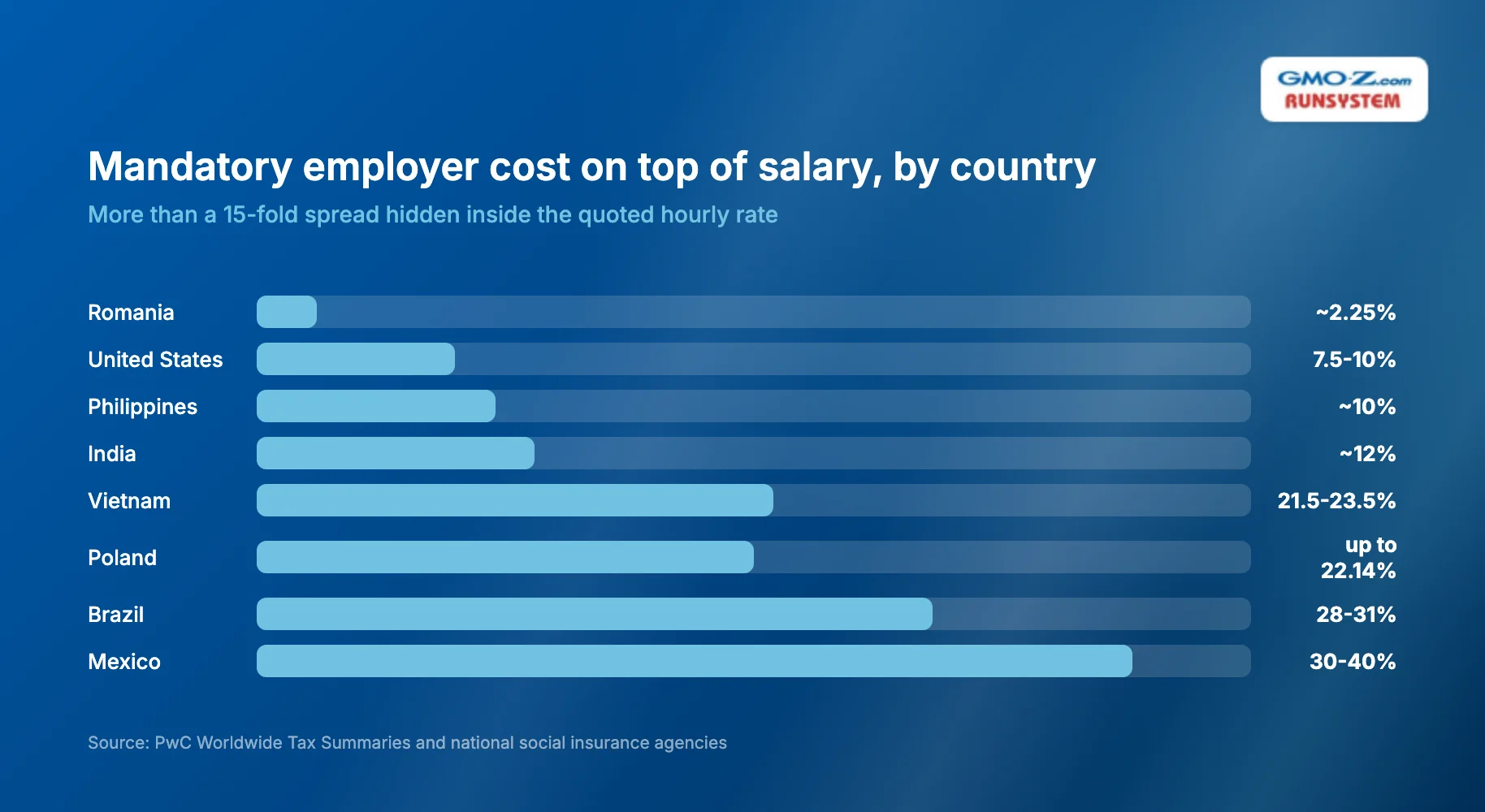
The gap that actually moves your budget is the mandatory cost an employer carries in each country, on top of salary. Romania sits at roughly 2.25%, the United States at 7.5% to 10%, the Philippines around 10%, India near 12%, Vietnam around 21.5% to 23.5%, Poland up to 22.14%, Mexico at 30% to 40%, and Brazil at 28% to 31%, according to PwC Worldwide Tax Summaries and national social insurance agencies. That's more than a 15-fold spread between the lowest and highest country, buried inside a quoted rate that never itemizes it.
An hourly quote rarely states what it includes. Beyond salary and statutory contributions, the rate has to cover office space and equipment, a buffer for attrition, the allocated share of PM and QA time, and margin on top of all of it. Unpack two quotes at the same hourly number and you can find them buying two entirely different things.
A new engineer takes 60 to 90 days to reach steady productivity: roughly 50% to 60% in month one, 70% to 80% in month two, and 85% to 95% by month three. Those figures are vendor-reported and not independently audited, so treat them as directional. Complex regulated domains, such as fintech or healthcare, stretch that ramp to 12 to 16 weeks, with onboarding-period costs exceeding $40,000, also vendor-reported.
Here's the calculation almost no comparison page runs: translate that ramp curve into a real cost per productive person-month across the first year, then compare it against the listed rate. Take a $45/hour engineer at 160 hours a month ($7,200 nominal). At 55% productivity in month one, you're paying $7,200 for the equivalent of 88 hours of output, or roughly $82/hour in effective cost.
By month four, once the engineer is fully ramped, effective cost converges back toward the nominal rate. Blended across a 12-month engagement, the real landed cost typically runs 15% to 25% above the quoted hourly rate; once ramp-up is priced in, a gap the listed rate never discloses.
Back to top"Review the portfolio and check references" is the advice every page in the top 10 results gives, and none of them explains how to actually do it. Here's the actual process: three checks you can run in your next vendor call, each one taking under five minutes.
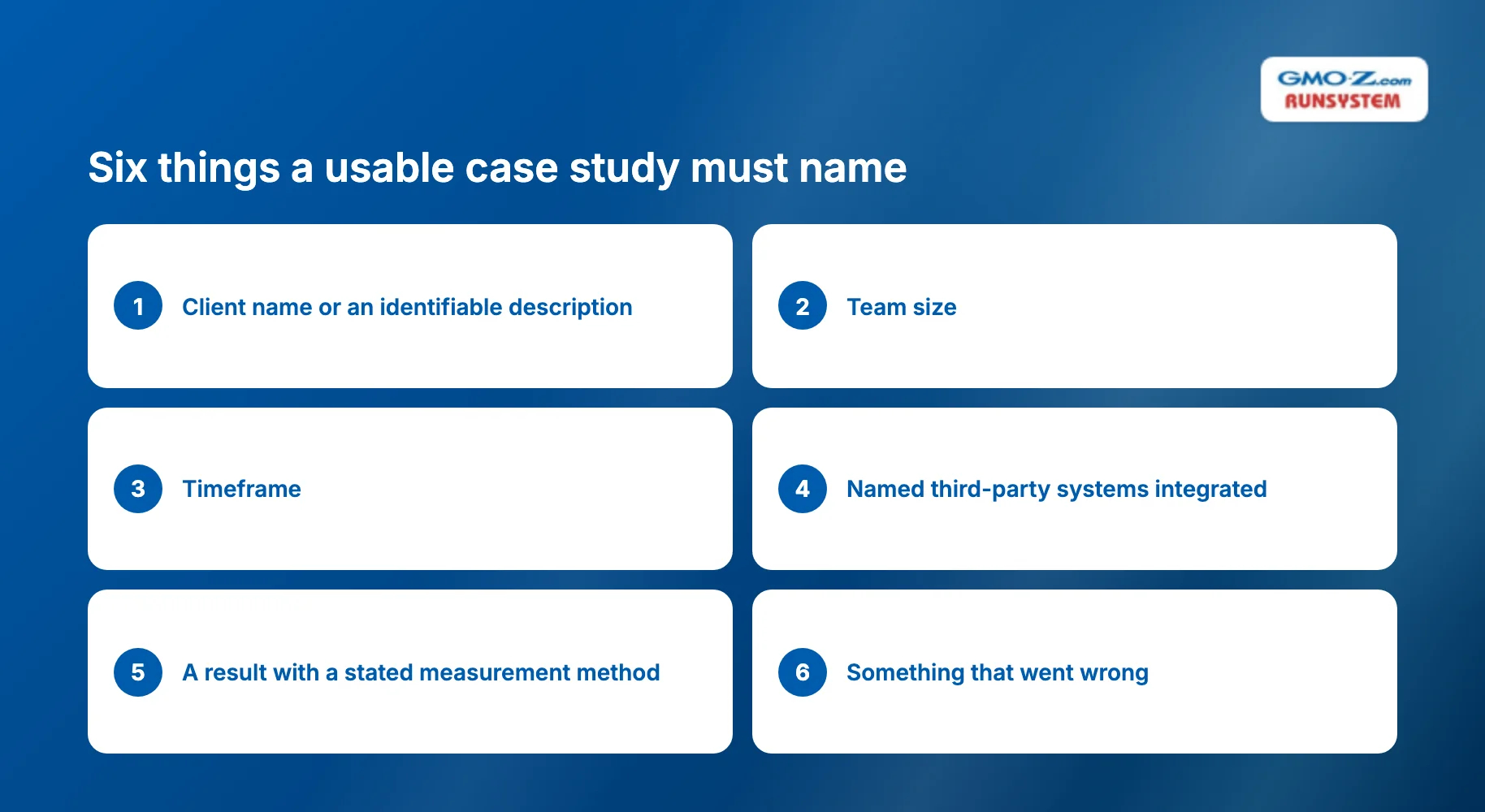
Ask the vendor for one case study relevant to your project type, then check it against six details:
Missing two or more of these means the case study isn't usable evidence: ask for a different one, or move to a different vendor.
Two of these six are worth pushing on hardest:
Don't ask how many engineers the company employs. Push for a name-by-name breakdown instead:
Total headcount tells you nothing about the four to eight people who will actually touch your codebase. A team that's worked together for a year moves faster from day one than a larger team assembled the week the contract was signed, because the smaller team has already solved its own coordination problems.
If the vendor can only answer in aggregate ("we have 200 engineers") instead of specifics about your team, that's the answer. Ask again, by name and by tenure, before you sign.
A certification logo on a website proves nothing on its own. Ask three direct questions:
Then cross-check the answer against the certifying body's public registry when one exists (ISO maintains one; ask the vendor for the certificate number to look it up yourself).
Watch for vendors who blur two different claims:
That distinction is why it's worth asking for the certificate, not just the claim.
Back to topFour questions filter out vendors a brochure can't answer for, and each one asks for a number or a process that already exists, not an intention.
If a vendor can't answer most of these, it's usually not because they're hiding something. It's because they've never had to measure it.
Back to topA confident quote before enough questions have been asked predicts scope getting reinterpreted after signature, and every reinterpretation costs extra. Watch, too, for a vendor that leads with total engineer headcount instead of describing your specific team; that's usually a sign the people you meet in sales won't be the people assigned to your project.
If a vendor can't produce one project that went wrong, that's either limited experience or a habit of not surfacing bad news, and neither is reassuring. Same goes for a sales rep who answers every technical question with no engineer in the room: it predicts a gap between what gets promised in sales and what gets delivered in execution.
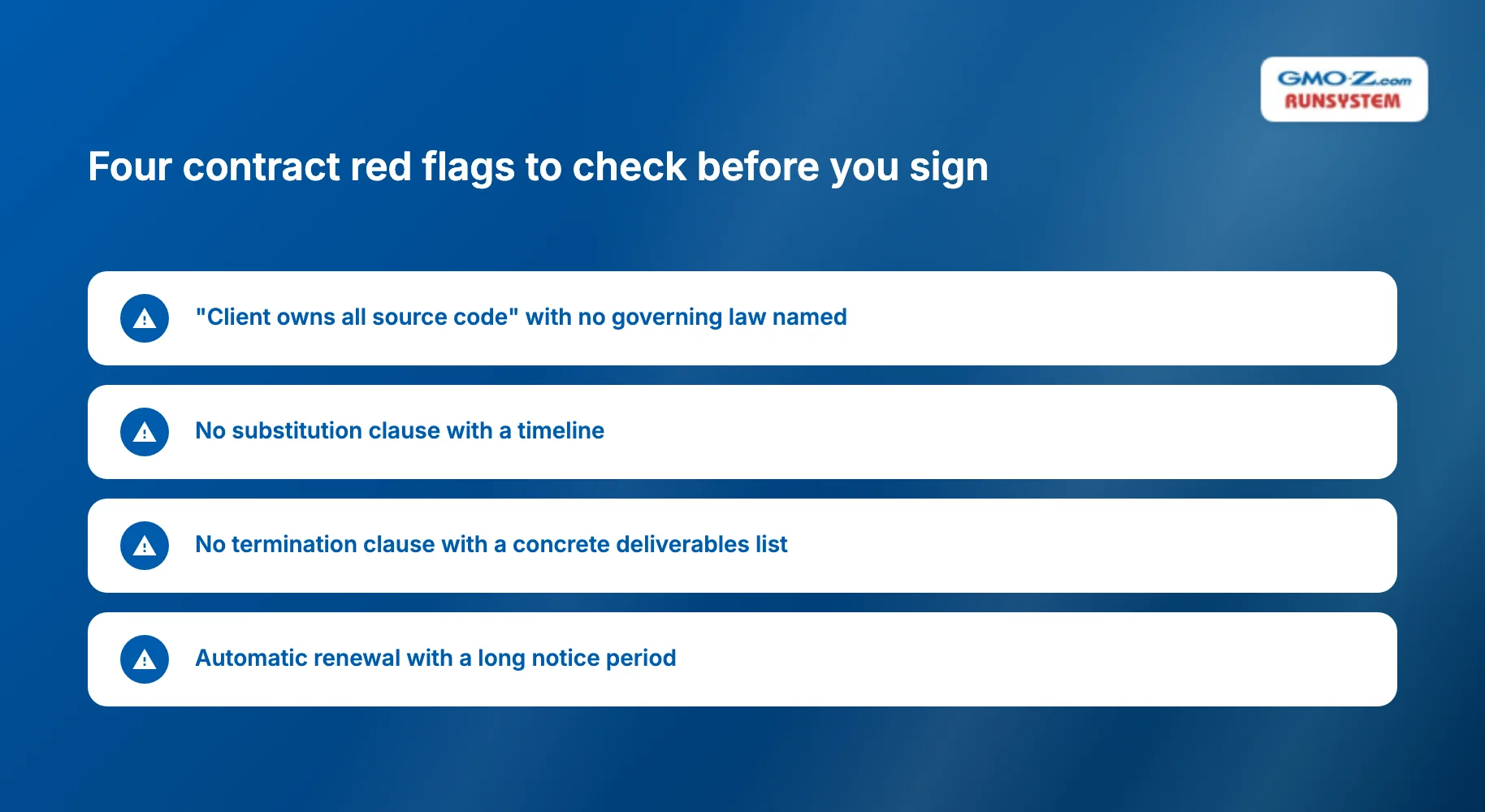
A few contract patterns predict specific problems once work starts:
Code ownership depends on which legal system applies, not on marketing language in a proposal. In the United States, code written by an employee within the scope of employment automatically belongs to the employer, but code written by an independent contractor doesn't transfer that way. It stays with the contractor unless a written assignment specifically transfers it, under the Copyright Act's work-for-hire doctrine as clarified in Community for Creative Non-Violence v. Reid.
Most civil-law countries follow a similar default, with the author retaining rights until a written transfer says otherwise. And that has a direct practical consequence for how a partnership works: hiring through a development partner usually means the code is written by that company's employees, so ownership passes through the vendor's hands before it reaches you.
That chain of title, the unbroken sequence of legal transfers from the engineer who wrote the code to you, has to be documented step by step; the contract needs to spell out exactly how it works, not just assert the outcome.
Three contract elements have to be present together for "you own everything" to mean anything: the governing law, the exact moment ownership transfers, and the scope of what transfers. Miss any one of the three and the ownership clause has no clear legal effect.
One scenario makes this concrete. If the transfer clause is conditioned on "payment in full," then during any invoice dispute, ownership hasn't actually passed to you yet, even if the code is already sitting in your repository.
The table below lists the applicable law and the specific contract requirement for five common delivery locations.
Region | Applicable law | What the contract must specify |
EU / UK | General Data Protection Regulation (GDPR), especially Chapter V on cross-border transfers | The transfer mechanism used (standard contractual clauses or equivalent) |
India | Digital Personal Data Protection Act 2023 | Consent and data-localization obligations specific to the processed data category |
Brazil | LGPD | Legal basis for processing and the data controller/processor designation |
Philippines | Data Privacy Act | Registration status with the National Privacy Commission where applicable |
Vietnam | Decree 13/2023 | Data classification and cross-border transfer conditions |
Don't accept a contract clause that just says "complies with applicable law." It has to name the actual statute governing the country where the team sits. A separate question the contract has to answer before signature, not after, is whether the development environment touches real production data at all.
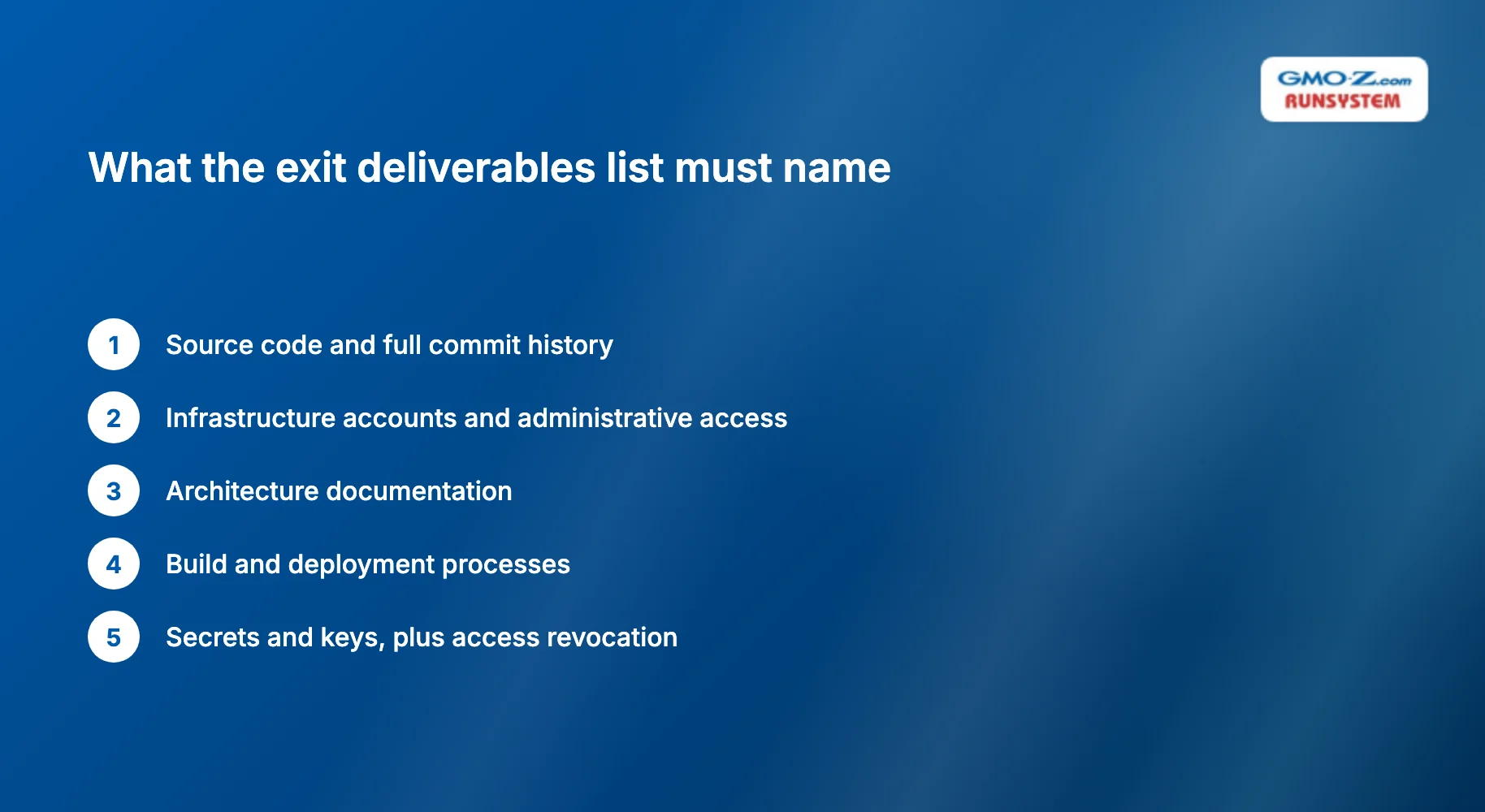
The exit deliverables list has to name five specific things: source code and full commit history, infrastructure accounts and administrative access, architecture documentation, build and deployment processes, and secrets and keys along with access revocation.
Each of those five needs a stated deadline, plus a transition-support period measured in weeks at a price agreed before you need it, not negotiated during the handoff itself. You need these terms most right when the relationship has already turned adversarial. That's the one moment when nothing is left to negotiate.
Back to topGovernance after signing runs on the same test as selection: verify accepted deliverables, not percentage-complete estimates. A status report that says "80% done" measures effort, not output. Effort doesn't tell you whether anything shippable exists yet.
Build the reporting cadence around deliverables the product owner has actually accepted, not story points burned, and check in weekly or biweekly for most engagements. Anything longer lets scope drift too long before anyone notices.
Escalation needs to be defined before you need it. Name who on your side can escalate a slipping deadline, and to whom on the vendor's side, before the first delay happens; without that path, the first real slip becomes a negotiation about process instead of a fix to the actual problem.
Back to topRun the three-question test from the top of this article against RunSystem, and it clarifies fit faster than a features page would. It fits when a company needs a dedicated team that stays stable across multiple release cycles, needs integration with existing enterprise systems, or needs a Japanese-language bridge. That last one runs through BrSE (bridge systems engineer) and Comtor roles, both real staffed positions rather than a marketing label.
The certifications back that up with a stated scope, and scope is exactly what the certification section above just taught you to ask for: CMMI Level 3, held since 2012, and ISO/IEC 27001, upgraded to the 2022 revision in 2025, covering offices in Hanoi, Ho Chi Minh City, Da Nang, and Hue.
It's a weaker fit in a few specific situations, worth stating plainly rather than glossing over. Small one-off projects don't need a standing team. Engagements that require near-full-day overlap with US West Coast hours are a stretch. And buyers who specifically require SOC 2 (an audit of internal data security controls) or PCI DSS (the payment card industry's security standard) certification won't find either publicly listed among RunSystem's credentials.
On price: RunSystem doesn't publish a public rate card, and measured against the transparency standard this article has been applying throughout, that's a real gap, not a footnote. Engagement scope and pricing vary; contact RunSystem directly for a quote specific to your project.
Back to topThree things need to be settled before you sign, each one pulling together a section above. Which engagement structure actually matches your situation (the comparison table earlier in this article). What the quoted price includes, and what the first three months really cost once ramp-up is factored in. And the exact moment code ownership transfers, along with the deliverables list for an exit.
Two points are worth repeating because they're the two most commonly missed. The word "partner" carries no certification behind it, so the contract terms matter more than the label. And a lower hourly rate doesn't mean lower total cost: statutory employer costs alone vary more than 15-fold across countries.
Back to topA partner shares ownership of the backlog, absorbs part of the risk when an estimate is wrong, and keeps the same team stable across release cycles. A contractor delivers a fixed scope, hands off, and typically passes estimation risk straight back to you. Check these three points directly rather than trusting either label.
Choose based on scope and internal capacity: a freelancer suits small, closed-scope work with a clear finish line. An agency or partner suits open-ended work, but only if someone on your side can write requirements and accept delivery; without that counterpart, even a strong partner builds the wrong thing.
Hourly rates run $30 to $90 depending on region (Vietnam $30 to $50, Poland $50 to $90, per Accelerance), but the rate alone isn't the cost. Factor in statutory employer costs, which vary from roughly 2% to 31% by country, and ramp-up time, which adds 15% to 25% to effective cost in year one.
Most vendors report 60 to 90 days to reach steady productivity, with complex regulated domains like fintech or healthcare taking 12 to 16 weeks. These figures are vendor-self-reported, not independently audited, so use them as a planning range rather than a guarantee.
Run three checks: does their case study name a specific third-party system they integrated with, has the proposed team worked together for a meaningful stretch, and does their certification list a specific scope and a recent audit date. A vendor that fails all three is a risk regardless of how the sales conversation goes.
Ownership depends on the governing law named in the contract, the exact moment transfer happens, and the scope of what transfers, not on a sentence like "you own everything." In the US, contractor-written code doesn't transfer automatically without a written assignment, unlike employee work product.
Track accepted deliverables, not percentage-complete estimates, on a weekly or biweekly cadence. Name an escalation contact on both sides before the first delay happens, so a slipping deadline triggers a fix instead of a negotiation about process.
Choosing a vendor on hourly rate alone isn't a cost-saving move. It's a decision that gets expensive around month four, once ramp-up costs and statutory employer costs are actually counted. Run the three-question test (backlog, risk, team continuity) and the ownership check in this article before you sign, and the label on the contract stops mattering nearly as much as what the contract actually says.
Back to top