Family site
Family site
Family site



The instinct to treat nearshore IT outsourcing as "offshore but closer" misses the actual trade you're making. You give up some rate savings for faster feedback loops and lower coordination risk. That trade only pays off if you restructure how the team works with you, not just pick a country on a map.
This article walks through what nearshore actually costs and which engagement model fits your situation. It also covers the risks overlap hours don't automatically solve.
The final sections show how to vet and run a partner so the collaboration advantage shows up in your delivery, not just in the sales pitch.
Explore now!
Back to topNearshore IT outsourcing means contracting software development or IT functions to a provider in a nearby country or region that shares substantial working-hour overlap with your team. That overlap typically runs 3 to 6 hours of real-time working time in a shared workday.
That overlap is the entire point. A US company contracting a team in Colombia gets 4 to 6 hours of shared working time, enough for a live standup, same-day code review, and real-time sprint planning. A US company contracting a team in India gets almost none, so every exchange waits a full day for a reply.
Nearshore sits between onshore (fully domestic, full-price, full overlap) and offshore (lowest headline rate, little to no overlap). It isn't automatically cheaper than offshore, and it isn't automatically better.
It's a different trade: you give up some rate savings in exchange for faster feedback loops and lower coordination risk. Whether that trade is worth it depends on the workload, which the next sections walk through.
Back to topThe three models differ mainly on cost, overlap, and how much oversight you keep, not on the quality of engineers available. The table below compares them across the factors that actually drive a decision.
Factor | Onshore | Nearshore | Offshore |
Hourly rate | Highest | Mid-range | Lowest headline rate |
Working-hour overlap | Full | 3-6 hours | 0-2 hours |
Talent pool size | Smallest, most expensive to scale | Large, growing fast in Latin America (LATAM) and Central and Eastern Europe (CEE) | Largest globally |
Real-time collaboration | Native | Strong, live standups possible | Limited to async handoffs |
Travel for on-site visits | Same day | Short-haul flight, 1 time zone or less shift | Long-haul, multi-day trip |
Cultural/business proximity | High | Moderate to high | Variable |
Management overhead | Low | Moderate | High |
Best-fit workload | Regulated, high-touch, client-facing | Agile product work needing daily collaboration | Well-documented, low-ambiguity, standardized work |
Don't compare models on hourly rate alone. Hourly rate is not total delivery cost. Offshore usually wins on the rate card, but the real cost includes several hidden line items.
Those items are management time spent chasing async updates, rework from requirements lost in translation, turnover that resets your onboarding clock, and post-release defects.
Nearshore is gaining ground precisely because it prices in less of that hidden cost. Offshore outsourcing in the Philippines or India is typically 20-40% cheaper on the rate card, according to Cloud Employee. That gap narrows once you count the hidden costs above.
Back to topNearshore developer rates in LATAM or Eastern Europe run $4,000 to $7,000 per month on average as of 2026. Offshore outsourcing in the Philippines runs $3,500 to $5,500 per month, according to Cloud Employee. That's a higher headline number for nearshore, but it isn't the number that should drive your decision.
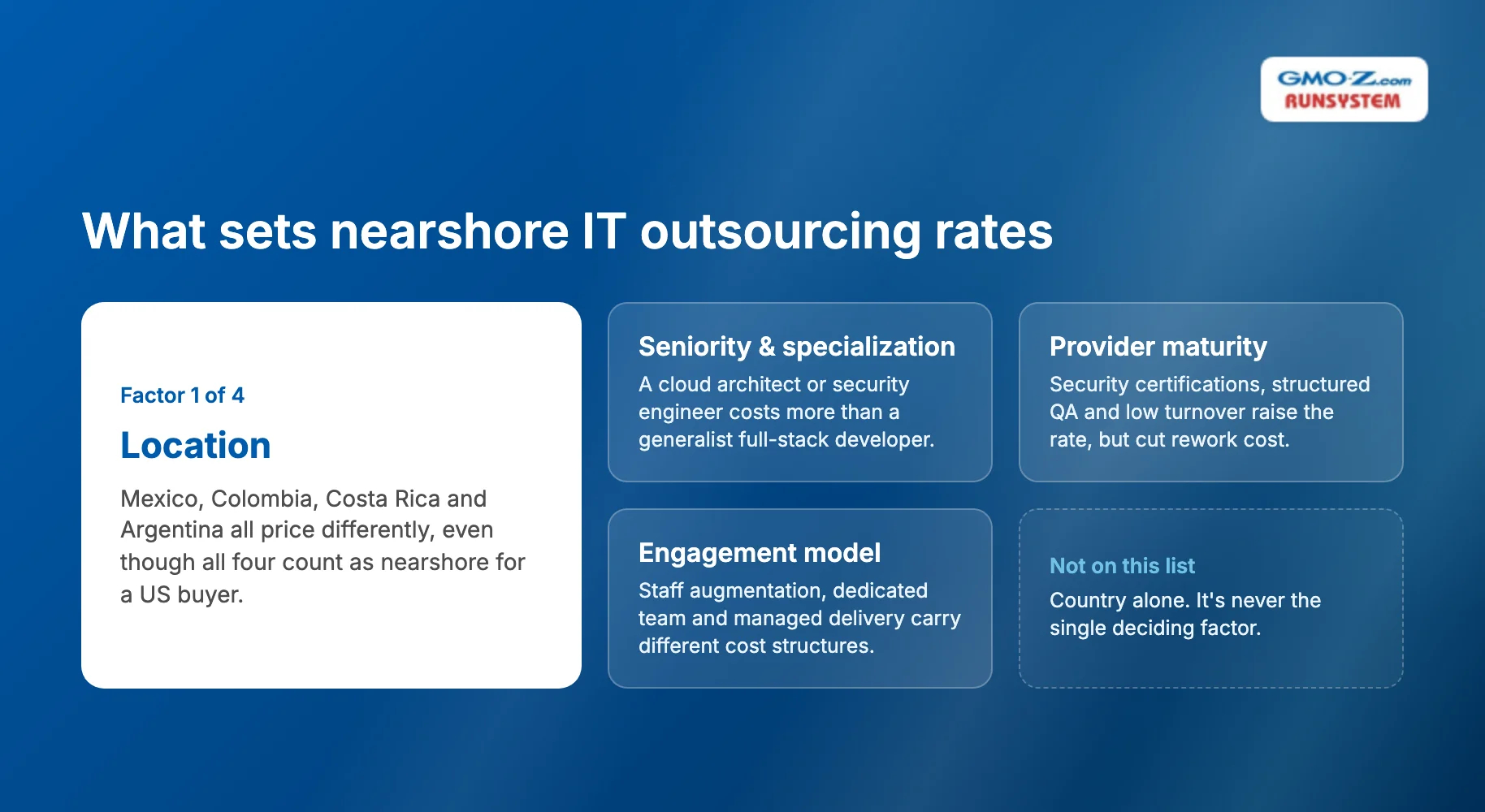
Four factors set the price, and none of them is "which country."
Use this formula instead of comparing rate cards:
Nearshore TCO = delivery fees + internal management time + onboarding + rework + tooling + compliance + turnover/transition costs
Here's what that looks like for a 5-person agile product team over one year, comparing onshore, LATAM nearshore, and offshore.
Cost component | US onshore | LATAM nearshore | Offshore (non-overlapping) |
Blended monthly rate (5 people) | $50,000-$62,500 | $20,000-$35,000 | $15,000-$27,500 |
PM overhead (internal hours spent coordinating) | Low | Moderate | High |
Working-hour overlap | Full | 4-6 hrs/day | 0-2 hrs/day |
Expected communication burden | Minimal | Daily standup fits normal hours | Async handoffs, next-day replies |
Ramp-up to full velocity | 4-6 weeks | 6-10 weeks | 8-14 weeks |
The onshore column carries the highest sticker price but the lowest coordination tax. The offshore column carries the lowest sticker price but the highest coordination tax, since a 12-hour time gap turns every clarifying question into a full day of lost velocity.
Nearshore lands in between on both axes. For teams running weekly sprints with frequent scope changes, that middle position often produces the lowest total cost per shipped feature, even though the invoice looks bigger than offshore's.
Back to topThe right model depends on one question: how much day-to-day management do you want to keep in-house? Three models answer that question differently, and picking the wrong one is a common, expensive mistake, not a minor inconvenience you fix later.
Staff augmentation works best when you already have a team and architecture in place and just need more hands. You keep direct control over the engineers' day-to-day work, which is the point, but it also means the management burden stays fully on you.
Staff augmentation fits when:
Staff augmentation fails when a company uses it to cover a capability gap it doesn't actually have in-house. If nobody on your side can review a cloud architect's design decisions, adding one through staff augmentation just adds an unsupervised expert to your team. That trades one risk for a different, harder-to-spot one.
A dedicated nearshore team fits a long-term product roadmap where you need a stable, cross-functional group that builds up domain knowledge over time. The trade-off is a bigger commitment.
You're not renting capacity for a sprint. You're building a team that needs onboarding, retention planning, and a real seat at your product table. That commitment pays off specifically when:
The trade-off is real. A dedicated team you can't keep staffed at 80%+ utilization turns into a fixed cost you're paying for idle capacity. That's worse than staff augmentation's flexibility.
Managed delivery works when the outcome is clearly defined and you don't want to manage engineers day to day. The vendor owns delivery end to end. The trade-off is less visibility and less control over how the work actually gets done.
Managed delivery fits a narrow set of situations well:
It fits poorly for anything with a roadmap that changes quarter to quarter. A fixed-scope contract makes every change request a renegotiation, and that friction erodes the speed advantage nearshore was supposed to deliver in the first place.
The table below maps common situations to the model that fits.
Situation | Recommended model |
You need two additional Java developers for six months | Staff augmentation |
You're building a new SaaS product from scratch | Dedicated team |
You're migrating one legacy system | Managed/project team |
You need ongoing product ownership past launch | Dedicated team |
You have a temporary capacity spike | Staff augmentation |
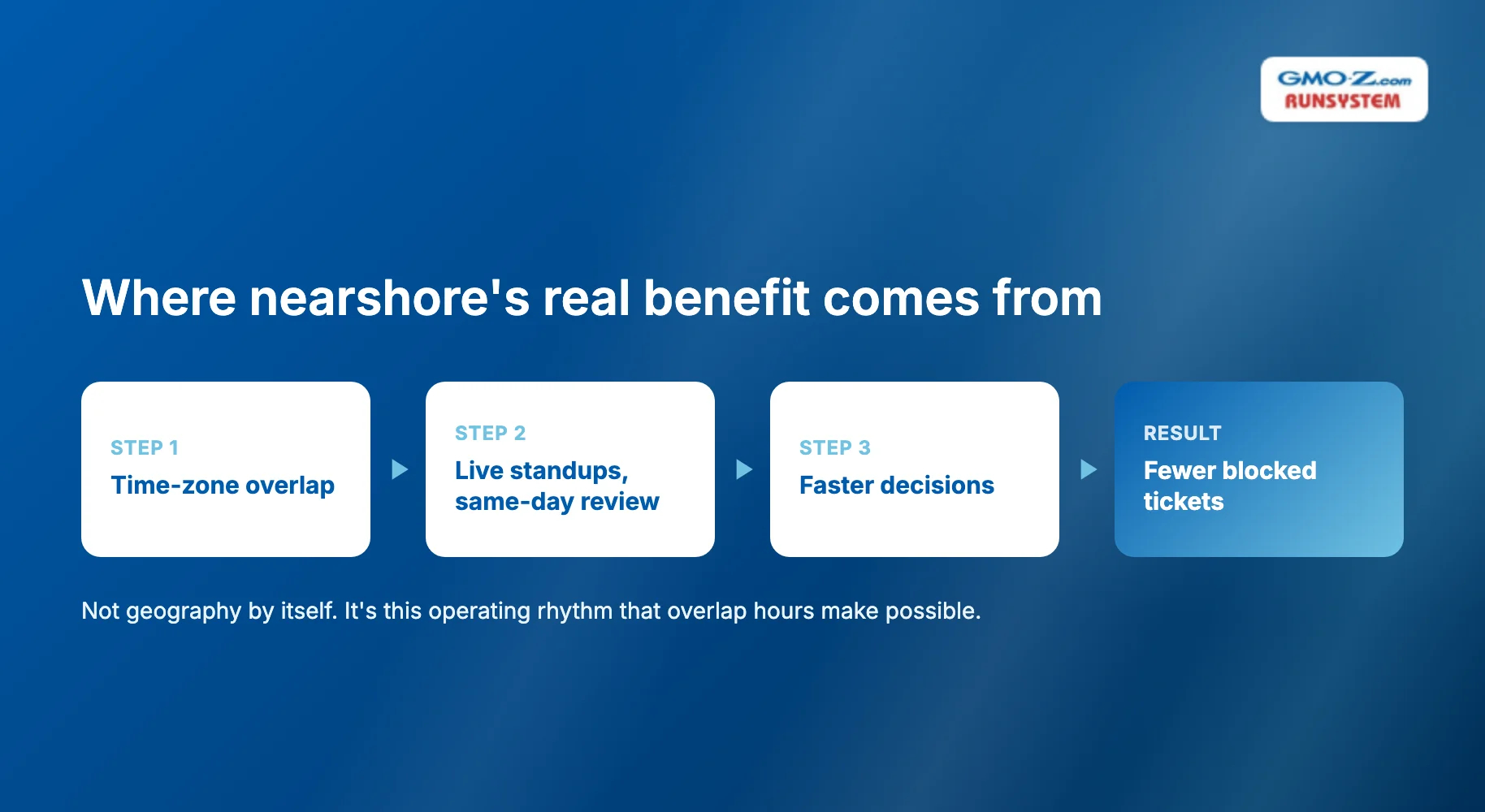
Nearshore's advantage doesn't come from geography by itself. It comes from the operating rhythm that overlap hours make possible, from shorter feedback loops to easier day-to-day integration.
Time-zone overlap means live standups, same-day code review, and faster decisions. That chain directly reduces the number of tickets sitting blocked on a question nobody can answer until tomorrow.
The mechanism is specific, not just a vibe. A blocked pull request on an offshore team with zero overlap waits a full working day for the author to see the review comment. It waits another day for the fix to get re-reviewed.
On a nearshore team with 4 to 6 hours of overlap, that same exchange happens inside one shift:
Multiply that gap across a team shipping dozens of pull requests a week. The offshore lag compounds into weeks of lost velocity over a quarter, exactly the "invisible" cost a rate-card comparison never captures.
Nearshore markets have built up real depth in cloud, DevOps, data engineering, AI, and cybersecurity, not just a larger pool of generalist developers. That specialization is what lets a nearshore team take on architecture-level work, not just ticket execution.
This matters most when your gap isn't headcount, it's a specific skill your internal team doesn't have in-house yet:
Hiring that specialization onshore usually means a multi-month search at a premium salary. A nearshore partner with a deeper bench in that specific skill can staff the gap in weeks, at a fraction of the onshore fully-loaded cost.
When your roadmap accelerates, a domestic hiring cycle can take months. A nearshore partner with bench capacity (engineers already vetted and ready to deploy) can add qualified people in weeks. That speed matters most when your team can least afford to wait, for example when a new client contract carries a hard delivery date.
This is where the savings show up, after the collaboration and specialization benefits, not before them. A nearshore team typically costs less than an equivalent onshore hire while still supporting close to full working-day collaboration.
Put a number on it. A US-based senior engineer often runs $120-$200 per hour fully loaded, while a comparable LATAM senior engineer runs $55-$95 per hour, according to the rate data cited earlier in this article. That gap holds even after you add nearshore's coordination overhead, which is smaller than offshore's but larger than a fully in-house team's.
A nearshore team can sit inside the same sprint as your internal team on one shared cadence, not a separate track that syncs up once a week:
That shared cadence, not the map, is the actual benefit. A nearshore team run as a separate silo gets none of this. It just gets the invoice.
Back to top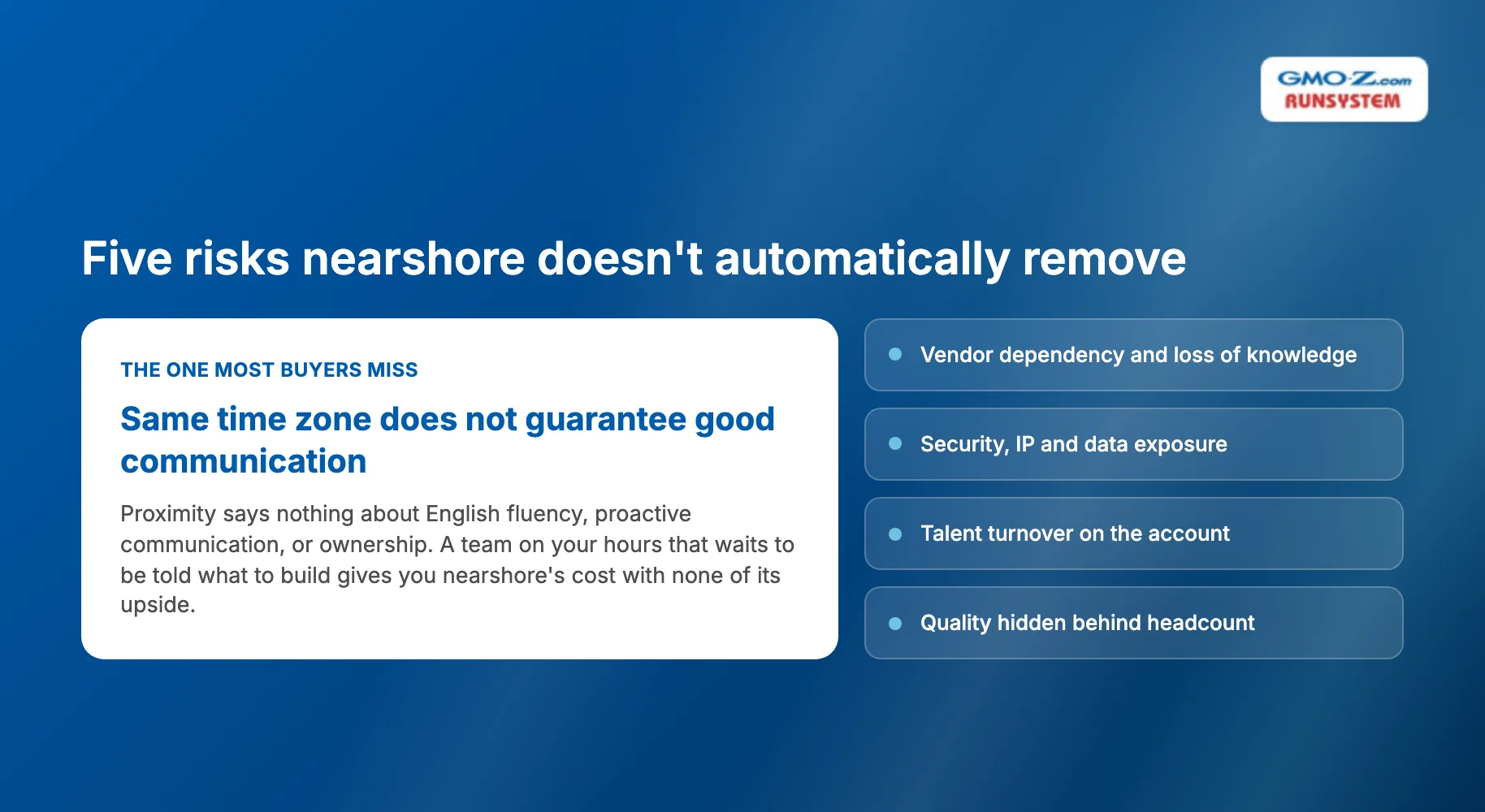
Nearshore reduces some risks common to offshore work, but it introduces its own, and treating it as risk-free is where most buyers get burned. Each risk below follows the same pattern: why it happens, and what to check before it becomes a problem.
This risk happens when a vendor owns critical architecture knowledge that never gets documented anywhere your team can access. Check that your contract requires documentation, repo ownership on your side, architecture ownership, and a clear transition clause if you end the engagement.
This risk happens when access controls and data handling are treated as a footnote instead of a contract term. Check IP assignment language, access controls, and where data is physically stored.
Also verify relevant certifications like SOC 2 or ISO/IEC 27001 (the international standard for information security management). Confirm incident response procedures and the vendor's subcontractor policy too.
This risk happens when a vendor runs thin on bench capacity and quietly rotates junior staff onto your account once the senior engineers from the sales process move on. Ask the vendor directly about retention rate, replacement SLA (the contractual timeline for filling a departed engineer's seat), bench strategy, and how they handle knowledge transfer when someone leaves.
This is the risk most nearshore buyers don't see coming, and it's a genuinely contrarian point worth stating plainly. Geographic and time-zone proximity says nothing about English fluency, proactive communication, product thinking, or ownership. A team that shares your working hours but waits to be told exactly what to build gives you all of nearshore's cost profile with none of its collaboration upside.
This risk happens when "we have 10 developers on your account" gets treated as a success metric instead of an input.
Measure cycle time, deployment frequency, defect escape rate, pull-request turnaround, availability against SLA, and delivery predictability instead. Headcount tells you what you're paying for. These metrics tell you what you're getting.
Back to topThe answer depends entirely on where your business is located, since "nearshore" is a relationship between two locations, not a fixed set of countries. A US buyer's nearshore map looks nothing like a Western European buyer's.
For US and Canadian companies, common nearshore locations include Mexico, Colombia, Costa Rica, Argentina, and, for some workloads, Brazil and Chile.
For Western European companies, the nearshore map shifts entirely to Central and Eastern Europe (CEE): Poland, Romania, Czechia, and nearby CEE markets. These countries share several working hours with Western Europe the same way LATAM shares hours with North America.
Vietnam-based providers like RunSystem serve as a useful reminder that "nearshore" is always relative to the buyer, not a fixed label attached to a region. A Vietnamese delivery team is offshore for a US buyer, but it functions closer to nearshore-level overlap for a buyer in Australia or parts of Asia-Pacific.
The table below compares specific locations on the factors that matter, since no single country is "best" independent of the workload you're outsourcing:
Location | Time-zone fit (for US buyers) | Talent strengths | Cost level | English proficiency | Legal/compliance environment | Best for |
Mexico | Strong (aligned with Central/Mountain time) | Full-stack, manufacturing-adjacent software | Mid | Good, improving | USMCA-aligned | Product teams needing daily overlap with US West/Central |
Colombia | Strong | Software engineering, fintech | Mid | Strong | Stable, growing tech policy | Dedicated agile teams |
Costa Rica | Strong | QA, support, mid-level dev | Mid to higher | Strong | Stable | Support-heavy or hybrid technical/BPO work |
Argentina | Moderate to strong (varies by US region) | Senior engineering, data/AI | Mid | Strong | Currency volatility affects contracts | Specialized senior talent needs |
Poland | Strong (for Western Europe) | Enterprise software, cybersecurity | Mid to higher | Strong | EU-aligned, GDPR native | EU buyers needing compliance-heavy delivery |
Romania | Strong (for Western Europe) | Software engineering, QA | Mid | Strong | EU-aligned | Cost-conscious EU dedicated teams |
Don't look for the single best country overall. The best location depends on the workload: a compliance-heavy EU project points toward Poland, not Colombia, even though both are "nearshore" for their respective buyers.
Back to top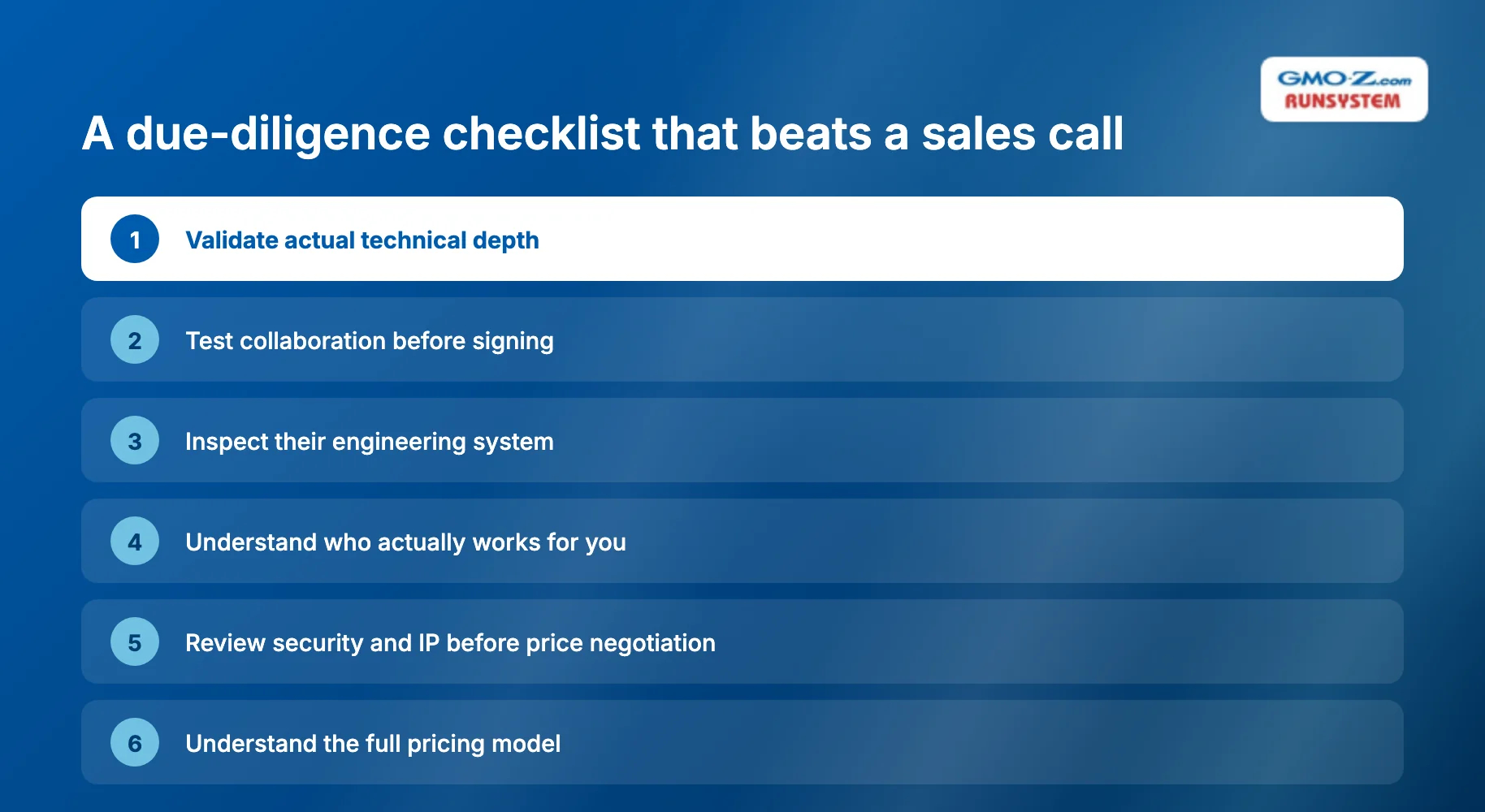
Checking experience, price, and communication is not a due-diligence framework. It's a checklist any vendor can pass on a sales call. Verifying how a vendor actually operates takes more work, and that work is what separates a partner who delivers from one who only looks good in a pitch deck.
Ask to meet the engineers who would work on your project, not only the salespeople who sold it to you. Check their architecture experience, ask for real code examples or a walkthrough of their process, and confirm their stack specialization matches your needs. Also look at the actual seniority mix, not just the most senior person on the call.
Run a real architecture discussion, a sprint-planning simulation, or a technical workshop before you sign anything. Watch whether the team challenges your assumptions or just agrees with everything you say. A team that only says yes in the sales process will keep saying yes after the contract starts, and that's a far more expensive problem to discover in production.
Request evidence of how the vendor actually builds software: their CI/CD (continuous integration and deployment) setup, QA automation, code review process, observability practices, security controls, and documentation standards. A vendor that can't produce this evidence on request likely doesn't have a consistent process to show.
Get clear answers to each of the following before you sign, since a vague answer to any one of them is a red flag:
Review security posture and IP terms before you negotiate price, not after. A vendor that's willing to negotiate rate but not IP terms is telling you which one it actually prioritizes.
Look past the headline rate for setup fees, minimum commitment periods, replacement fees, overtime rates, project-management fees, and termination terms. These line items are where a competitive rate quietly turns into an expensive engagement.
Back to top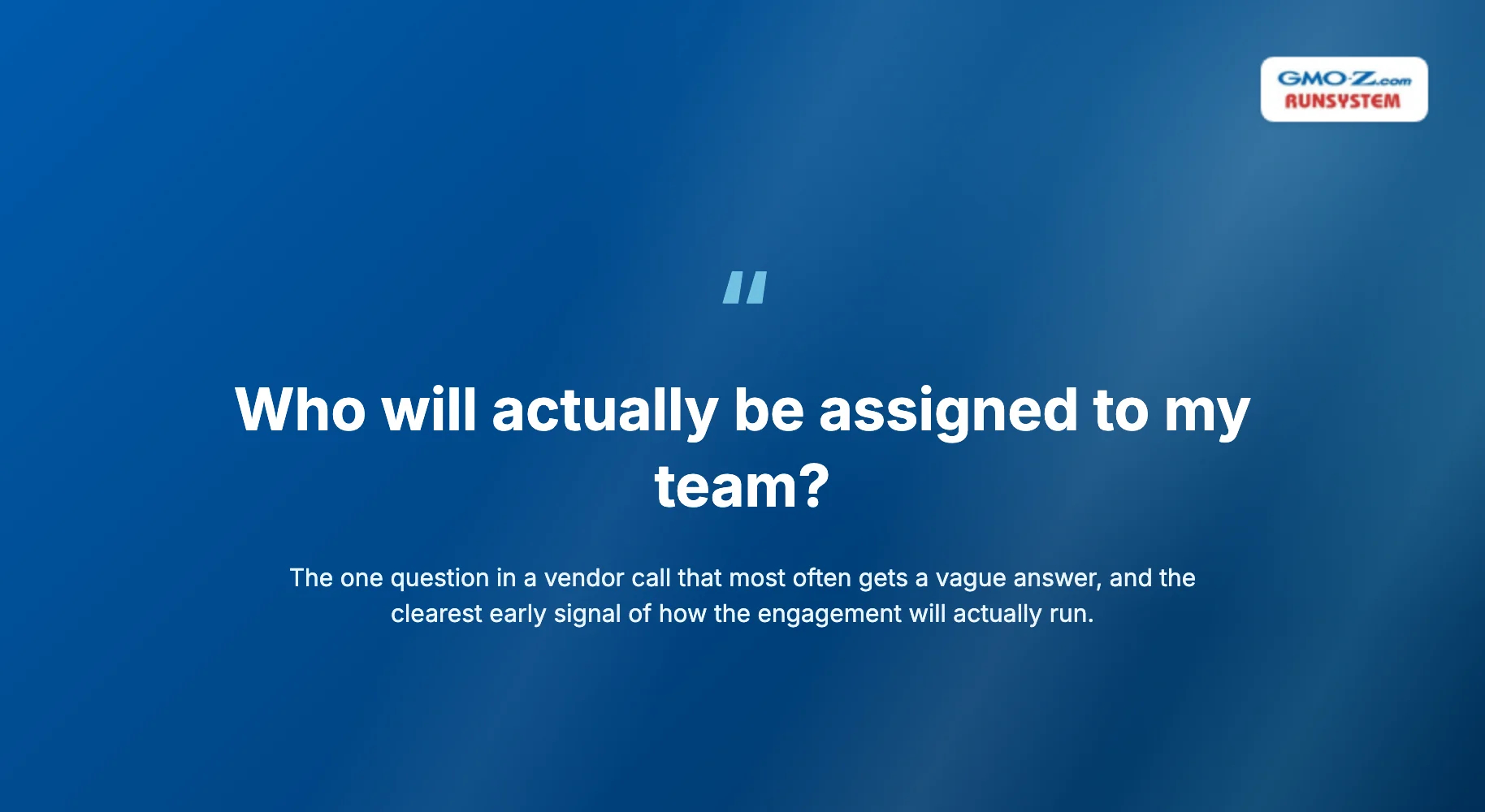
Each question below exists to catch a specific answer vendors like to leave vague. Ask directly, and push for a specific answer instead of a reassurance:
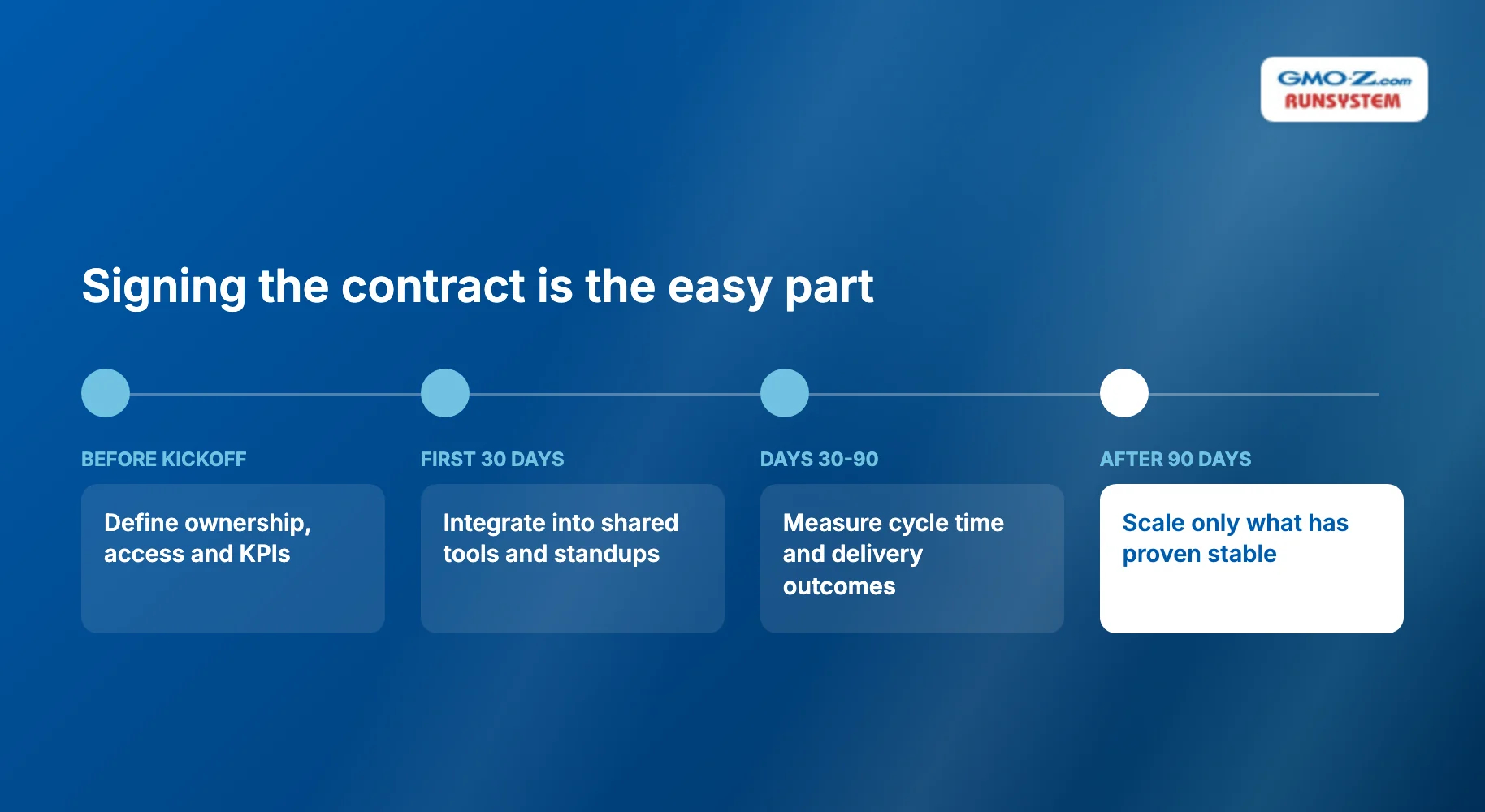
Most guides stop at "choose a provider." But the overlap-hours advantage this article has argued for only pays off if you actually integrate the team. Signing the contract is the easy part.
Every item below is harder to retrofit once the team is already mid-sprint, so define each one before kickoff, not after:
Bring the nearshore engineers into the same tools and rituals your internal team already uses, not a parallel set built just for them:
Don't create an outsourcing island that only interacts with your team through a project manager. That structure quietly recreates offshore's communication lag, even when the team sits in an overlapping time zone.
Baseline cycle time, defect rate, delivery predictability, release frequency, and support SLA during this window. These numbers become your reference point for whether the engagement is actually working, not just whether it feels fine.
Only add more people once the operating model has proven stable across that first 90-day window. Don't scale dysfunction: adding headcount to a team with unclear ownership or a broken review process just produces the same problems faster and at higher cost.
Back to top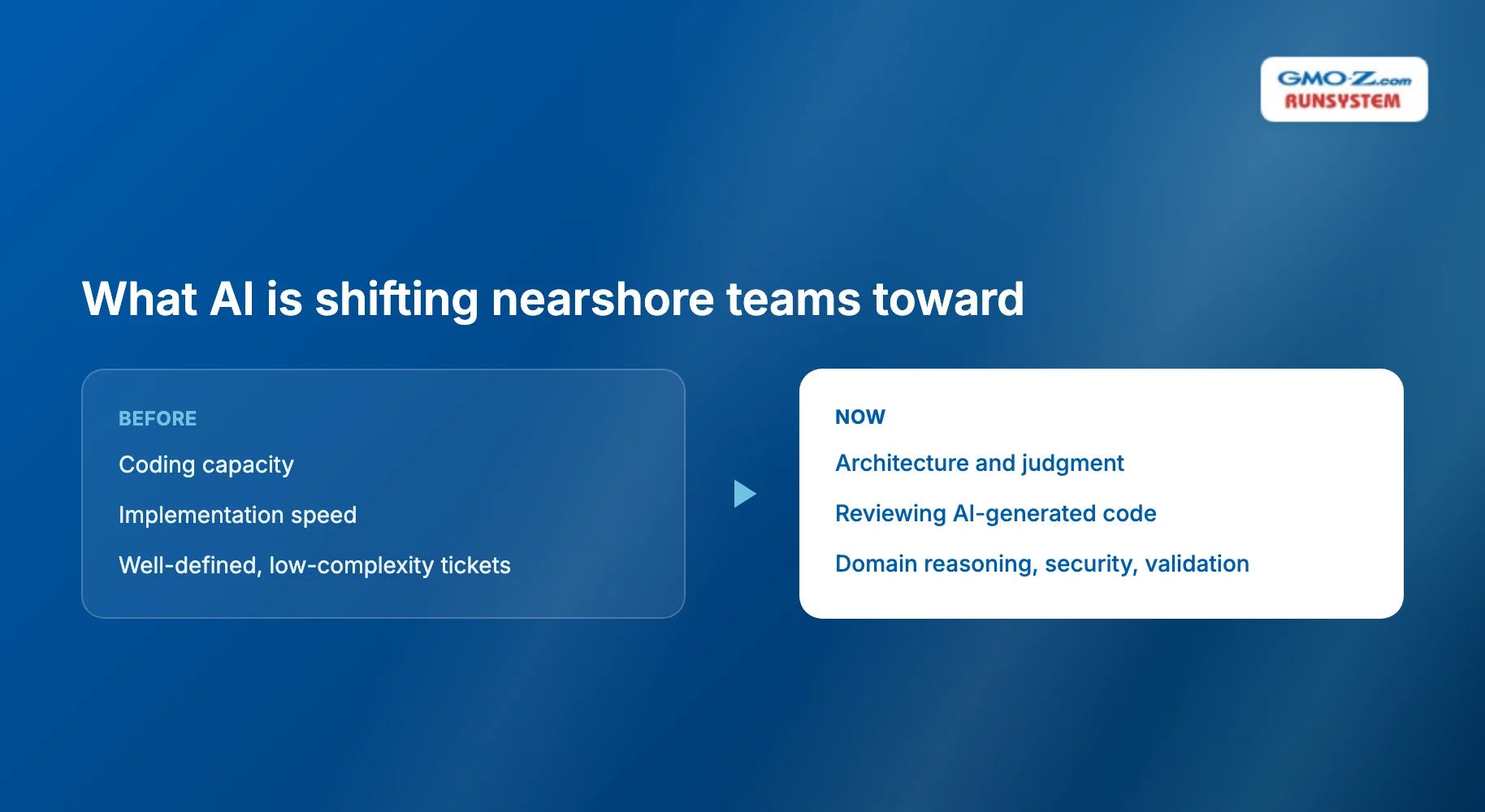
AI coding assistants are reducing the value of simple coding capacity while making architecture, review, and judgment more important. Those are exactly the activities that benefit most from real-time collaboration, which is nearshore's core advantage.
Low-complexity, well-defined tickets are increasingly produced by AI coding agents rather than billed as hours of junior developer time. That shift changes what you're actually paying a nearshore team for.
Nearshore teams now need to be strong at architecture, reviewing AI-generated code, domain reasoning, security, validation, and product decisions, not just implementation speed. These are exactly the activities where a live, overlapping conversation beats an asynchronous handoff.
Ask which coding assistants the vendor's engineers are allowed to use, and whether proprietary code can be sent to external models. Also ask how AI-generated code gets reviewed before merge and what testing and security controls apply to it. A vendor without clear answers here is exposing your codebase to risk it hasn't fully mapped either.
Back to topChoose nearshore if your work requires frequent live collaboration and you have a talent or capacity gap. It also fits if you're under pressure to cut cost without giving up overlap hours, or if your requirements change often enough that async handoffs would slow you down.
Consider offshore instead if the work is highly standardized and your documentation is strong enough to remove ambiguity. It also fits when real-time communication isn't critical and the lowest possible rate matters more than delivery speed.
Consider onshore if regulatory or data-residency requirements demand physical presence in a specific jurisdiction. It also fits when your collaboration sensitivity is high enough that even a nearshore overlap window isn't sufficient.
A simple decision tree captures the logic:
Does the work require frequent live collaboration? If yes: is domestic hiring too slow or too expensive to meet your timeline? If yes to both: nearshore is likely a strong fit.
Most of that due-diligence checklist is hard to run against your current vendor after the fact, once code ownership, documentation, and review process are already unclear. If any of it feels shaky when you ask, that gap tends to surface later as a missed deadline, not now.
RunSystem's delivery teams are built to hold up under that same scrutiny across multiple time zones. Scope and pricing are set per engagement, so contact RunSystem to walk through your specific requirements rather than comparing against a generic rate card.
Back to topUsually not on hourly rate. Nearshore developers typically cost $4,000-$7,000 per month versus $3,500-$5,500 for offshore. On total delivery cost, nearshore is often cheaper once you factor in less rework, fewer delays, and lower management overhead from real-time collaboration.
Common functions include full-stack and mobile development, cloud infrastructure and DevOps, QA and test automation, data engineering, cybersecurity, and dedicated product teams. Highly regulated or safety-critical systems sometimes stay onshore depending on jurisdiction.
Mexico, Colombia, Costa Rica, and Argentina are the most common nearshore locations for US companies, each offering 4 to 6 hours of working-day overlap. The best choice depends on the specific talent, budget, and compliance needs of your project, not a single "best" country.
Security depends on the specific vendor's controls, not the model itself. Verify IP assignment terms, access controls, data storage location, and certifications like SOC 2 or ISO/IEC 27001 before signing, regardless of whether the vendor is nearshore, offshore, or onshore.
Back to top