Family site
Family site
Family site



An offshore development center is a dedicated team of engineers in another country, employed and paid by a vendor, working exclusively on your backlog for years, not months. The number that decides whether it works isn't the hourly rate on the quote; it's whether that team still exists six quarters from now.
Of 29 vendor pages we reviewed, only three calculate ODC savings total cost to total cost, and stated setup timelines range from three days to three years. This article closes that gap: real cost, real setup time, and the questions that expose whether your team stays intact.
Back to topAn offshore development center (ODC) is a team of engineers based in another country who work exclusively for one client, long-term, under a vendor's legal entity. The vendor recruits, employs, and pays the team; you direct the backlog and run delivery as if the team sat down the hall.
The word that does the real work in that definition is dedicated: the same engineers stay on your account across quarters, not whichever ones a vendor happens to have available this sprint. A team reassigned to another client between projects is not an ODC, whatever the contract calls it.
Buyers conflate three different commercial models, then only notice they signed the wrong one when the team changes mid-engagement.
The distinction matters at the exact moment a project ends: in a real ODC, the team stays and picks up the next initiative; in the other two models, it disperses and continuity resets to zero.
Four commercial structures get sold under the "ODC" label, differing on who employs the team, who owns the entity, and what it costs to exit.
Model | Who employs & pays | What you own | Upfront capital | Time to first hire | Exit cost |
Vendor-managed dedicated team | Vendor | Nothing (no entity) | Minimal | Fastest | Low, per contract terms |
Captive center | You (via your new local entity) | The legal entity itself | High | Slowest | High (entity wind-down) |
Employer of Record (EOR) | Third-party EOR entity | Nothing (no entity yet) | Low | Fast | Moderate |
Build-operate-transfer (BOT) | Vendor, then you | The entity, after transfer | Moderate, rising at transfer | Fast | Depends on transfer terms |
A vendor-managed dedicated team puts the vendor's legal entity, payroll, and compliance behind your team: minimal capital, fastest to staff, but you never own the entity. A captive center is the opposite trade: you incorporate and hire directly, gaining the most control and exposure.
An Employer of Record lets you hire through a third party's local entity without incorporating; a build-operate-transfer arrangement has the vendor run the center first, then hand you the entity later (our BOT guide covers the mechanics).
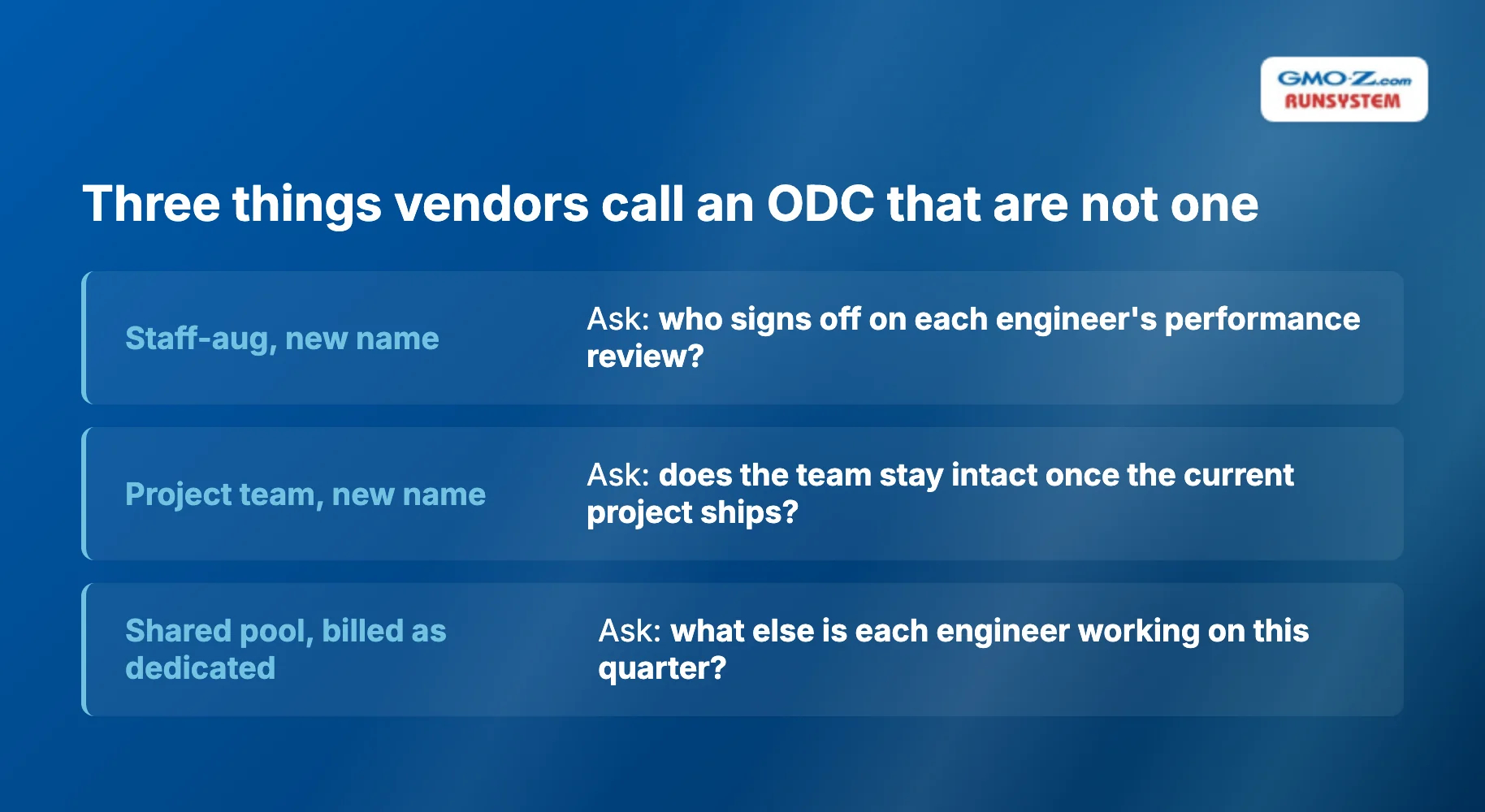
Some vendors relabel an existing arrangement as an "ODC" without changing anything structural. Three patterns show up often enough to name, each with a question that exposes it in the first sales call:
An offshore development center runs your backlog through a fixed team structure: developers and testers execute, QA verifies, and a project manager (PM) keeps the schedule. For clients delivering into Japan, that structure typically adds a bridge systems engineer (BrSE) and a Comtor (a dedicated technical interpreter), both salaried, permanent roles rather than a service add-on most Western vendors staff at all.
GMO-Z.com RUNSYSTEM's cashless payment delivery team in Japan illustrates this at scale: more than 20 people split across PM, sub-PM, developers, testers, QA, and a Comtor. Ask your vendor to itemize these roles' costs rather than fold them into a single "team rate."
You hand a prioritized backlog to the BrSE or PM, they translate it into implementation-ready tasks, and the team builds against those tasks, with progress reported on a cadence you agree on upfront.
SAPO, an e-commerce platform client, requires daily status reports, a cadence it settled on after running enough of its own technology projects to know where delays tend to hide. That rhythm is a contract term, not a courtesy, worth specifying in writing before the team starts.
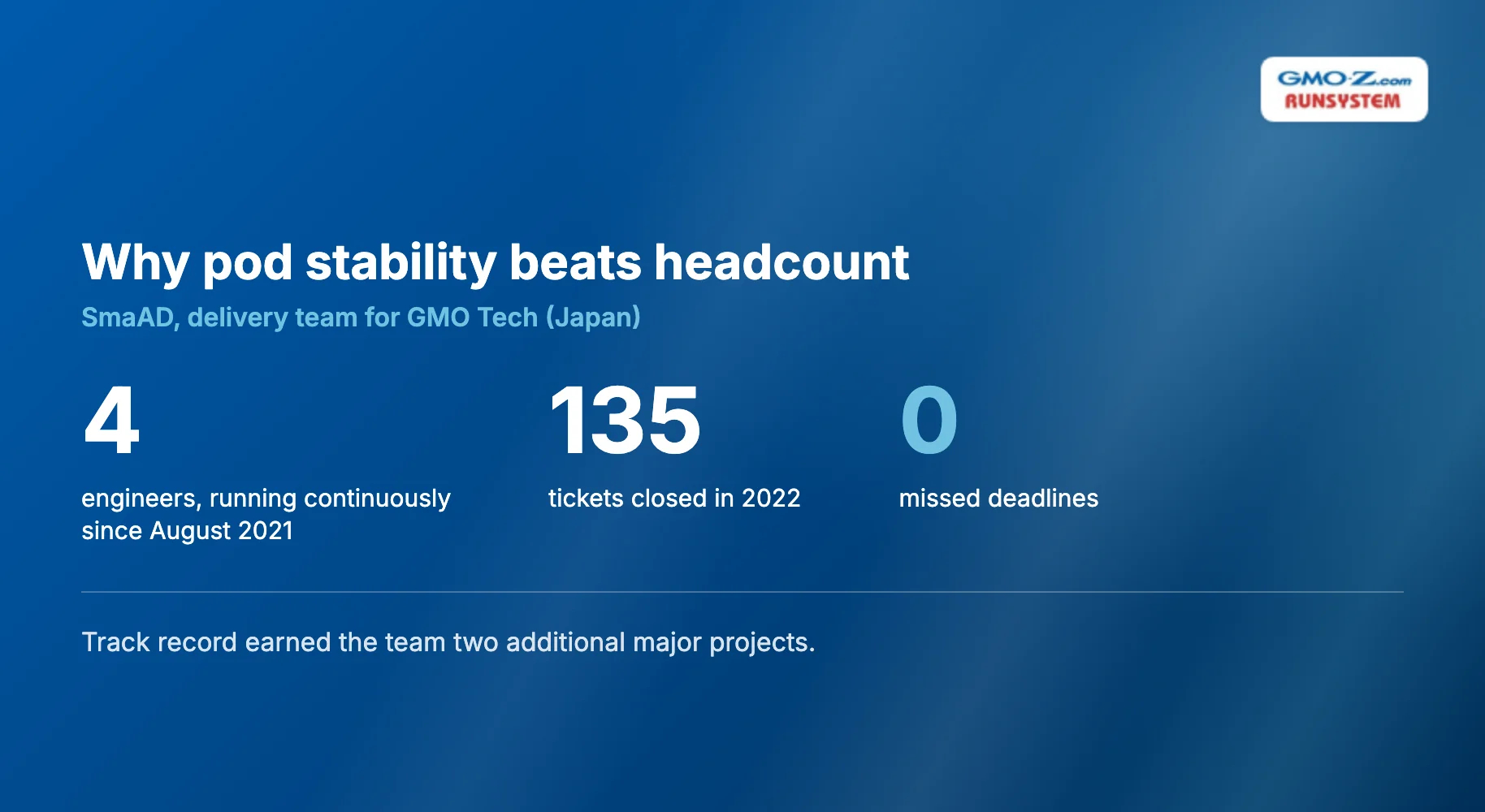
The number that actually predicts whether an ODC delivers isn't how many engineers a vendor has on staff. It's how long the specific pod, the small group of engineers actually assigned to your account, has worked together.
A stable pod compounds context (your codebase, your past decisions, your failure modes) in a way a rotating one never does.
SmaAD, a delivery team for GMO Tech, a Japanese digital-advertising company, ran continuously from August 2021 with exactly four engineers. It closed 135 tickets in 2022 with no missed deadlines, including catching a MySQL upgrade regression before it reached production, and was then handed two additional major projects on the strength of that track record.
Ask your vendor how long the specific people on your proposed pod have worked together, not how many engineers the company employs overall. Tenure on the pod predicts outcomes; total headcount is a vanity metric.
That's why GMO-Z.com RUNSYSTEM's Offshore Delivery Center service is built around keeping a pod intact across engagements rather than reassembling one per statement of work.
Back to top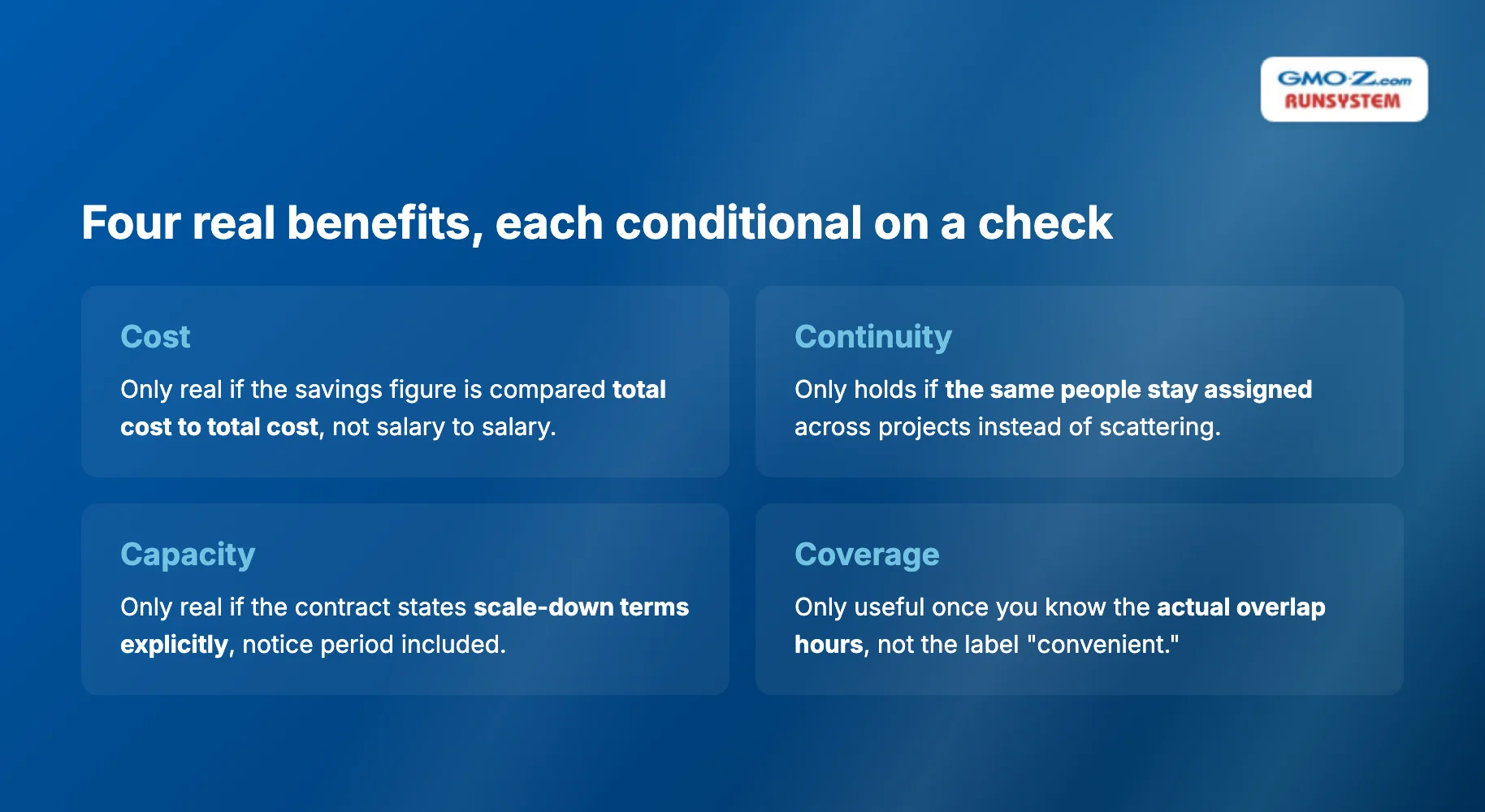
An offshore development center's real benefits (cost, continuity, capacity, coverage) only hold when you verify the condition behind each one. Unverified, all four are marketing claims, not outcomes.
The number to check isn't the savings percentage itself, it's what that percentage compares. Of 29 vendor pages advertising an ODC savings figure, only 3 explained whether the comparison was total cost to total cost or salary to salary.
Without that basis stated, a savings claim can't be used to compare vendors.
Every time a project team disbands, its accumulated knowledge leaves with it: why a system was built a certain way, where its fragile points are, what was already tried and rejected. An ODC prevents that reset since the same people stay assigned across projects.
Vendors report meaningfully lower attrition on dedicated teams, though that figure is self-reported and unverified; SmaAD's multi-year run without a missed deadline is the kind of team-specific evidence worth asking for instead.
An ODC lets you add or reduce engineers as demand shifts, skipping your own hiring process and layoff costs. That flexibility is only real if your contract states scale-down terms explicitly, notice period included; otherwise, "we can scale down anytime" is a sales promise, not a right.
Don't settle for a vendor telling you the time zone is "convenient." Ask for the actual number of overlapping working hours with your core hours. More overlap isn't automatically better: synchronous stand-ups need real-time overlap, while asynchronous, ticket-based work can operate with almost none.
Back to topVendor pages advertise offshore development center savings anywhere from 20% to 75% off an equivalent onshore team, close to meaningless until you know what it's measured against. Of the 29 vendor pages we reviewed, twenty state a percentage, fifteen say what it's compared against, and only three calculate the as total cost to total cost.
Strip out the unsupported claims, and the range narrows to roughly 20% to 60%, the defensible range this article uses from here on.
RunSystem's own site is in that sample, and it doesn't meet the three-page bar either, the most credible admission in this section, since the same audit method applies to us as to any competitor.
A defensible monthly cost per engineer breaks into line items most quoted rates never separate out:
Cost line item | Paid once or ongoing | Fixed or scales with headcount | Usually in a quote? |
Base salary | Ongoing | Scales | Yes |
Employer-mandated contributions | Ongoing | Scales | Rarely broken out |
Statutory or customary bonus | Ongoing | Scales | Rarely |
Training, amortized | Ongoing | Scales | Rarely |
Workstation, tooling, security software | Ongoing | Scales | Sometimes |
Bench reserve (idle time, attrition backfill) | Ongoing | Scales | Rarely |
PM, BrSE, Comtor, QA allocation | Ongoing | Scales | Sometimes |
Vendor margin | Ongoing | Scales | Never itemized |
Two countries' hourly rates aren't directly comparable: employer-mandated contributions alone vary by more than 16x across popular offshore destinations, and no rate card in the 29-page sample states whether its quoted number already includes that line.
Most "up to 60% savings" claims compare a low-cost country's salary against a Western salary, not total cost to total cost, a smaller gap than advertised since it excludes overhead and margin on both sides. A defensible savings figure states its source, such as the Accelerance 2026 rate report.
Back to topPublished ODC setup timelines look contradictory because they measure different milestones, not because the industry disagrees on how long setup takes. Ten of the 29 vendor pages in our sample state a timeframe, and the figures span 3 days to 3 years, because each number answers a different question, as the table below shows.
Milestone | Typical duration | What slows it down | What you need to prepare |
Contract signed | Baseline (day 0) | Legal review, procurement cycles | Scoped requirements, budget approval |
First engineer starts | 3 to 5 days to a few weeks | Role specificity, security clearance needs | Finalized role profiles |
Full pod staffed | 4 to 8 weeks | Niche skill combinations, seniority mix | Complete team structure sign-off |
First code ships to production | 6 to 8 weeks past staffing | Environment access, unclear specs | Access provisioning, a real spec |
Team runs at stable velocity | 3 to 6 months | Domain ramp-up, process friction | Patience through the ramp period |
Scaling the team begins | 18+ months | Proven track record, budget cycle | A documented delivery history |
Staffed does not mean stable. Those two milestones sit months apart, and most disputes between clients and vendors happen in that gap, when the team is technically in place but hasn't yet absorbed enough of your domain to move at full speed.
GMO-Z.com RUNSYSTEM's published delivery timelines land inside those ranges: ABBank, a Vietnamese commercial bank, delivered phase-one CRM (including Temenos T24 integration, a core banking platform) in close to three months.
The timeline variable no vendor page volunteers is how much of it depends on you, not the vendor. VinWonders, an entertainment park chain, needed three weeks of in-person design workshops before any code could start, since it didn't yet have finished imagery for unlaunched products.
That wasn't wasted time; it was the cost of buying certainty before committing engineering hours to specs that would have changed anyway.
Back to top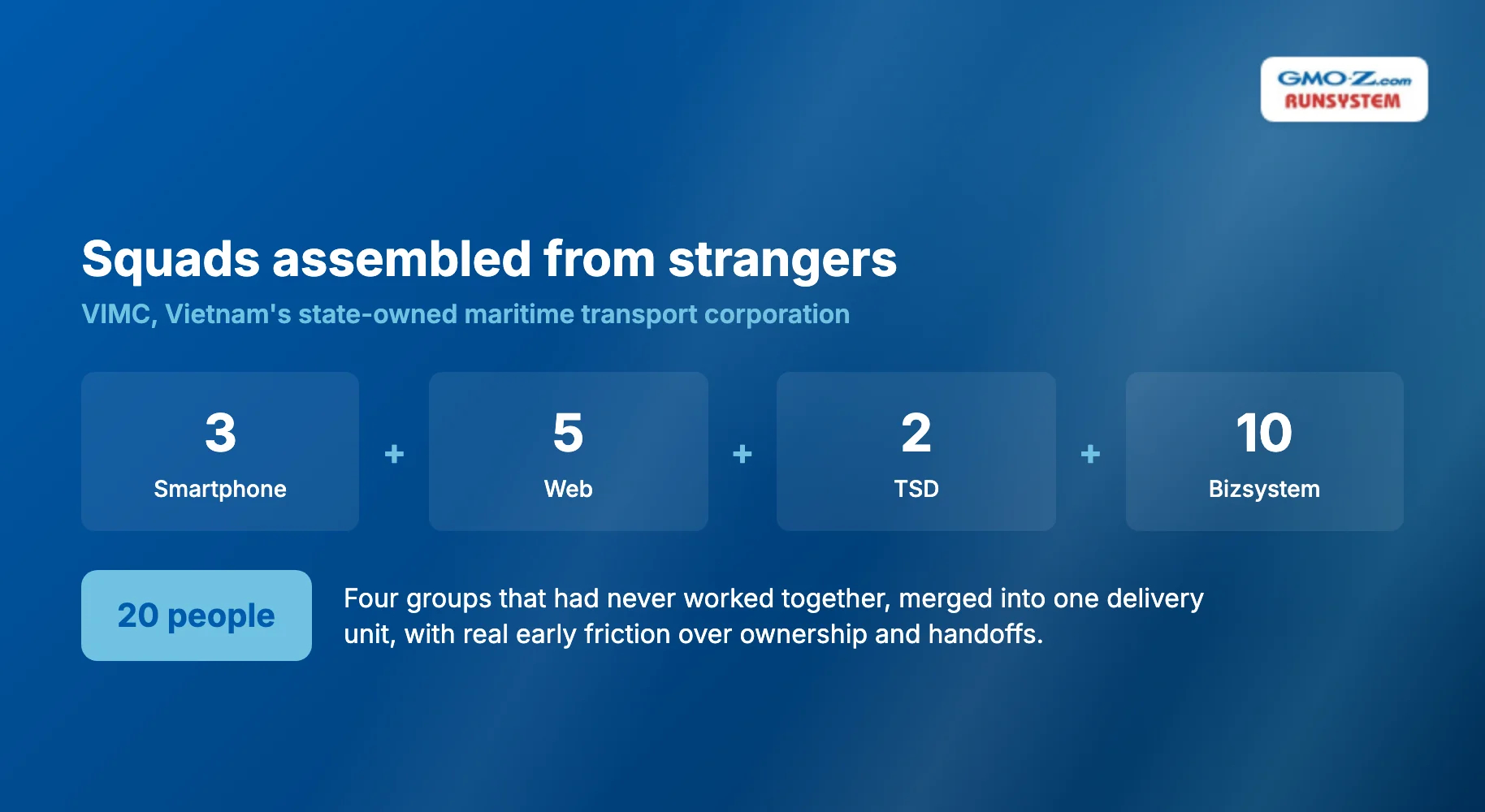
VIMC, Vietnam's state-owned maritime transport corporation, staffed a 20-person team by combining four groups that had never worked together: Smartphone (3), Web (5), TSD (2), and Bizsystem (10). Merging them created early friction over ownership before the team settled into a working rhythm.
The fix is a question you ask before signing, not a process you inspect after: has the proposed pod worked together before, and who is accountable for how it was assembled? One that can't name the person who made the staffing call is telling you the pod was assembled for your deal, not built to last.
A poorly organized offshore engagement burns an extra 15% to 25% of project time re-explaining requirements, versus only 5% to 10% for a well-organized one (self-reported by vendors, so treat it as directional). The BrSE role covered earlier exists to close that gap: catching a misread requirement in a stand-up prevents rework that shows up three sprints later.
Back to topISO/IEC 27001:2022 replaced the 2013 version with a restructured Annex A control set: 114 prior controls consolidated into 93, plus new ones covering cloud security and threat intelligence.
A certificate can still be valid on paper while covering a site that isn't the one staffing your team, so ask which physical locations it covers and when the most recent surveillance audit closed.
If you operate in the EU or UK, cross-border data transfer is governed by GDPR Chapter V regardless of which offshore country you choose, through an adequacy decision, Standard Contractual Clauses, or a documented transfer impact assessment.
Data protection law varies sharply beyond the EU too, and a contract that says "compliant with applicable law" without naming the law is not enforceable in any specific way.
Destination | Law | Effective | Local data residency required |
EU / UK | GDPR | 2018 | No (transfer mechanism required instead) |
India | Digital Personal Data Protection Act | 2023 (phased through 2027) | Case-by-case, government-specified |
Vietnam | Law on Personal Data Protection (PDPL), Law No. 91/2025/QH15 | 2026 (replaced Decree 13/2023) | Yes, for specified data categories |
The contract should name the exact law governing the country where your team sits, not a general reference to "applicable data protection law."
Code ownership depends on that same governing law, and the default assumption that the client owns everything is often wrong without a specific clause: in the US, employee-written code belongs to the employer automatically, but contractor-written code needs a written assignment to transfer, and most civil-law jurisdictions go further still.
GMO-Z.com RUNSYSTEM holds ISO/IEC 27001:2022 certification as of 2025 (covering its Hanoi, Ho Chi Minh City, Da Nang, and Hue sites), plus CMMI Level 3 and ISO 9001 since 2012. It does not hold HIPAA, SOC 2, or PCI DSS certification, though it builds systems that meet GDPR or HIPAA requirements on individual engagements.
Back to topComparing offshore destinations by hourly rate alone is misleading, since each country carries a different employer-mandated cost load that a quoted rate may or may not include. The two tables below need to be read together.
Destination | Hourly rate range | Overlap with US hours | Overlap with Western Europe hours | Talent pool size | Biggest risk |
India | $35-65 | Low | Moderate | Very large | Attrition, oversubscribed vendors |
Vietnam | $30-50 | Low | Low-moderate | Large, growing fast | Language/communication gap without BrSE-style roles |
Philippines | Regional range | Low | Low | Large | Narrower engineering depth vs. business-process-outsourcing (BPO) depth |
Poland | $50-90 | Moderate | High | Moderate | Rising rates vs. peers |
Romania | Regional range | Moderate | High | Moderate | Smaller total pool |
Latin America | $33-75 | High | Low-moderate | Growing | Rate convergence with Eastern Europe |
The second table is the one almost no competitor publishes: employer-mandated contributions by country.
The gap between the lowest and highest country here is more than 16x, and none of the 29 vendor pages in our cost-audit sample state whether its published hourly rate already includes this line. The country with the lowest hourly rate is not necessarily the country with the lowest total cost.
Talent depth is the other variable worth checking against rate: it determines whether a vendor can actually staff a stable pod at the seniority level you need. Vietnam, for instance, has an estimated 530,000 to 600,000 developers, with 50,000 to 60,000 new graduates added yearly, per the Vietnamese IT industry association.
Choose on overlap hours and talent depth, not which country's rate card looks lowest this quarter.
Back to top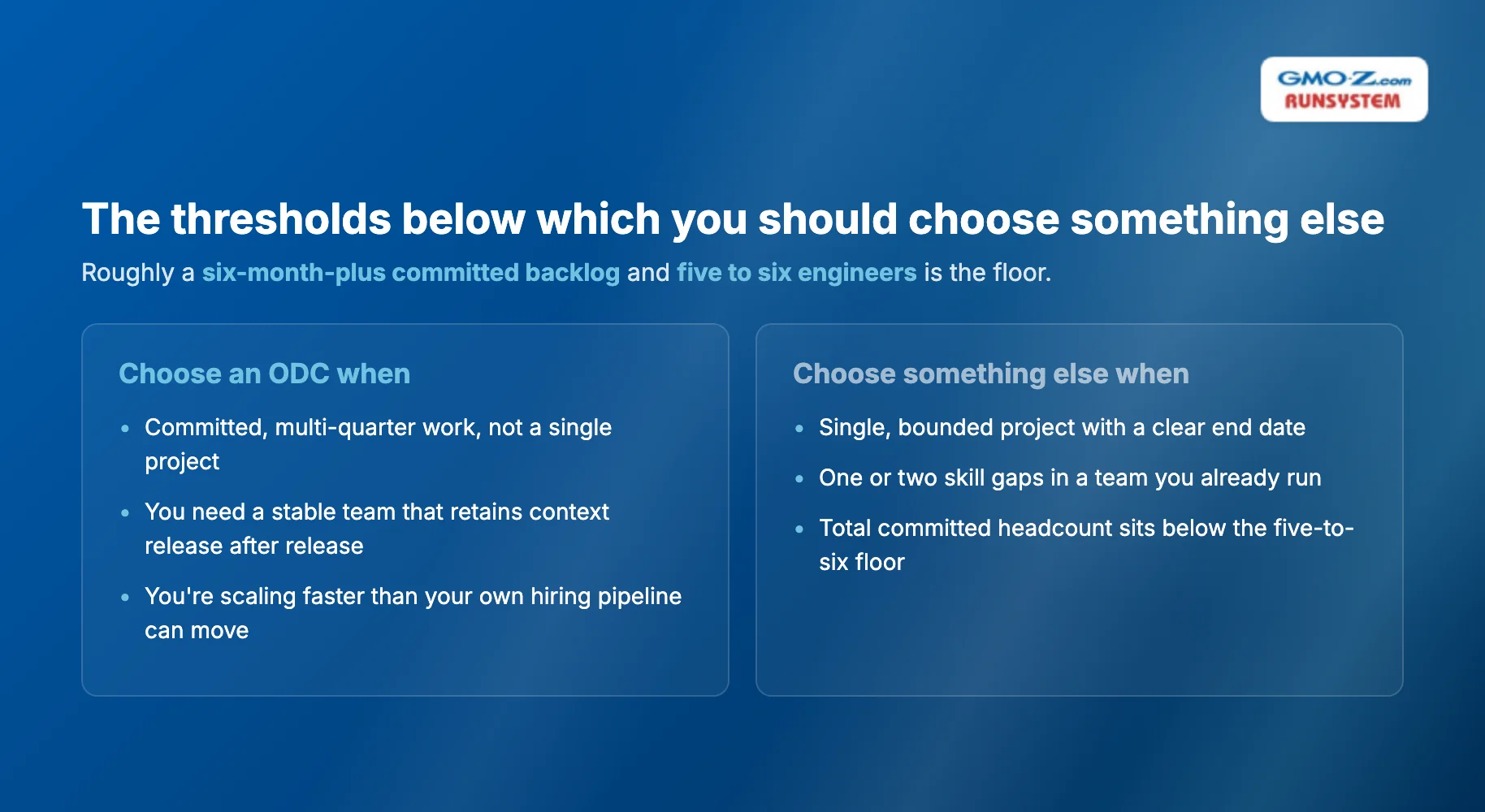
An offshore development center makes sense above a specific, checkable threshold, not "when it feels right": roughly a committed six-month-plus backlog and a team of at least five to six engineers.
Below it, a dedicated pod's fixed overhead (PM, QA, onboarding) doesn't amortize, and a lighter model serves you better: an offshore development company for a single bounded project, or staff augmentation for one or two skill gaps in a team you already run.
Only 1 of the 29 vendor pages in our sample tells buyers where the ODC model stops making sense, exactly why this section exists: a vendor with no incentive to turn away a bad-fit deal isn't going to volunteer this.
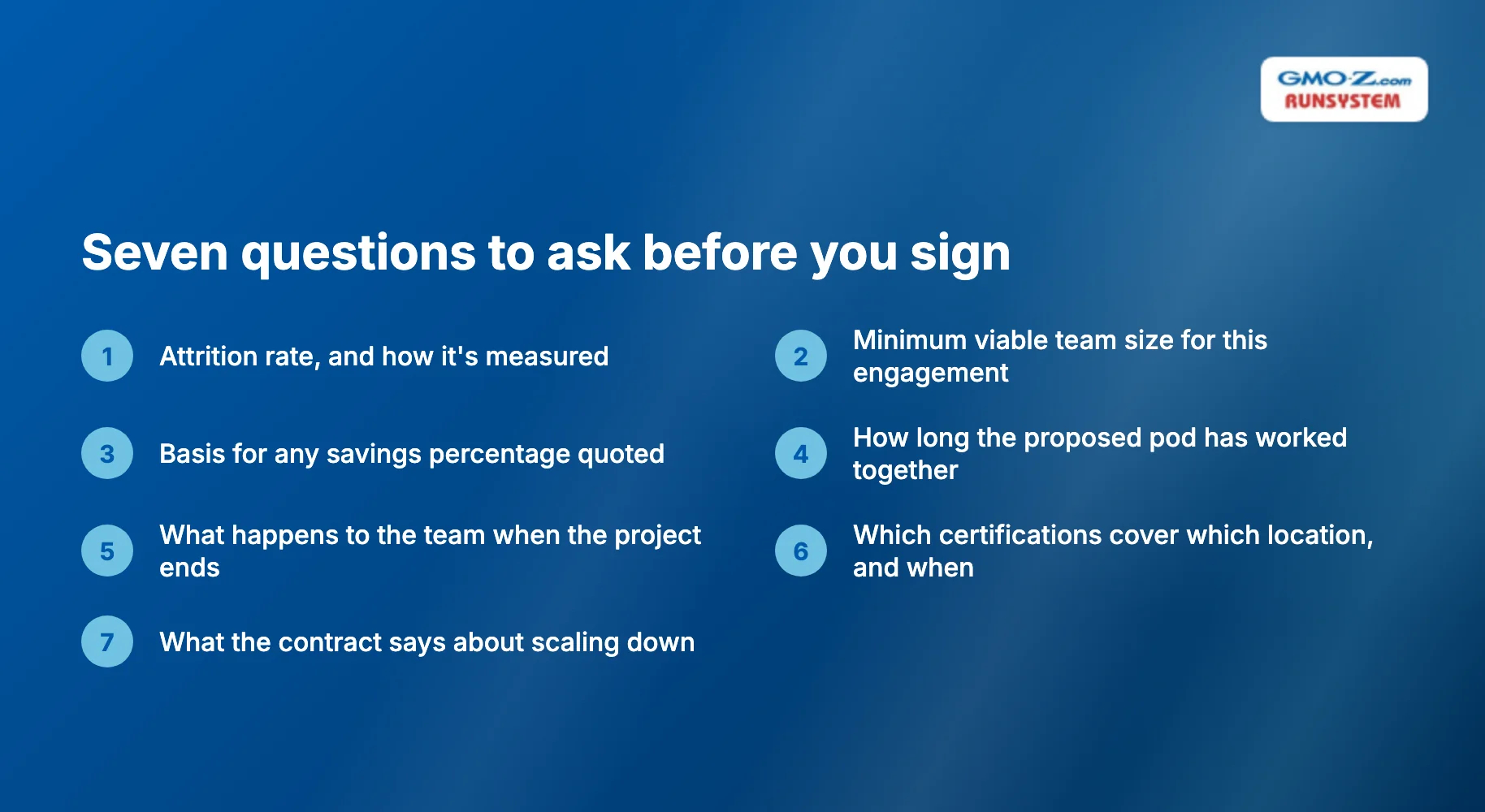
Ask these seven questions before you sign; each asks for a number most vendor pages, per our review, never publish voluntarily.
On these seven, GMO-Z.com RUNSYSTEM answers most directly, backed by the named engagements and certification scope covered earlier. It doesn't yet have a public, independently verified attrition figure by pod, a real gap worth naming rather than glossing over.
A vendor willing to say where its answer is incomplete is more useful than one that claims a clean answer to every question.
Back to topChoosing an offshore development center is a decision about which team you're committing to keep together, not which vendor quotes the lowest rate: staffed and stable are different milestones; a savings percentage with no stated basis isn't usable for comparison; and a team below five to six engineers rarely justifies a dedicated pod's overhead.
Before your next vendor call, bring three numbers of your own: the committed work volume, the headcount you actually need, and the overlap hours your process requires.
Bring those to a conversation with GMO-Z.com RUNSYSTEM's delivery team instead of a request for a price sheet, and ask how it would staff and hold a stable pod against them.
Back to topRoughly 20% to 60% below an equivalent onshore hire, but only when comparing total cost to total cost, including employer-mandated contributions that vary by more than 16x by country. Ask your vendor to itemize the comparison.
Full staffing typically takes 4 to 8 weeks; running at stable velocity takes another 3 to 6 months after that. Most disputes happen in the gap between "staffed" and "stable."
It depends on the governing law, the transfer moment, and the contract's scope, not a blanket "client owns everything" clause. In the US, contractor-written code needs a written assignment to transfer.
Back to top