Family site
Family site
Family site



Building a software team in another country used to mean two blunt choices: outsource the work or open your own legal entity. Build-operate-transfer (BOT) sits between them, and the market has quietly renamed it. Legal advisors, including Morgan Lewis now frame it differently. They list it as one of the models companies use to stand up a Global Capability Center (GCC). That's the term that has replaced "captive offshore unit" in enterprise sourcing conversations since 2024. That reframing changes what you should be negotiating for: not a smoother handover, but a cleaner acquisition.
This article covers what a BOT deal actually transfers and why public timeline estimates can differ by as much as 24x. It also covers what BOT really costs and the team-size threshold below which it stops paying for itself.
Back to top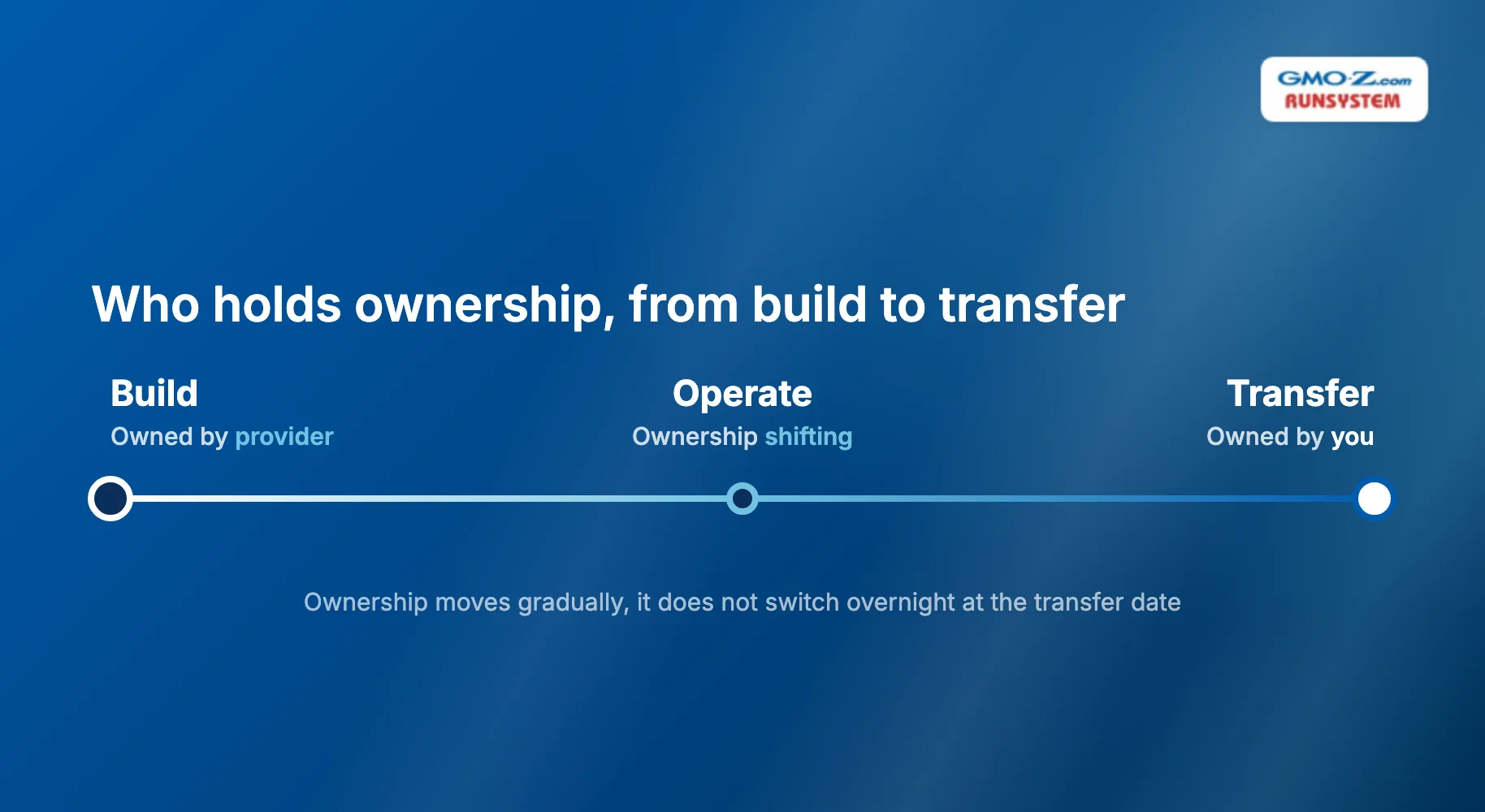
A build-operate-transfer arrangement is a contract in which a provider hires people, builds infrastructure, and runs a technical team in another country on your behalf. At an agreed point, the provider transfers the whole operation to you, and you end up owning what was, until then, someone else's operation. BOT is a staged acquisition paid for in installments, not a richer outsourcing package.
Every top-ranking page on this keyword defines BOT through its three phases: build, operate, and transfer. This article does the same to match how people search. What most of them skip is what "transfer" actually hands you, covered below.
The term to know alongside BOT is Global Capability Center (GCC). Morgan Lewis and Torry Harris now frame nearly all BOT content around GCC rather than treating BOT as a standalone concept. A company setting up a GCC abroad increasingly treats BOT as one of the most practical ways to start. If your organization is researching offshore delivery models, BOT, and GCC aren't separate searches anymore. They're the same conversation from two different entry points.
The same three letters describe two different deals. In infrastructure and public-private partnerships, BOT transfers a physical asset (a toll road, a power plant) and the right to operate it. In software and IT services, BOT transfers a company and a team instead: people, contracts, and intellectual property. This piece covers the software and IT delivery version only.
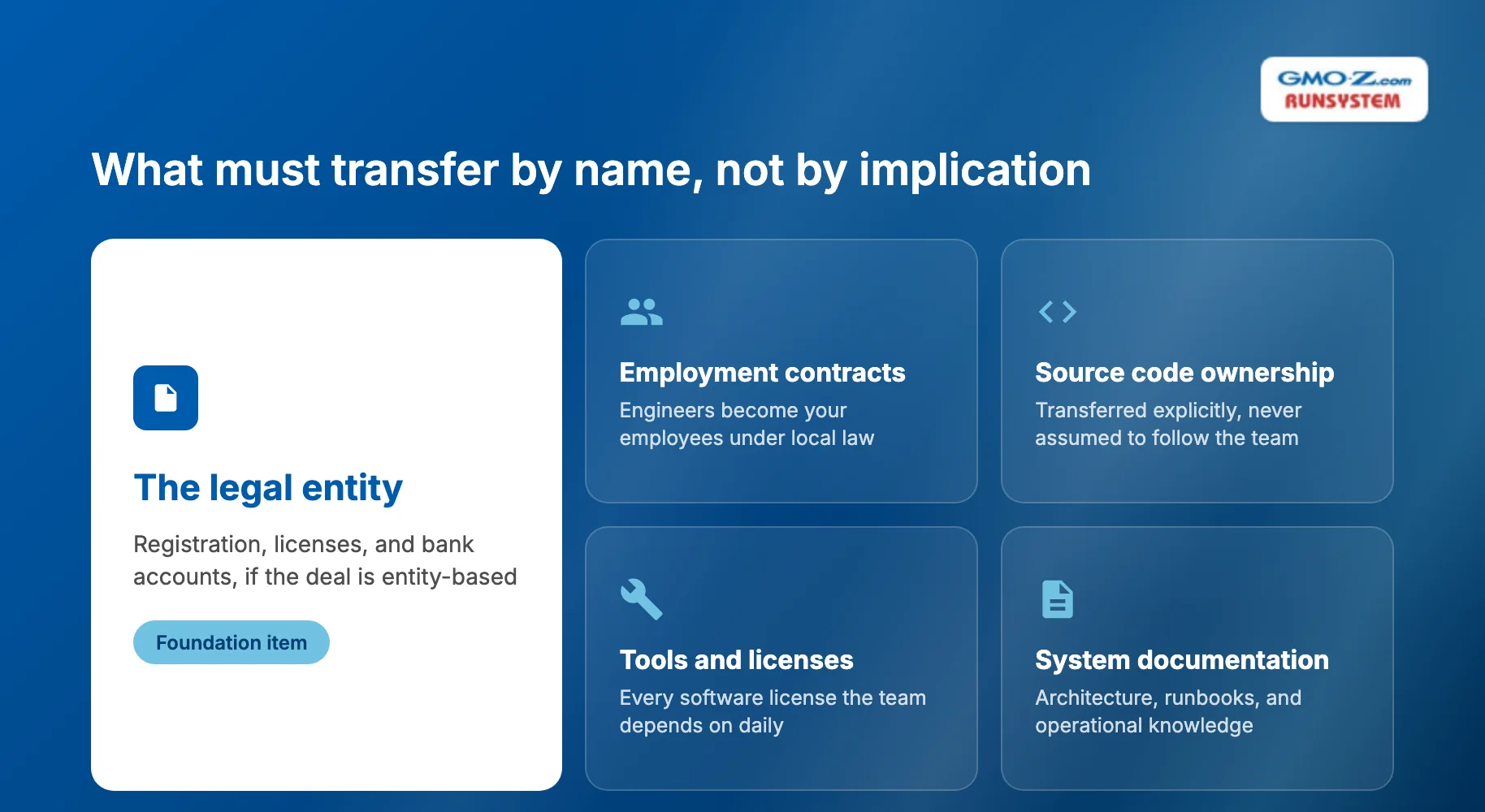
BOT deals structure the transfer in three ways. Asset-based means you buy the equipment and IP, but the provider's local entity keeps existing. Entity-based means the provider sets up a legal entity that becomes yours. Joint venture means you and the provider co-own the entity for a period before full transfer. Which structure a contract uses changes what "transfer" legally means, so confirm it before signing.
Whatever the structure, five things need to change hands by name:
Every one of the top five ranking pages on this keyword describes the transfer phase in general terms without listing what specifically changes hands. Contracts that just say "the team transfers" without naming these five items are where disputes start. Those disputes usually surface months later, when someone asks who owns a repository or a support contract.
Back to topPublic timelines for BOT disagree sharply. No top-ranking page explains why before quoting a number. The table below lines up estimates from the three sources with the most specific figures:
Phase | Saigon Technology | ttpsc | Coderslink | Spread |
Build | 6-8 weeks | 1-3 months | 3-6 months | ~4x |
Operate | 2-6 months to stabilize, 6-24 months to prepare transfer | 2+ years | 18-48 months | ~24x |
Transfer | 4-12 weeks | 3-6 months | 1-6 months | ~6x |
Two of the five top-ranking pages give no timeline figures at all. Where the three above cite ranges, the gap between the low and high end runs from four times (Build) to twenty-four times (Operate).
That spread isn't inconsistent data. It's inconsistent measurement. Each source starts and stops the clock at a different milestone. Some measure the build from signed contract to first hire, others to a fully staffed team. Some measures operate until the team is functionally stable. Others measure it until it's contractually ready for transfer, a much later and fuzzier bar.
ttpsc adds a detail none of the others quantify. Build duration depends heavily on team size: around one month for a team under five people, two to three months for a team over fifty. Team size, not process maturity, is the real driver behind the build-phase spread. It's also the one variable you can plan around.
Duration alone doesn't tell you what to check for. The table below sets out what happens in each phase:
Phase | What happens | Completion milestone | Typical duration | Who owns what after | What slows it down? |
Build | Design the operating model, hire and onboard the first team, and set up infrastructure and security | The team is staffed and delivering against a defined scope | 6 weeks to 6 months (see spread above) | The provider owns the entity and employment contracts. | Team size, local hiring market, infrastructure complexity |
Operate | Stabilize delivery, transfer knowledge gradually, and build a local management layer | The team meets agreed delivery and readiness criteria for transfer. | 2 months to 2+ years (see spread above) | The provider still owns the entity; you own the roadmap. | Whether a local manager was hired early or only at transfer time |
Transfer | Move the entity, employment contracts, assets, and documentation. | All five transfer items (above) are legally reassigned. | 4 weeks to 6 months (see spread above) | You own the entity, contracts, and IP. | Certification scope, contract renegotiation, disputed asset ownership |
Build means designing how the team will operate, hiring and onboarding the first cohort, setting up infrastructure, and setting security baselines. It's not just posting job listings. GMO-Z.com RUNSYSTEM has run this exact build-and-operate cycle four times. New delivery centers opened in Tokyo (2007), Ho Chi Minh City (2008), Da Nang (2012), and Hue (2023). Each one followed the same sequence: legal setup, hiring, infrastructure, and security certification, all completed before the center took on delivery work. That sequence is a useful reference point for what "build" actually includes beyond recruiting.
Operate is where delivery stabilizes, knowledge transfers gradually, and a local management layer gets built that will take over after transfer. That last part matters most. The common mistake is treating this phase purely as a delivery period. Companies only start looking for that local manager once the transfer is already on the calendar. By then, you're hiring a manager into a team that's used to reporting to someone else. Adoption slows, and the odds the manager doesn't stick go up.
Operate is also where the 24x timeline spread shows up. Some vendors measure it from the point the team is functionally running. Others measure it to the point it's contractually ready to transfer. That readiness bar requires a stable local manager, documented processes, and often a specific retention track record. Ask any vendor which milestone they mean before comparing quotes.
Transfer moves the entity, employment contracts, assets, and documentation to you. Duration runs 4 to 12 weeks according to the lowest estimate, but 3 to 6 months according to the highest.
Before transfer completes, the contract should define exact readiness conditions: documented processes, a functioning local manager, and a retention track record. It should also define what happens if the team hasn't met them by the target date. Does the operation phase extend? Who pays for that extension?
Back to top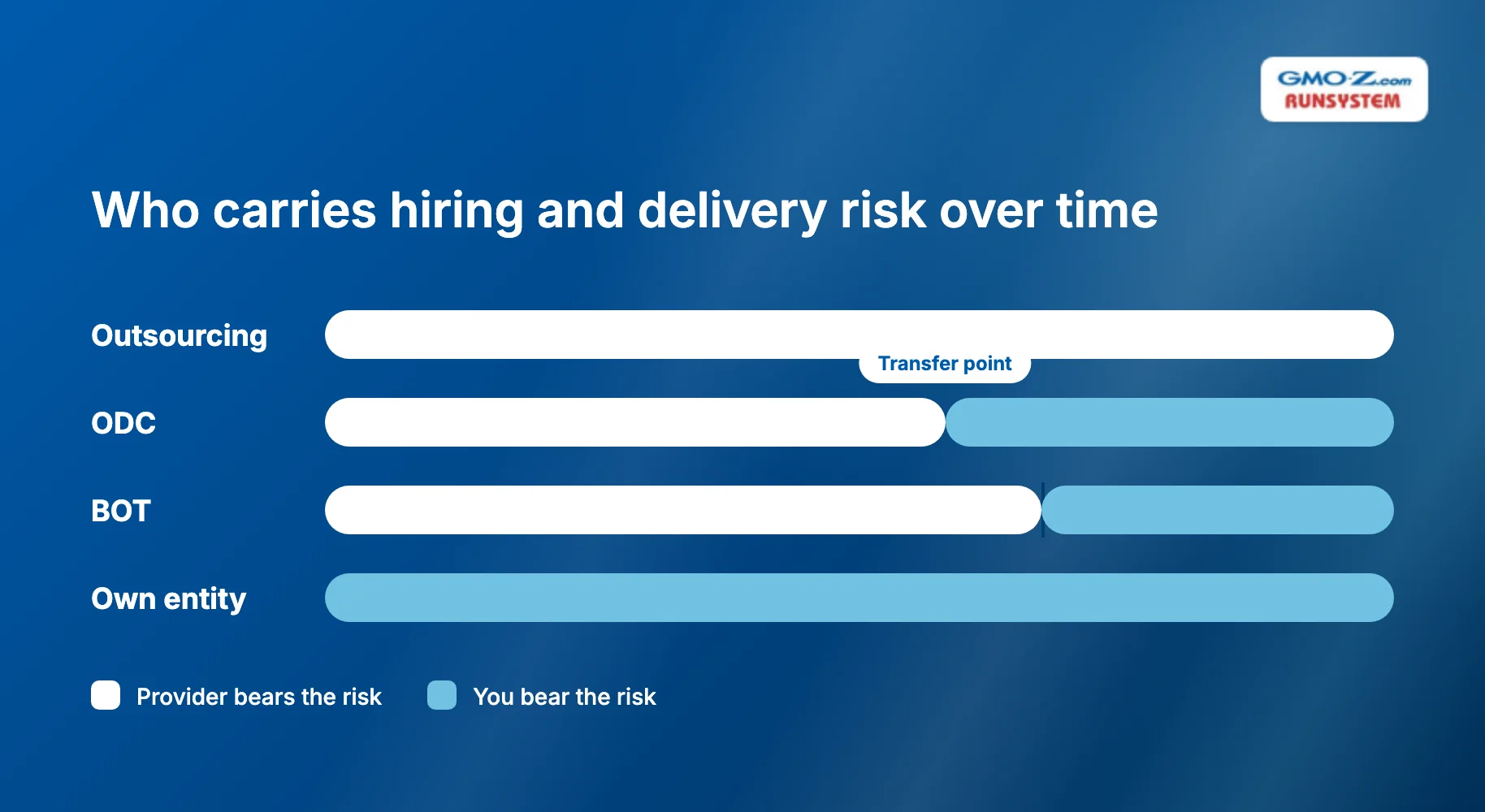
You're choosing between outsourcing, an offshore delivery center (ODC), BOT, and setting up your own entity. Really, you're choosing between four risk allocations, not four service tiers. Four of the five top-ranking pages compare them by feature instead ("more flexible," "more control"). That doesn't tell you when to pick which. Compare them by threshold and exit cost instead:
Option | Upfront cost | Time to first hire | Who bears hiring risk | Who bears delivery risk | Cost to exit | When it wins |
Project-based outsourcing | Low | Days to weeks | Provider | Provider | Low, cancel the contract | Short, well-defined scope |
Offshore delivery center (ODC) | Low to moderate | Weeks | Provider | Shared | Low to moderate | Ongoing work, no need to own the entity |
Build-operatee-transfer | Moderate to high | Weeks | Provider, until transfer | Shared, then yours | High after transfer, low before | You want ownership but not year-one hiring risk |
Own legal entity | High | Months | You | You | High, entity wind-down | Long-term core capability, full control needed |
BOT gives you your own company and team without carrying the hiring risk and legal risk of year one. That claim holds only with a clear cancellation clause for the transfer itself. Skip that clause, and the risk doesn't disappear. It just gets deferred to the transfer date.
You get people working within weeks instead of waiting months for entity registration. That's true only where the provider already has an established entity and recruiting pipeline. In a new market, BOT takes just as long to start as building your own operation would. What's different from standard outsourcing is that people are recruited against your criteria from day one, specifically so the team is transferable later. GMO-Z.com RUNSYSTEM's own history includes a real ownership transfer, not a hypothetical one. The company joined the GMO Internet Group in 2011, a change of ownership that shaped how it thinks about transferable teams today.
Back to top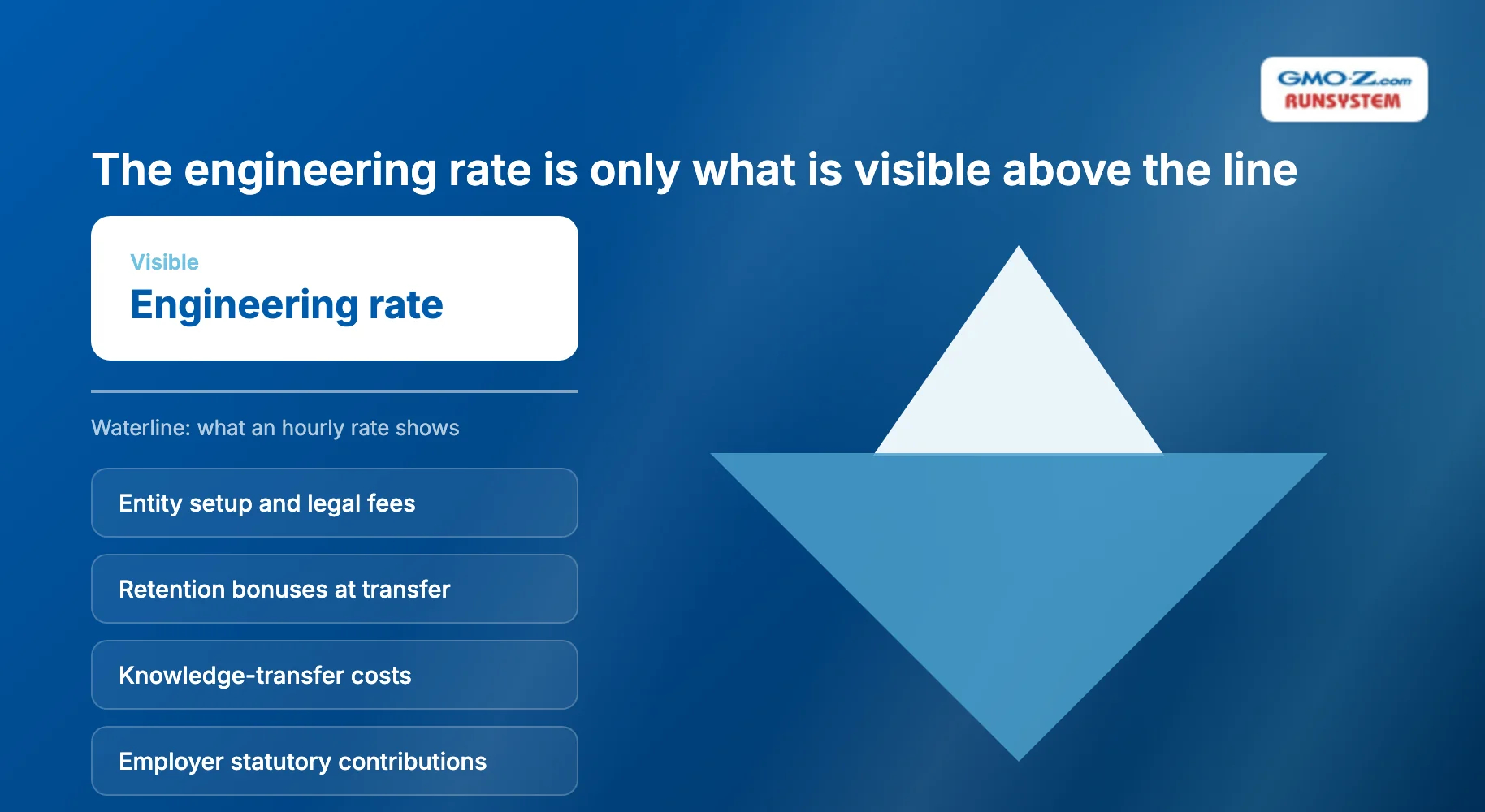
None of the top five ranking pages on this keyword publish a cost breakdown. The TTPSC claims BOT saves "up to 60%" against "the usual cost." Botulinum America claims it can "cut IT costs by 20-30%." Neither states whether that figure includes the full loaded cost. Neither cites a source or shows the calculation. That's why a line-item cost table is more trustworthy:
Cost item | Payment structure | Fixed or scaled with headcount | Which phase, who pays? |
Entity setup and legal fees | One-time | Fixed | Transfer, buyer |
Local payroll system setup | One-time | Fixed | Operate to transfer, provider then buyer |
Retention bonuses at transfer | One-time | Scales with headcount | Transfer, negotiated |
Knowledge-transfer costs | One-time | Scales with team complexity | Operate to transfer, shared |
Duplicate management during handover | Recurring, temporary | Fixed | Transfer, negotiated |
Legal and advisory fees | One-time | Fixed | Transfer, buyer |
Employer statutory contributions | Recurring, ongoing | Scales with headcount | Post-transfer, buyer, permanently |
BOT carries cost items a standard per-engineer rate doesn't. These include entity setup and standing up a local payroll system. They also include retention bonuses timed to the transfer, knowledge-transfer costs, duplicate management overhead during handover, and legal and advisory fees. They sit on top of engineering cost, not inside it. That's why a straight hourly-rate comparison undersells what BOT costs in year one.
The single largest cost you inherit permanently is the employer's mandatory statutory contribution. It varies by up to 16 times depending on the country. Figures below reflect 2026 published rates. Romania sits at 2.25%. The United States runs roughly 8-15%, depending on the state. That figure combines FICA (the payroll tax funding Social Security and Medicare) at 7.65% and FUTA (the federal unemployment tax) at 0.6%. It also includes a variable state unemployment tax. The Philippines runs around 14%, combined across SSS (the state social security fund), PhilHealth (public health insurance), and Pag-IBIG (a mandatory housing fund). India runs 12% EPF (Employee Provident Fund, a mandatory retirement savings scheme). Vietnam runs 21.5%. Poland runs up to 22.14% under the ZUS system (the state social insurance institution). Mexico runs roughly 30-40%, and Brazil 28-36%.
This figure matters more for BOT than for other delivery models because of when the liability lands on you. Under standard outsourcing, that contribution is baked into the provider's rate, and you can exit by canceling the contract. Once the transfer is complete, it becomes your own statutory obligation. It's payable for as long as you employ that team, with no contract to cancel out of.
Two sources are worth anchoring your budget to. Use the Accelerance 2026. Global Software Development Rates & Trends Guide for regional hourly rate ranges. Use the Stack Overflow Developer Survey 2025 for developer salary benchmarks by country.
Back to top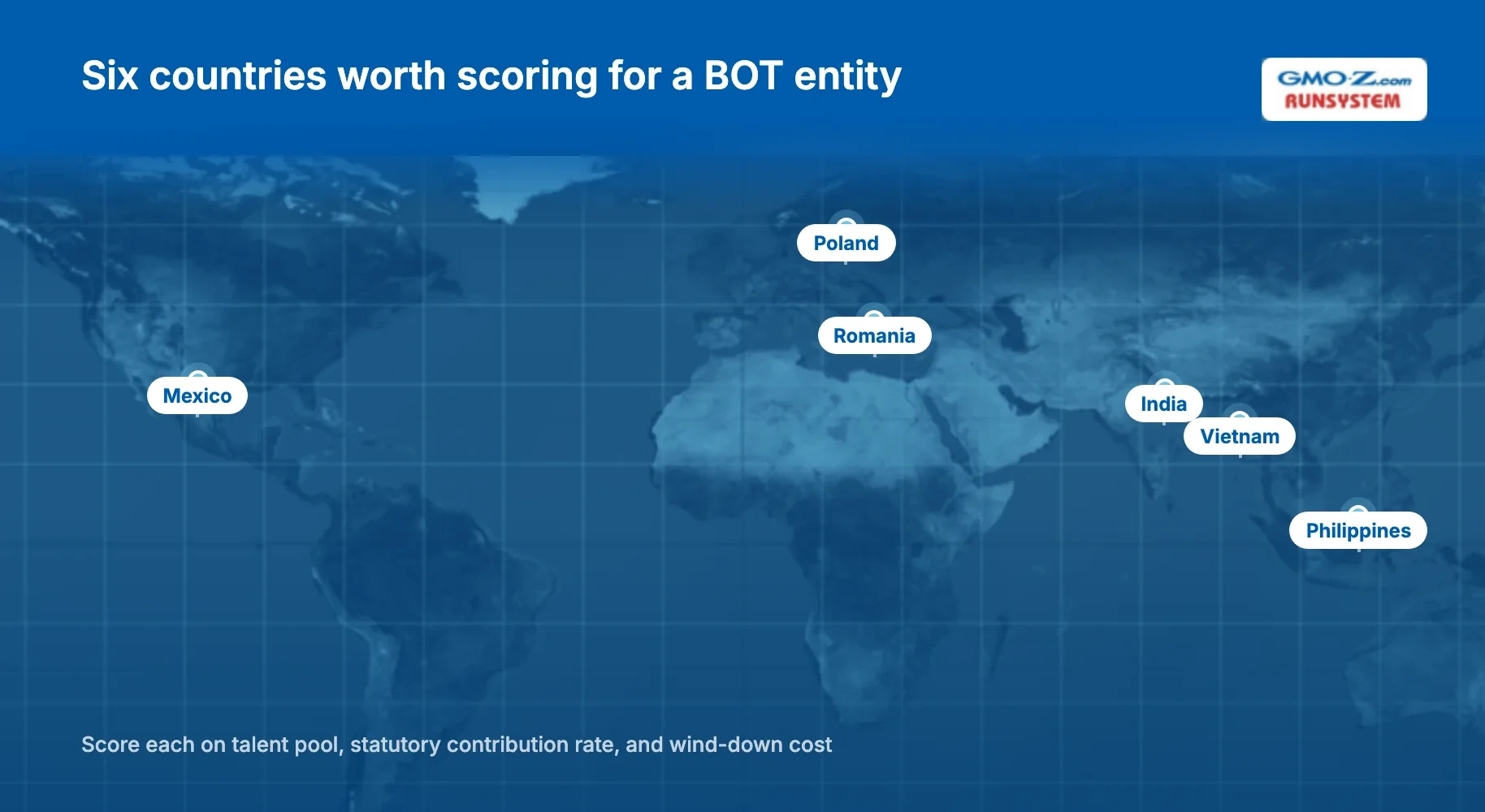
None of the top five ranking pages compares countries for entity placement. That's a real gap. Three of the five sources are themselves based in different countries: Poland, Vietnam, Mexico. Fixed transfer cost is what a country comparison should actually score on:
Country | Entity setup cost and time | Employer statutory contribution | Talent pool size | Employment contracts transfer automatically? | Wind-down cost if you exit |
India | Moderate, 4-6 weeks | 12% EPF | Very large | No, it requires re-signing. | Moderate |
Vietnam | Low, 3-4 weeks | 21.5% | 530,000-600,000 developers | No, it requires re-signing. | Low to moderate |
Philippines | Low, 3-5 weeks | ~14% (SSS, PhilHealth, Pag-IBIG) | Large | No, requires re-signing. | Low |
Poland | Moderate, 4-8 weeks | Up to 22.14% ZUS | Large, EU-integrated | Yes, under EU transfer-of-undertakings rules | Moderate to high |
Romania | Moderate, 4-6 weeks | 2.25% | Moderate | Yes, under EU transfer-of-undertakings rules | Moderate |
Mexico | Moderate, 4-8 weeks | ~30-40% | Large, growing | No, requires re-signing. | Moderate |
Score countries on three things you can verify, not on adjectives: talent pool size, mandatory contribution rate, and the procedure for transferring business ownership. Vietnam also adds 50,000-60,000 new IT graduates a year, on top of the figures in the table above.
For a BOT deal specifically, what decides the outcome isn't the hourly rate; it's the fixed cost and procedural complexity of transferring ownership.
A capability worth transferring should already meet enterprise-grade standards before it changes hands, not after. GMO-Z.com RUNSYSTEM's four delivery centers operate under the CMMI Level 3 process maturity and ISO/IEC 27001:2022 information security certification. That's the kind of baseline you should confirm exists before assuming a transferred team will meet it on day one.
Back to top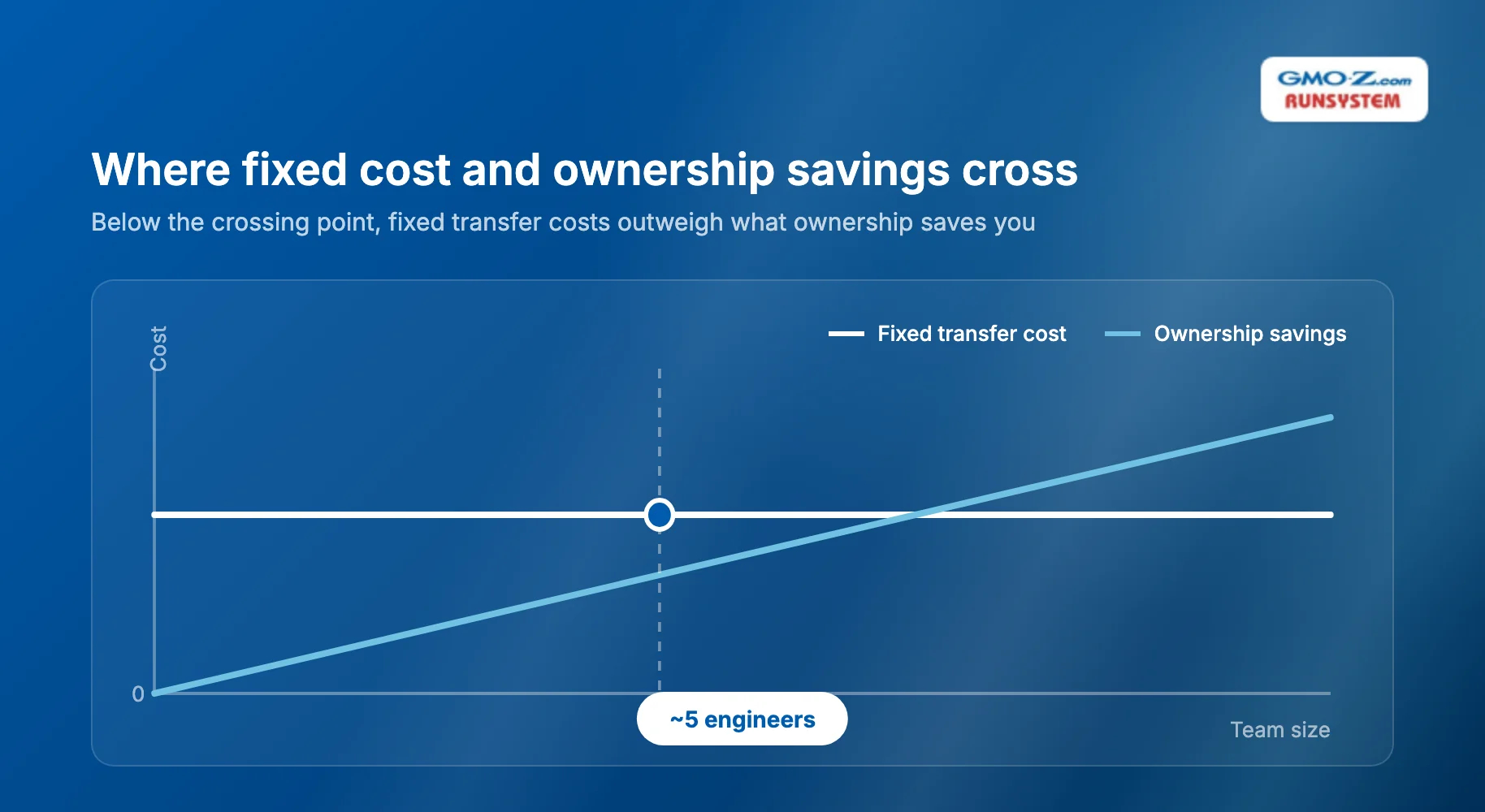
Three of the top five ranking pages on this keyword address who BOT suits, but they answer with company type. This section answers with a headcount threshold and the calculation behind it.
Three kinds of companies commonly choose BOT. Enterprises scaling engineering capacity beyond what local hiring can support are one. Companies establishing a GCC in a new country for the first time are another. The third is organizations that want long-term ownership of a delivery team without carrying first-year hiring risk.
Here's where sources disagree, and by how much. Coderslink states that "the BOT is best used in development teams of 10 or more employees." ttpsc prices a Build phase for teams under 5 people at around one month. That implicitly treats teams smaller than 5 as workable. It's a 2x gap between the two sources that actually name a threshold, and neither shows the math behind their number.
The break-even calculation resolves the disagreement, using the same cost buckets from the pricing section above. Fixed costs stay the same regardless of team size: entity setup, payroll system setup, retention bonuses, IP transfer, duplicate management, and legal fees. Variable costs scale with headcount: the cost gap between owning a team directly and outsourcing the same work, multiplied by engineer count.
The break-even point is where these two lines cross. It shifts with market salary levels, local procedural complexity, and how long you plan to run the team. Below that point, fixed costs outweigh the savings from ownership. Above it, ownership wins.
Fixed cost varies by country, so the minimum viable team size varies by country too. That's the actual reason Coderslink (Mexico-focused) and ttpsc (Poland-focused) land on different thresholds. Each is correct for the fixed-cost structure of the country they're describing. Each is also only half right as a general rule.
For most countries in the table above, the fixed cost of transferring a team outweighs the ownership savings below roughly five engineers. If your planned team is smaller than that, ask about an offshore delivery center (ODC) model instead. Revisit BOT once the headcount justifies the fixed cost.
Back to top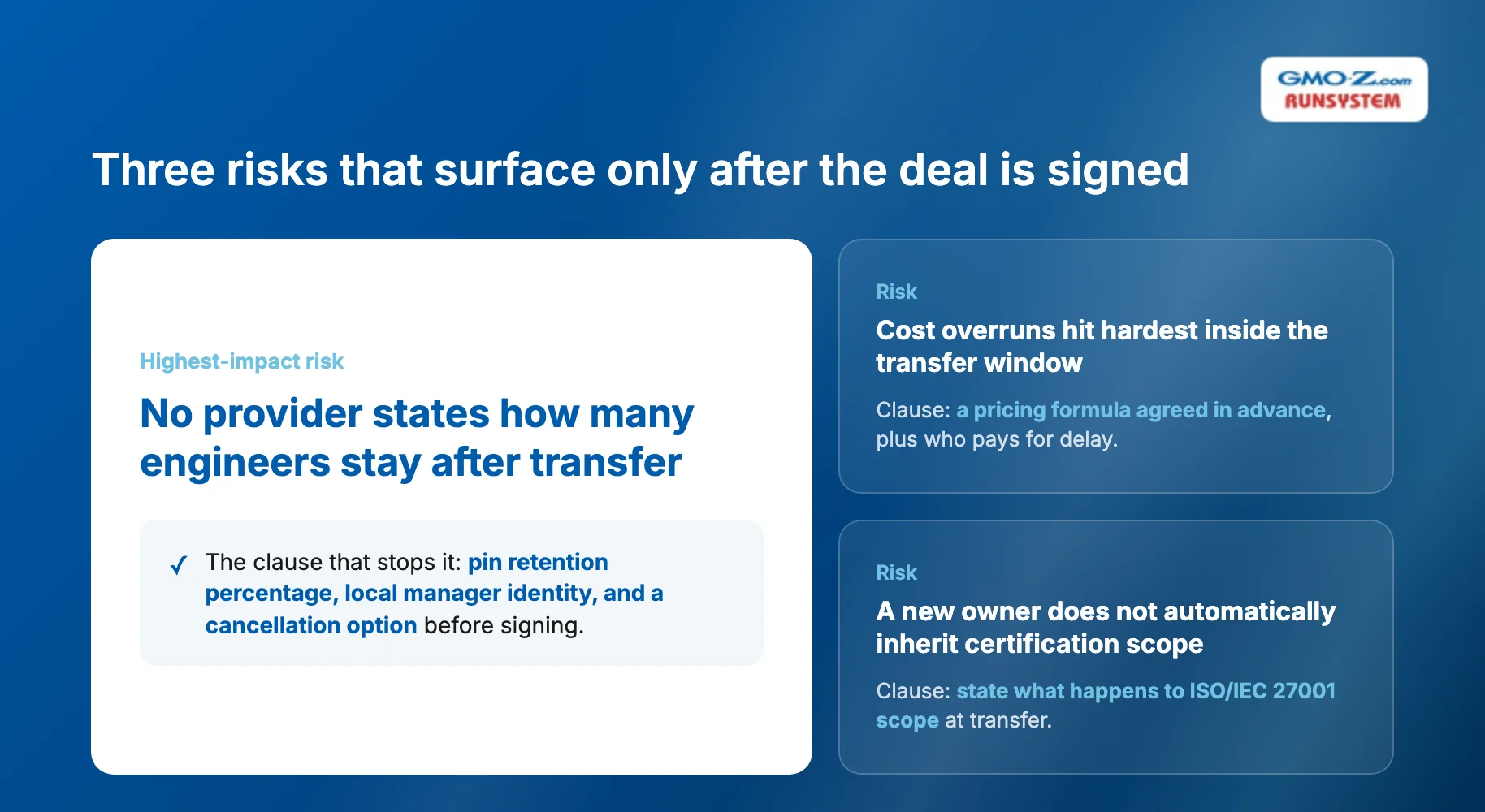
The second-ranked page on this keyword groups risks with the clauses that mitigate them under one heading. This article follows the same structure. Splitting them into two sections would just repeat the same information twice. All three risks are below the surface in the back half of the contract, not the build phase.
None of the five top-ranking pages state how many engineers stay on the team after transfer or publish their own attrition rate. The second-ranked page has a dedicated section titled "Employee Retention Challenges" and mentions retention bonuses but still doesn't include a figure.
Your contract should pin down four things:
For reference, industry-reported figures (self-reported by providers, not independently audited) put dedicated-team attrition at 8-12% and staff-augmentation attrition at 18-22%. Post-transfer retention doesn't fit cleanly into either bucket, and no one currently measures it, RunSystem included; it will publish that figure once it has one.
Duplicate management, retention bonuses, and legal costs spike specifically when a transfer runs longer than planned. Sources quote transfer duration anywhere from 4 to 12 weeks up to 3 to 6 months. A contract might be priced against the low estimate while the actual transfer lands at the high end. That gap is exactly where the extra cost shows up. The clause that prevents it is a pricing formula agreed in advance, plus a clear answer to who pays for time beyond the window.
An ISO/IEC 27001 certification is issued for a specific legal entity and scope. A new owner doesn't automatically inherit it, one of the least visible risks in a BOT deal. The clause that prevents it should state explicitly what happens to the certification and its audit records at transfer.
Whether employment contracts transfer automatically also isn't uniform. The EU has transfer-of-undertakings rules that preserve employment terms. Many countries in Asia require re-signing new contracts instead. That single legal difference determines how many people actually follow the team into the new entity.
Source code ownership depends on which country's law applies, and BOT complicates it further because ownership changes hands twice. In the US, code written by employees automatically belongs to the company, but code written by contractors doesn't, unless there's a written assignment. In most civil-law countries (continental Europe, Latin America, and much of Asia), the original author retains rights until a written transfer occurs. The contract needs to specify exactly when code moves from engineer to provider. It needs to separately specify when it moves from provider to you.
Back to top
The second-ranked page has a section titled "Due Diligence Questions You Should Ask." Its questions are the kind a sales brochure already answers. The six questions below are different. Each asks for exactly what the research behind this article found nobody publishing, with a clear signal for a good answer versus a weak one:
GMO-Z.com RUNSYSTEM can answer some of these directly today: certification scope, delivery-center history, and entity structure. Not all of them yet, particularly published retention and attrition figures. Naming that gap honestly is exactly the kind of answer this article argues you should be listening for.
Back to topBOT is a staged acquisition, so the transfer clause decides the outcome, not how smoothly the operation phase felt along the way. This article found three places where the market gets confident on numbers it can't back up:
If you're evaluating BOT, bring your planned headcount, target country, and timeline to a conversation. Run the break-even calculation against your own numbers rather than a vendor's rate card.
Back to topBOT is a staged acquisition. A provider builds, staffs, and runs a technical team on your behalf, then transfers the legal entity, contracts, and IP to you. It's distinct from infrastructure BOT, which transfers a physical asset and its operating rights, not a company.
Public estimates disagree sharply by phase. Build runs 6 weeks to 6 months. Operate runs from 2 months to over 2 years. Transfer runs 4 weeks to 6 months. The exact number depends on which milestone each source measures from and to.
For most countries, fixed transfer costs outweigh ownership savings below roughly 5 engineers. The exact threshold depends on the country's entity setup and statutory contribution costs; below it, consider an ODC model instead.
BOT wins when you want long-term ownership without year-one hiring risk and your team size clears the break-even threshold. Outsourcing wins for shorter, well-defined scopes where you don't need to own the entity.
This depends entirely on the cancellation clause negotiated upfront. Without one, the deal typically continues as an extended operate arrangement, and you should confirm in advance who bears the added cost of that extension.
Back to top