Family site
Family site
Family site



Outsourcing software development means contracting an outside company to handle engineering work you'd otherwise hire and manage yourself. Most buyers compare vendors by hourly rate. That's the wrong number to compare. Two vendors can quote the same rate under two different contract models, with two different definitions of what the rate includes, and end up costing very differently by month four.
This article shows you how to compare correctly: the contract models, the real cost behind a quoted rate, and how countries actually stack up. Then it walks through the seven steps to run the process, the risks worth planning for, and the questions that separate a vendor with a real answer from one without.
Back to topOutsourcing software development means handing execution to a company outside your own instead of hiring that capacity internally. That execution covers coding, testing, design, maintenance, and operations. Three things almost always stay with you:
A vendor that also wants to own architecture and product direction isn't an outsourcing partner. That's a co-founder relationship, and it needs a different contract.
Outsourcing differs from hiring internally in one concrete way: who eats the cost of a bad hire. Hire internally and a bad fit costs months of severance and a repeated search. Outsource, and that risk sits with the vendor instead.
Delivery splits into three types by geography, each with a different overlap-hours trade-off, meaning how many working hours your team and the vendor's team share in real time:
These aren't mutually exclusive. Many enterprises keep architecture and product ownership onshore. They send execution offshore instead, splitting work by what needs real-time judgment versus what needs hands on keyboard. The table below lines up all three by rate, overlap hours, and best-fit work.
Delivery type | Typical hourly rate | Typical working-hour overlap | Best fit for |
Onshore | Highest of the three (local market rate) | Full overlap | Architecture, compliance-sensitive work, client-facing roles |
Nearshore | Mid-range | Partial overlap (1-4 time zones) | Agile teams needing frequent live syncs |
Offshore | Lowest of the three | Minimal to no overlap (8+ time zones) | Defined-scope execution: coding, QA, maintenance |
Compared with keeping everything in-house, outsourcing trades fixed headcount cost for variable capacity. The price is less day-to-day control. Not every kind of work fits that trade equally well:
Companies outsource because it's now mainstream, not a fallback. The Deloitte Global Outsourcing Survey found that 87% of organizations count outsourced workers as part of their workforce. On average, they deliver 76% of technology work externally.
Four reasons explain the shift, each with a condition most vendor pitches leave out:
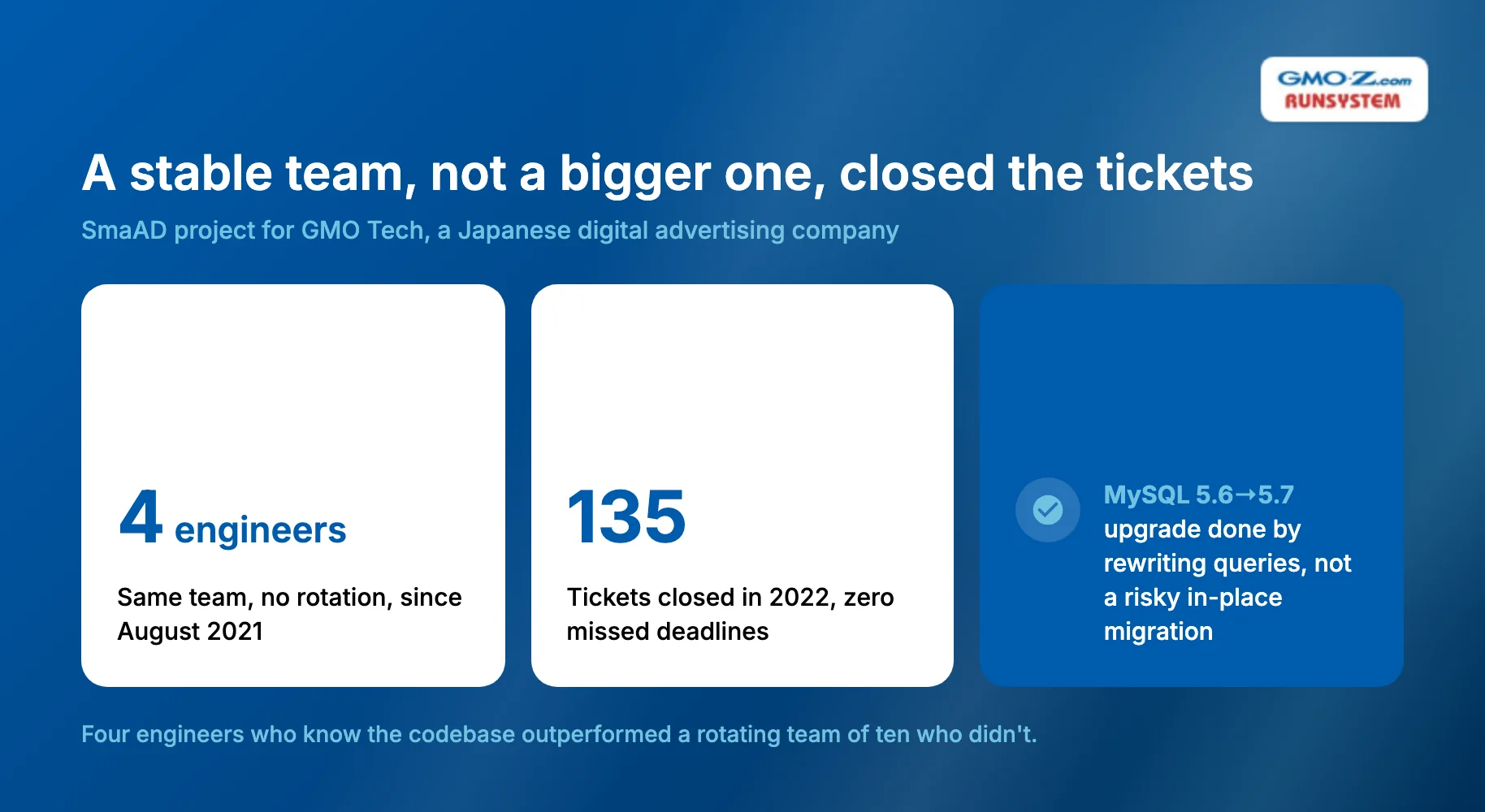
The SmaAD project for GMO Tech, a Japanese digital advertising company, ran with four engineers starting August 2021. That team closed 135 tickets in 2022 with zero missed deadlines. One of those tickets was a MySQL 5.6-to-5.7 upgrade, handled by rewriting queries instead of a risky in-place migration. Four people who know the codebase outperform a rotating team of ten who don't.
Every benefit above holds under a condition:
No. Outsourcing is being redefined by what gets delegated, not by whether delegation still makes sense. Global technology services spending hit a record $42.4 billion in Q2 2026, up 43% year over year, according to the ISG Index. A market in decline doesn't post its fastest growth on record.
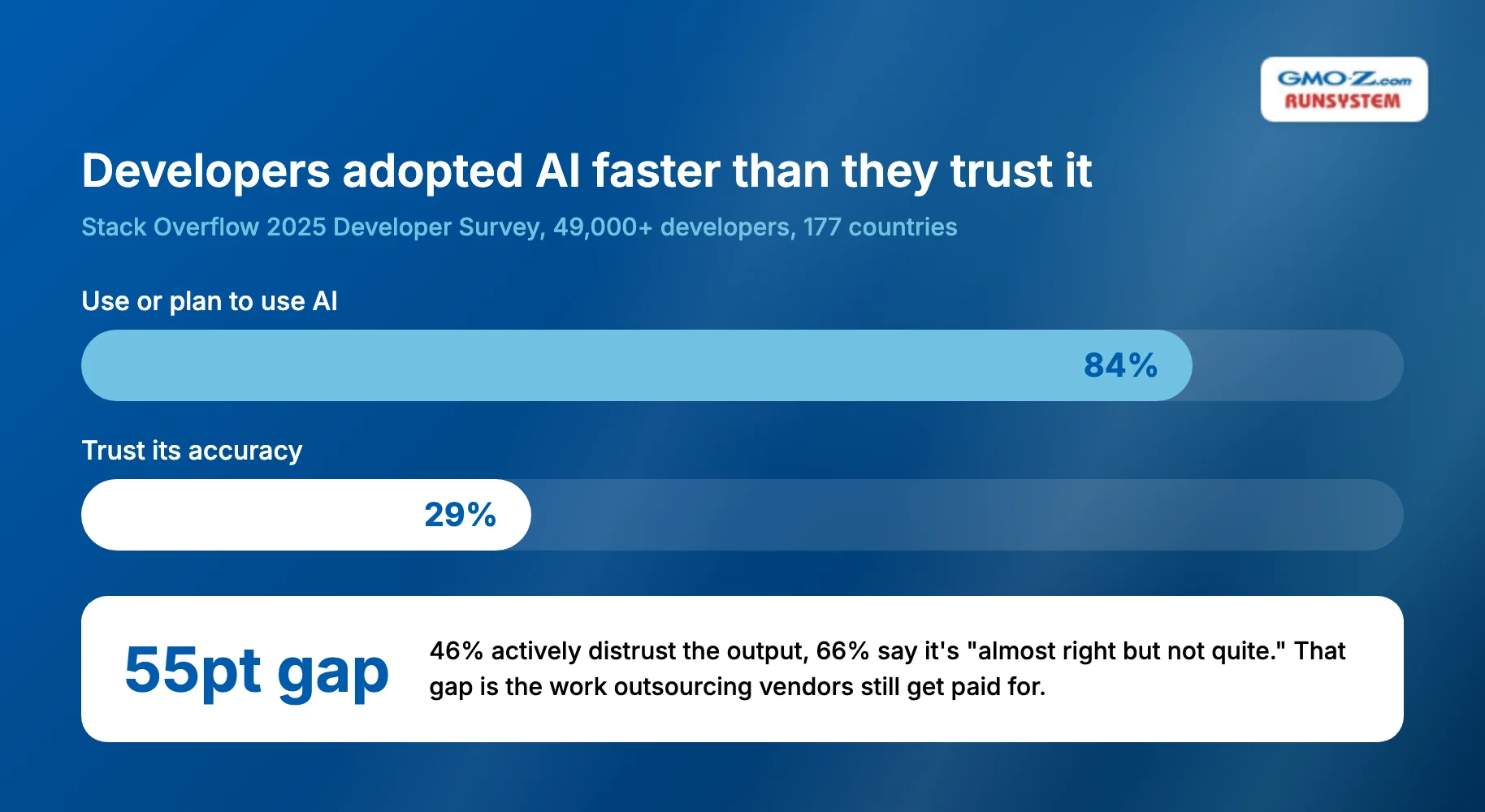
The Stack Overflow 2025 Developer Survey shows where AI actually helps. It surveyed over 49,000 developers and found:
That 55-point gap between 84% adoption and 29% trust is the part of the job that still needs a person. AI is shrinking one category of delegated work: repetitive boilerplate code. At the same time, it's expanding two others: integration and testing. The work outsourcing vendors get paid for is moving, not disappearing.
One exception: if the only thing you ever outsourced was repetitive boilerplate billed by the hour, that category genuinely is shrinking. That's a narrow slice of the market, not the whole of it.
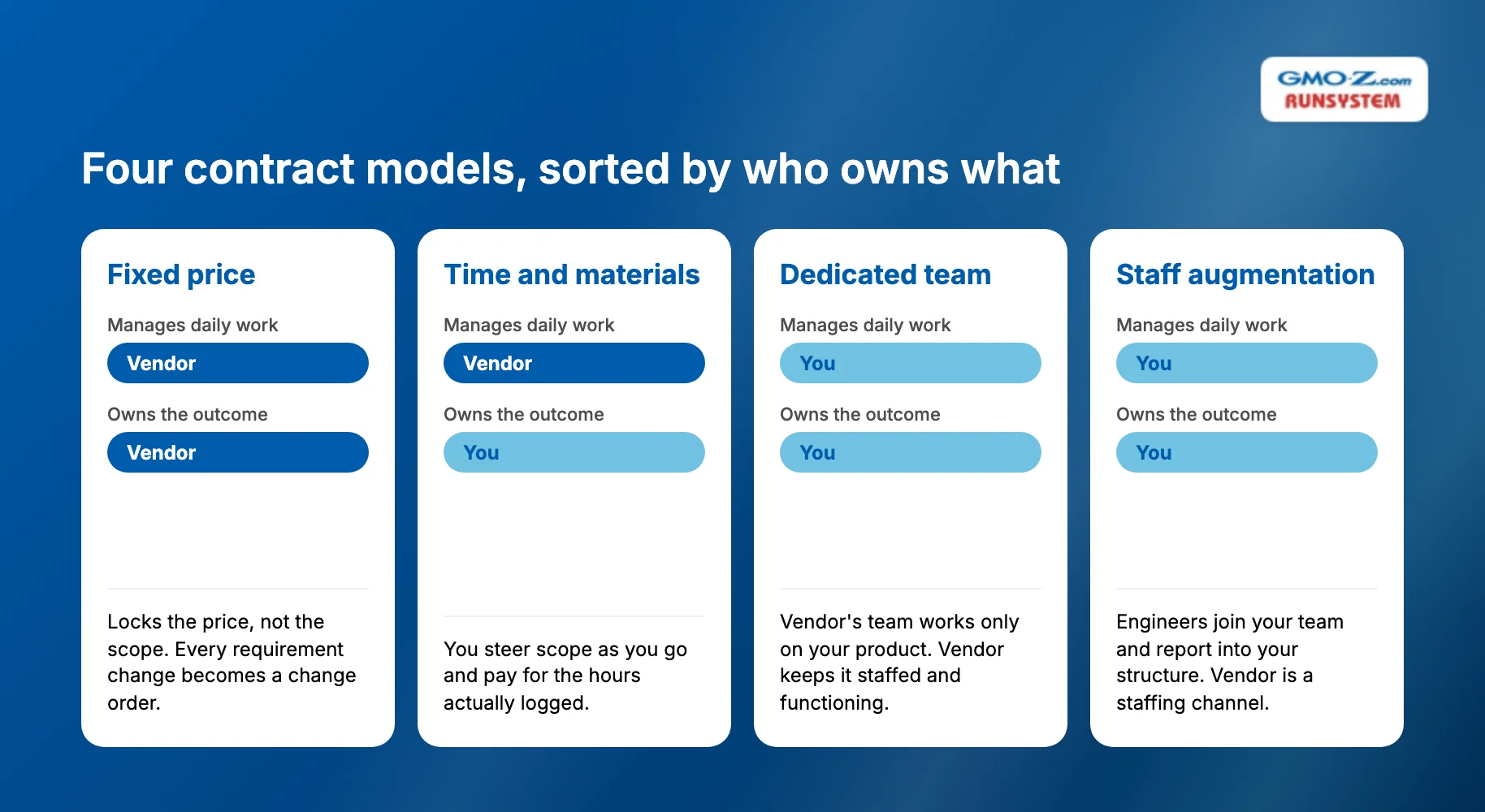
Back to topFour contract models cover almost every outsourcing deal. Tell them apart by who manages daily work and who's accountable for the result, not by how the invoice is calculated.
Every model has a breaking point. Check your project against three thresholds:
Few guides name where a given model actually stops working. That's why these three thresholds matter. For related deep dives, see RunSystem's dedicated guides on staff augmentation and offshore development centers.
Back to topAn hourly rate is not a full price. A vendor's rate has to cover eight separate cost components. Almost no rate card itemizes them. The table below breaks a typical rate into its parts. It also shows what you'd pay separately if you hired directly.
Cost component | Estimated share of the rate | Who pays it if you hire directly instead? |
Gross salary | Largest single component | You, as payroll |
Mandatory employer contributions | Varies sharply by country (see below) | You, as a statutory employer, cost |
Benefits and bonuses | Moderate | You, as HR budget |
Workstation, equipment, licenses, security tooling | Small but recurring | You, as the IT budget |
Training | Small | You, as onboarding cost |
Bench time (people between assignments, and attrition backfill) | Moderate, often hidden | You, if you keep spare capacity on payroll |
Share of project management, QA, and interpretation | Moderate | You, as a separate hire or overhead |
Vendor margin | Remainder | Not applicable when hiring directly |
Mandatory employer contributions are the line every rate card skips. The gap between countries is large enough to change your total cost by itself:
That's 12 to 16 times higher, according to PwC's Worldwide Tax Summaries. Before comparing quotes, ask each vendor one question: does this rate already include project management, QA, and a replacement engineer if someone leaves?
A new outsourced team doesn't produce at full capacity from day one. That ramp curve has a real cost inside a fixed-length contract. Vendor-reported onboarding runs like this (vendor self-reporting, not audited data):
Applied to a 12-month contract, you pay for 12 months but receive roughly 11.2 person-months of output. Real cost per unit of work runs about 7% above the quoted rate. Complex domains, financial services, healthcare, and critical infrastructure stretch that ramp to 12-16 weeks and widen the gap.
Ramp-up cost is fixed and paid once at the start. So a shorter contract lets it eat a larger share of total spend. The fix isn't a lower rate. It's keeping the same people on your project, since every engineer swap resets the ramp curve.
Back to topMost "top countries for outsourcing" rankings reflect where the publisher operates, not an objective comparison. ParallelStaff's ranking lists only five Latin American countries and no Asian country. N-ix puts Central and Eastern Europe at the top. Both line up with where each company has its own offices. That answers "where does this vendor operate," not "which country fits your project."
Scoring every country against the same four criteria removes that bias. The table below covers eight countries on four points: hourly rate, mandatory employer contribution, overlap with a 9-to-5 US Eastern workday, and talent pool size.
Country | Typical hourly rate | Mandatory employer contribution | Overlap with 9am-5pm US Eastern | Talent pool | Best fit for |
Brazil | Mid-range | 28-36% | 8 hours | Large | Real-time collaboration, nearshore US delivery |
Mexico | Mid-range | Moderate | 6 hours | Large | Nearshore US delivery, manufacturing/logistics systems |
Poland | Mid-to-high | Moderate-high | 3 hours | Large | EU compliance-sensitive work, nearshore Europe |
Romania | Mid-range | 2.25% | 2 hours | Moderate | Cost-efficient EU-based teams |
India | Low-to-mid | Moderate | 0 hours | Very large | Large-scale offshore execution, 24/7 coverage |
Philippines | Low-to-mid | Moderate | 0 hours | Large | BPO-adjacent work, offshore execution |
Vietnam | Low-to-mid | Moderate | 0 hours | Large, growing | Offshore execution, dedicated teams, cost-efficient scaling |
Ukraine | Mid-range | Moderate | 3 hours | Large | Nearshore Europe, complex engineering work |
Rates across these countries are converging, which changes what differentiates them. According to the Accelerance 2026 Global Software Development Rates and Trends Guide, Latin American rates fell 7.1% over the past year. European rates fell 4.4%. As price stops differentiating vendors, overlap hours and talent pool size become the two variables worth comparing.
Back to topOutsourcing follows seven steps, and most guides skip what you, the buyer, need to prepare at each one:
Vendors routinely bundle two milestones into one term, "setup time." Setup time means the team exists and has access. Stable velocity means the team hits its normal output consistently. That takes longer, which is why vendor quotes don't match.
A cashless payment platform for the Japanese market launched April 8, 2019. It ran with a team of more than 20 people, spanning project managers, engineers, testers, QA, and interpreters. That's the shape a genuinely stable outsourced operation takes past the pilot stage.
Back to topEvery real outsourcing risk has a named project behind it and a named fix. Vague risks like "cultural differences" aren't specific enough to act on, so they're left out.
Source code ownership and data protection. Read the actual standard, not a vendor's summary. ISO/IEC 27001:2022 is the information security standard. It lists 93 controls in its Annex A. That's a reference set, not a mandatory checklist. The right question isn't "Are you ISO 27001 certified?" It's "which of these controls fall inside your certification's actual scope."
Back to topChoosing a partner comes down to seven questions, each paired with a good answer versus an evasive one:
On these same seven questions, it's worth being direct about where GMO-Z.com RUNSYSTEM has a clear answer and where it doesn't. RunSystem has held CMMI Level 3 certification since 2012. It also holds ISO/IEC 27001:2022 certification, covering its Hanoi, Ho Chi Minh City, Da Nang, and Hue locations. That answers the certification-scope question concretely.
On a phased CRM (customer relationship management) rollout for ABBank, the first stage synchronized more than 1.6 million customer records and served more than 1,600 relationship officers. It also integrated with the bank's T24 core banking, AML screening, and loan origination systems. It went live in roughly three months, evidence the process holds up on regulated, integration-heavy work.
Where RunSystem doesn't have a public, standardized answer yet is the attrition-rate metric above. That's a fair question to raise directly in a scoping call.
Back to topThe decision to outsource is a decision about what's actually comparable, not about which hourly rate is lowest. Settle three numbers before you talk to a single vendor:
Bring those three numbers to a conversation with RunSystem. Ask the seven vendor questions above to RunSystem and two other providers side by side. Skip the rate-card request. A number without context tells you nothing a full spreadsheet hasn't already told you.
Back to topOutsourcing in software development means contracting an external company to handle engineering work like coding, testing, design, or maintenance, instead of hiring internally. It can also be split by function: staffing individual roles (staff augmentation) versus handing off an entire product line (managed delivery).
No. Global tech services spending hit a record $42.4 billion in Q2 2026, up 43% year over year, according to the ISG Index. AI is shrinking boilerplate coding work. At the same time, it's expanding demand for integration and testing, not eliminating the need to delegate.
Rates vary widely by region. Mandatory employer contributions alone swing costs by 12 to 16 times between countries (2.25% in Romania versus 28-36% in Brazil). Two "equal" hourly quotes rarely represent equal total cost. Always ask what a rate includes before comparing it.
Organizations across nearly every industry now outsource technology work. Deloitte's Global Outsourcing Survey found that 87% of organizations count outsourced workers as part of their workforce. On average, they deliver 76% of technology work externally.
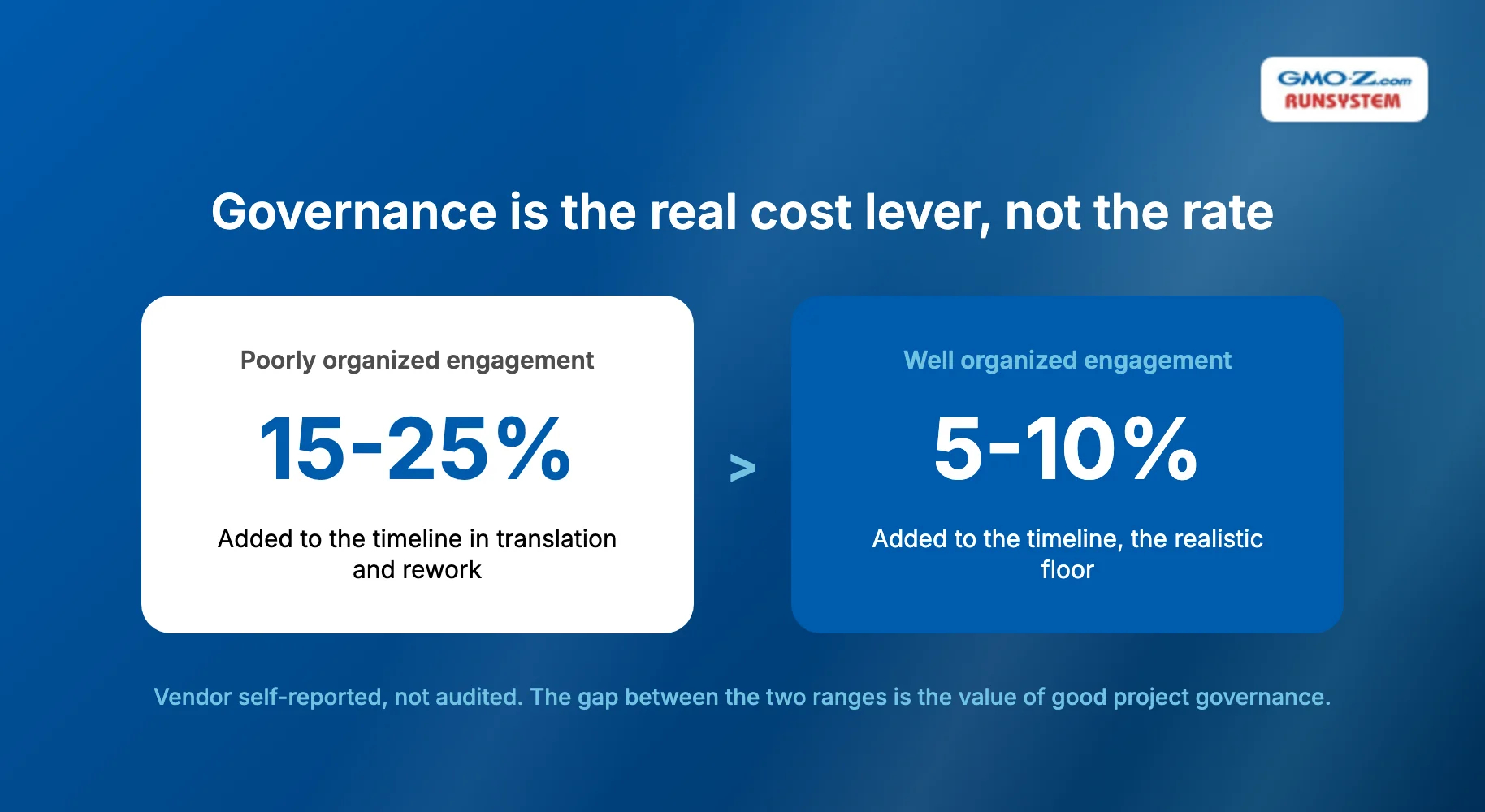
The largest financial risk is coordination overhead. A poorly organized engagement adds 15-25% to a project's timeline in rework and miscommunication, versus 5-10% for a well-run one. Source code ownership and certification scope are the two contract terms most often left vague.
Outsource when your committed workload is variable, or when you need a skill your local market lacks. Keep work in-house when it involves core, long-lived intellectual property. Also keep it in-house when it requires deep undocumented institutional context that a rotating external team can't hold onto.
Back to top