Family site
Family site
Family site



System integration services are outside teams that design, build, test, and run the connections between your applications, data, and infrastructure. Buyers often compare providers on the build quote, yet the recurring costs begin after go-live, the point when connections start running in production.
Change drives those costs. When a connected platform retires an API (application programming interface, the defined way software exchanges data), a working integration stops. MuleSoft's 2026 Connectivity Benchmark Report, a survey of 1,050 IT leaders, found the average organization manages 957 applications, many of them updated on their vendors' own release schedules.
So judge providers by who keeps your connections working for three years, what that costs, and how easily you can leave, rather than by the build quote.
Back to topSystem integration services are professional services that connect an organization's applications, data, and infrastructure so they exchange information automatically. They cover assessment, architecture, build, testing, and ongoing support of those connections.
A typical job is making CRM (customer relationship management) orders create invoices in the ERP (enterprise resource planning) system without anyone retyping them. If you need the underlying concept and the classic integration methods first, start with our explainer on what system integration means.
System integration services differ from integration software. Gartner defines iPaaS (integration platform as a service) as "a vendor-managed cloud service that enables users to implement integrations" between applications and data sources. The platform supplies the tools, while your own users still do the implementing.
A services engagement adds the people and the process around those tools. The provider's team maps your data, designs the connections, tests them, and answers the alert when one breaks.
Connection work takes a large share of IT time when your own staff do it. The same MuleSoft survey found that IT teams spend an average of 36% of their time designing, building, and testing new custom integrations.
Back to topMany service catalogs list integration types without saying when you need each one. Start from the problem in front of you instead, because the trigger often points to a single type:
Service type | What it connects | Typical trigger | Example |
Enterprise application integration (EAI) | ERP, CRM, HR, and SCM (supply chain management) systems | Your teams retype the same data across departments | CRM orders create ERP invoices |
API development and integration | SaaS (cloud subscription) apps, partner systems, mobile apps | You are launching a new digital channel or partner | A payment gateway inside your checkout |
Data integration | Many sources feeding a data warehouse or data lake (central stores built for reporting) | Your departments report different numbers | One shared sales and finance dashboard |
Cloud or hybrid integration | On-premises systems (run in your own data center) and cloud services | You are partway through a cloud migration | On-premises ERP linked to a cloud CRM |
Legacy system integration | Older systems without modern APIs | You cannot replace a core system yet | An API wrapper (a modern interface built around an old system) over core banking (the bank's system of record for accounts) |
B2B (business-to-business) or EDI (electronic data interchange) integration | Suppliers, distributors, and customers | Your trading partners require EDI documents | Purchase orders received from retailers |
IoT (Internet of Things) integration | Devices and sensors linked to business systems | You run a smart factory or track shipments | Sensor data feeding the MES (manufacturing execution system) and ERP |
Two rows deserve a closer look before you scope anything. IBM describes EAI as connecting disparate systems "often using APIs and middleware," meaning software that routes and translates data between applications. IBM adds that with EAI "companies maintain complete control over their integrations," and that question of control returns when you choose an engagement model.
EDI is the row that is easiest to underestimate. X12 is the body chartered by the American National Standards Institute to maintain EDI standards, and it lists "more than 320 transaction standards" for business-to-business operations. Your trading partners typically decide which of those transactions you must support, so confirm their requirements before you pick a tool.
Legacy system integration keeps a core platform usable, but it does not decide when to replace it. That decision belongs to a modernization plan.
Searchers also ask about the "four types of system integration," commonly given as vertical, star, horizontal, and common data format. Those are architecture methods rather than service lines, and the system integration meaning article covers them.
Back to topA system integration provider's work follows five phases, each ending in a deliverable you can inspect:
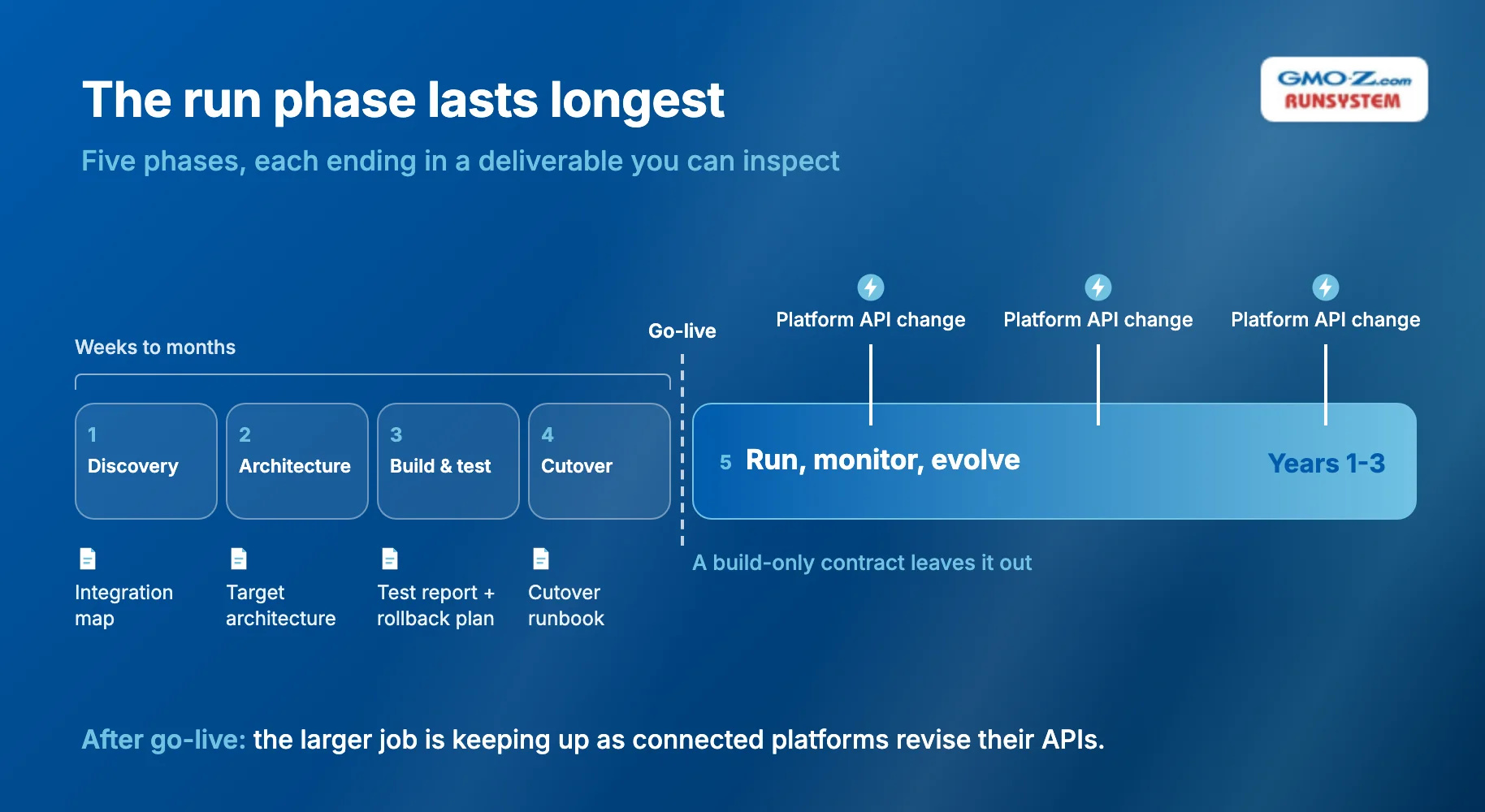
Discovery inventories your systems, the data moving between them, and who owns each master data set (shared core records such as customers). Your deliverables are an integration map (a diagram of systems and their links) and a risk list.
Architecture fixes the integration pattern from four common options:
The design package should hold a target architecture, field-level data mapping (which field feeds which), a security design, and the reasons the provider rejected the alternatives.
The build phase produces connectors (adapters that link one system to another), APIs, and transformation logic (rules that convert data between formats). Testing should run end to end on production-like data, including malformed records and realistic volumes. You should receive a test report and a rollback plan (steps to restore the previous state if go-live fails).
Cutover switches work from the old process to the new connections. For critical systems, go live in phases and run old and new in parallel until the totals in both match. The deliverable is a cutover runbook, a step-by-step script naming an owner per step.
The run phase lasts longest, and a build-only contract leaves it out. Monitoring catches failed messages, but the larger job is keeping up as connected platforms revise their APIs.
Three platforms' release policies show the pace of that change:
Phased programs are exposed too, because each new phase attaches to live connections.
ABBank, a Vietnamese commercial bank, is one example. GMO-Z.com RUNSYSTEM implemented its new CRM and reported in 2022 that phase one went live after three months. The CRM was integrated with platforms including T24 core banking, AML (anti-money laundering), and the LOS (loan origination system).
Phase one synchronized more than 1.6 million customer records and supports over 13,000 internal users. Further modules were still to come, and when later modules reuse phase-one connections, run terms matter as much as the build.
Back to topThe engagement model (the split of work between you and the provider) decides who absorbs post-go-live change, including change requests (billed work outside the original scope). The table below compares the three models on nine factors:
Factor | Project-based integrator | Self-service iPaaS | Managed integration service |
Who builds | The provider's team | Your team | The provider's team |
Who runs after go-live | You, unless support is contracted | You | The provider |
Who controls changes | You, through change requests | You, directly | The provider, within agreed scope |
Who owns code and mappings | You, if the contract assigns them | You, in the platform's format | Depends on the contract; mappings may sit on the provider's platform |
Upfront cost | High | Low to medium | Medium |
Ongoing cost | Unpredictable change requests | Subscription plus internal staff | Usually a fixed monthly fee |
Best for | You run a complex one-time program, such as an ERP rollout | You connect many SaaS apps and have strong internal IT | Your IT team is lean and your connections change often |
Main risk | Knowledge leaves with the provider | Skills gaps and connector limits | Dependency on one provider |
Exit path | You take over the code and documentation | You rebuild if you leave the platform | You follow a transition plan, if the contract has one |
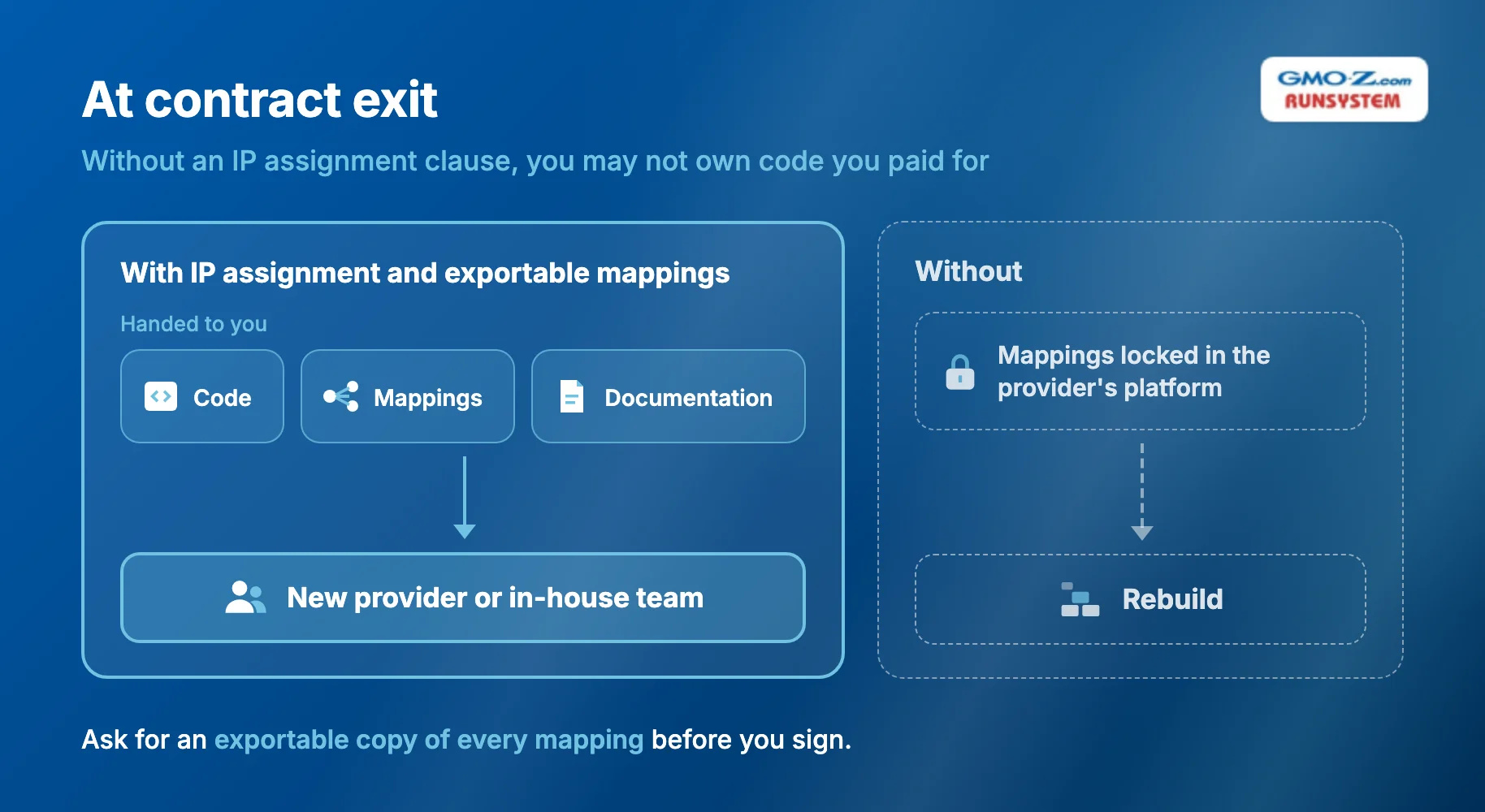
Exit risk, often called vendor lock-in, is the factor the provider comparisons we reviewed skip, though it sets your bargaining position at renewal. A managed integration service on its own platform can be easy to start and hard to leave. You should ask for an exportable copy of every mapping.
Some organizations hire an integrator to build and a managed integration service or internal team to run. With build and run on separate contracts, compare every option on one three-year TCO (total cost of ownership) formula:
3-year integration TCO = Discovery + Build + (Change requests × 3 years) + (Run and monitoring × 3 years) + Internal staff time + Incident cost
This hypothetical example connects an ERP, a CRM, an e-commerce platform, a WMS (warehouse management system), a payment gateway, and a BI (business intelligence) tool. The table compares cost lines in relative terms, not dollars:
Cost line | Project-based | Self-service iPaaS | Managed integration service |
Upfront (discovery and build) | High | Low | Medium |
Change requests after API updates | You pay per change | Your team absorbs the effort | Included up to a cap |
Run and monitoring | Your internal team | Your team plus the subscription | Included in the fee |
Incident risk | You absorb it | You absorb it | Shared through the SLA (service level agreement) |
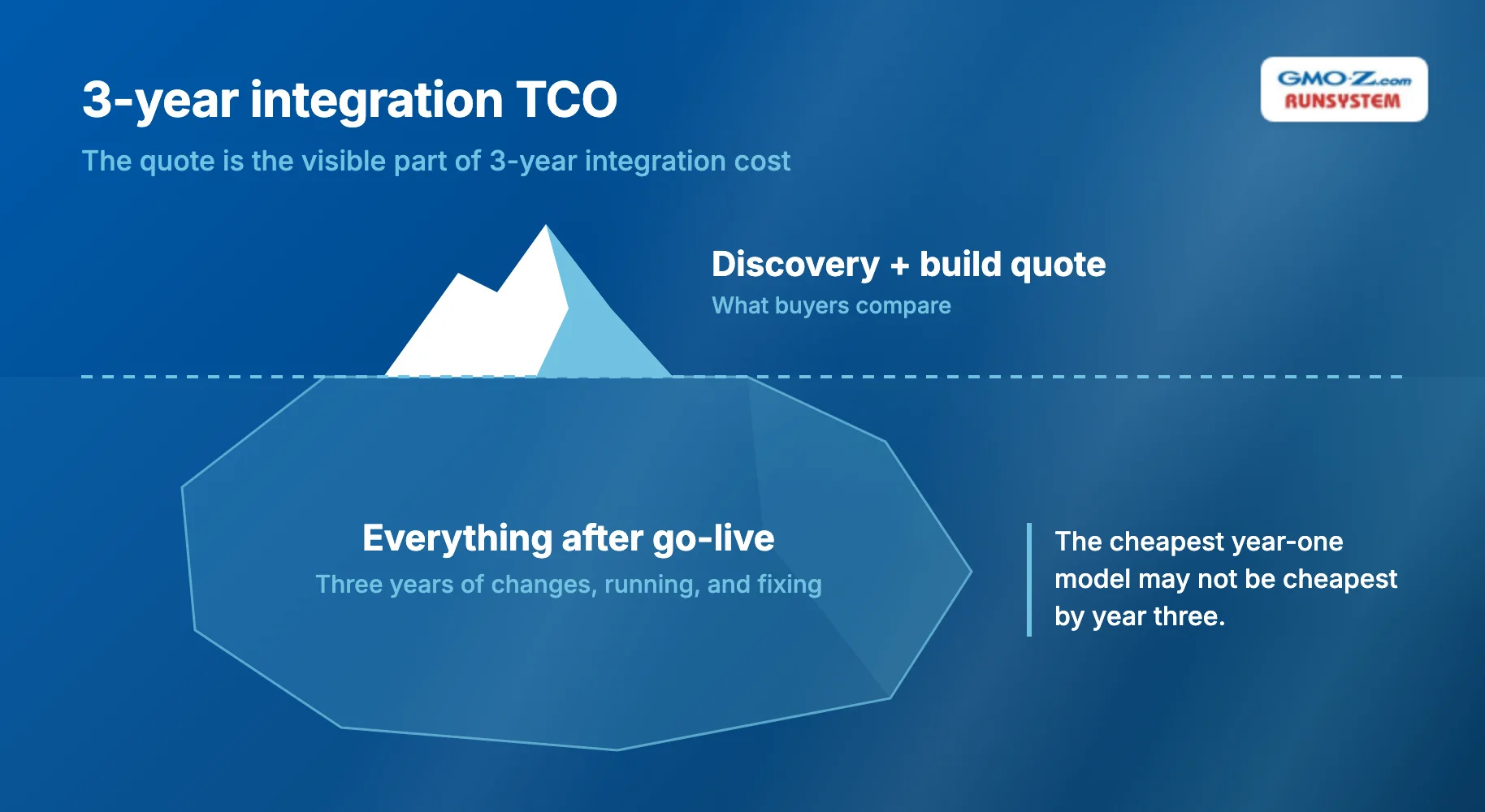
In this example, the e-commerce and payment platforms ship API versions on fixed schedules, so change requests recur every year. The cheapest year-one model may not be cheapest by year three.
Wikipedia's summary of integration methods notes a similar pattern in silo-style builds, which give each business function its own connections. Silos are "cheaper in the short term," yet their "cost-of-ownership can be substantially higher" once new functions need new silos. Pick the model whose change and run costs you can predict and cap.
Back to topThe biggest system integrators are global firms such as Accenture, TCS, Cognizant, Deloitte, IBM, and Capgemini, the six that MarketsandMarkets names as top companies in system integration services. It projects that market to grow from USD 553.33 billion in 2025 to USD 763.81 billion by 2030.
The same research calls the market fragmented, with five of those firms "collectively accounting for approximately 13–15%" of share. Its forecast also treats managed integration services as one of four service segments, so ongoing operation is already sold as a service in its own right.
In a market that fragmented, size is a weak shortlist filter. Global integrators often focus on multi-country programs, while a mid-size or offshore provider (one delivering from a lower-cost country) can suit a project with a handful of systems.
Side by side, the two provider profiles typically differ on scope, cost, flexibility, and senior attention:
Factor | Global system integrator | Mid-size or offshore provider |
Typical scope | Multi-country transformation programs | A few to a dozen connected systems |
Cost | Higher rates plus program overhead | Lower rates, especially offshore |
Flexibility | Standard methods and contract terms | Easier to tailor scope and terms |
Senior attention | May focus on the largest accounts | Easier to secure on mid-size projects |
Price comparisons hide the risks that cost most after go-live. Run each shortlisted provider through the five checks below:
Ask for a case with your exact systems rather than integration experience in general. A team that has connected SAP to Salesforce has likely already learned where those APIs limit request volumes, which fields fail to map, and how upgrades behave. Request a reference you can call, and ask that client what broke in the first year.
A capable integrator asks about your legacy systems before quoting. Expect questions about documentation, the people who still understand the old platform, and whether a test environment exists. If a provider quotes a fixed price without asking, the missing analysis is likely to return later as change requests.
Every connection opens a path into your data, so review security before the provider fixes the architecture. Ask how the provider handles access control, encryption, logging, and data residency (where data is stored and processed).
ISO describes ISO/IEC 27001 as "the world's best-known standard for information security management systems (ISMS)," and it defines the requirements such a system must meet. A certified provider has had that system assessed against those requirements, within a stated scope.
A certificate only helps when you can check its scope and date, so ask every provider for both. GMO-Z.com RUNSYSTEM, for example, moved its ISO/IEC 27001 certification to the 2022 version in 2025 and extended the scope to its Hue branch.
The same scope question applies to process certifications such as CMMI (Capability Maturity Model Integration). The CMMI Institute calls Level 3 "Defined," a stage where "organization-wide standards provide guidance" across projects.
GMO-Z.com RUNSYSTEM has held CMMI Level 3 and ISO 9001 (quality management) since 2012. With any provider, ask whether the team assigned to your integration works inside the scope those certificates cover.
Ownership after go-live is easy to leave vague. Named contract clauses close that gap.
Under U.S. law, the U.S. Copyright Office explains, commissioned work is "work made for hire" only in nine listed categories with a signed written agreement. Otherwise, "it is not a work made for hire," so without an explicit IP (intellectual property) assignment clause, you may not own code you paid for.
The matrix below turns ownership into clauses you can negotiate:
Responsibility | Your role | Provider's role | Agree before you sign |
Source code and mappings | You own them | Hands them over on request | You need an IP assignment clause in your favor |
Monitoring and alerting | You receive the alerts | Runs the monitoring | You need a response-time SLA |
Fixing breaks after a platform API change | You report and approve | Fixes the connection | You decide whether fixes are included or billed |
Adding a new system | You approve the scope | Builds the connection | You need a rate card (fixed prices per unit of work) for new connections |
Documentation updates | You review them | Updates them after each change | You set a delivery cadence you can enforce |
Compare quotes on the three-year TCO formula from the engagement-model section. Ask each provider to price one sample change, such as a connected platform's annual API upgrade, so you can compare the line that recurs. A low build quote with an open-ended change-request clause tends to grow.
Back to topQuotes tend to leave post-go-live terms vague, and those terms matter because API changes don't always arrive with a clear warning.
Postman's 2025 State of the API Report, a survey of more than 5,700 developers, architects, and executives, found only 26% use semantic versioning. That numbering scheme signals whether a change will break integrations, and Postman concludes most teams track changes "without communicating the impact."
[[IMG_4]]: api-change-breaks-integration-who-notices-fixes-pays.webp Alt text: A connected platform ships a new API version and breaks the link to your system, raising three contract questions: who notices, who fixes it, and who pays
Ask every shortlisted provider these eight questions, and get the answers in writing:
Questions 5 and 8 tend to separate providers most clearly, because they reveal who pays when something changes and how hard it will be to leave.
Back to topYour integrations need changes whenever you add, upgrade, or retire a system, and platforms such as Shopify and Stripe keep releasing new API versions. A provider that builds fast and leaves those changes to you has sold a project when you needed a capability.
Choose the provider and the engagement model by three tests. Ask who keeps your connections running for three years, what that costs on the TCO formula, and how you exit if the relationship ends. The build quote is only the first line of that calculation, and the lowest one may not stay lowest.
Start with the integration map from the discovery phase, listing your systems, the data each one owns, and the connections between them. Then book scoping sessions with two or three providers and ask each to price that map over three years, including change requests and run support. Their answers to the eight questions above will show which ones plan to stay accountable after go-live.
Back to topSystem integration services are professional services that design, build, test, and run the connections between your applications, data, and infrastructure. Unlike integration software alone, they include the people and process that keep data moving correctly after go-live, when connected systems change.
A systems integrator connects your systems and keeps them connected. The work runs through five phases, from discovery and design to build, cutover, and ongoing operation. The run phase lasts longest and keeps generating work, since platforms such as Shopify release a new API version every quarter.
A system integration project takes weeks to months, depending on the number of systems and how many legacy systems are involved. Vantage Point, a certified Salesforce, HubSpot, and MuleSoft partner, estimates 4-12 weeks for standard CRM-ERP integrations and 3-6 months for complex multi-system environments. ABBank's CRM phase one took three months.
No, iPaaS replaces part of the toolset rather than the service. IBM notes that with iPaaS, "internal teams build and maintain these integrations" themselves. You still need people to design the architecture, test with realistic data, and fix connections when APIs change.
Back to top