Family site
Family site
Family site




In the digital era, banks are no longer merely places for financial transactions but are gradually becoming a “digital experience hub” for customers. The explosion of mobile banking and digital platforms has fundamentally changed user behavior: customers expect fast, secure, and seamless transactions across all channels—from mobile apps, websites, and call centers to traditional branches.
This shift in behavior has created an urgent demand for the financial and banking sector to move beyond deploying multiple separate service channels toward an integrated and synchronized model that delivers a consistent end-to-end experience. This is precisely why the concept of Omnichannel Banking was born.
So what is Omnichannel in the context of commercial banking? Unlike fragmented multi-channel solutions in the past, Omnichannel Banking focuses on connecting all customer touchpoints into a single unified system, enabling users to start a transaction on one channel and complete it on another without disruption.
Omnichannel Banking is an integrated multi-channel banking model in which all touchpoints—from mobile banking, internet banking, call centers, chatbots to traditional branches—are connected within a unified ecosystem. Instead of managing each channel separately, banks use a centralized data platform to synchronize information and create a consistent customer experience.
Unlike Multi-channel banking, where each channel operates independently with little connection, Omnichannel Banking delivers:
Examples:
Today, Omnichannel Banking is no longer a “nice-to-have” but a “must-have” for commercial banks. Shifts in customer behavior, intense competition in the financial and banking industry, and government-driven digitalization policies are the three key drivers making this model inevitable.
Today’s customers are increasingly attached to mobile devices. According to recent reports, in Vietnam, smartphone usage has surpassed 75% of the adult population, with mobile banking becoming the most popular transaction tool. Millions of users perform activities such as money transfers, bill payments, mobile top-ups, or opening savings accounts directly on mobile applications.
Notably, customers are no longer satisfied with isolated experiences. They expect a seamless journey across all channels—checking loan information on a website, continuing the application via the app, and receiving final confirmation by email or at a branch without re-entering data multiple times.
This growing expectation has compelled banks to rapidly implement Omnichannel Banking. Only with tight integration between channels can customer experience be enhanced, thereby creating sustainable competitive advantages.
In addition to changing customer behavior, competitive pressure is another major driver of the Omnichannel trend. Digital banks and fintech companies continuously launch new products focused on convenience and speed. For example, within just a few minutes, users can open an online account, apply for consumer loans, or invest in financial products through fintech applications without visiting a branch.
If commercial banks delay their transformation, they will quickly fall behind. Customers will prioritize financial institutions that provide unified, modern, and personalized experiences. This makes implementing Omnichannel Banking a survival strategy—not only to retain existing customers but also to expand market share amid the rise of fintech.
Beyond market demand and competition, policy factors also play a significant role. In Vietnam, the Government has issued various strategic directions to promote digital banking and cashless payments. Under the Banking Sector Development Strategy to 2025, with a vision to 2030, the State Bank encourages credit institutions to adopt new technologies, expand digital payment infrastructure, and enhance customer experience.
This creates both opportunities and challenges. Opportunities lie in leveraging a favorable legal framework to invest in Omnichannel Banking systems, improve customer reach, and promote cashless transactions. However, challenges include ensuring information security, complying with strict regulations, and balancing technology investment costs with business benefits.
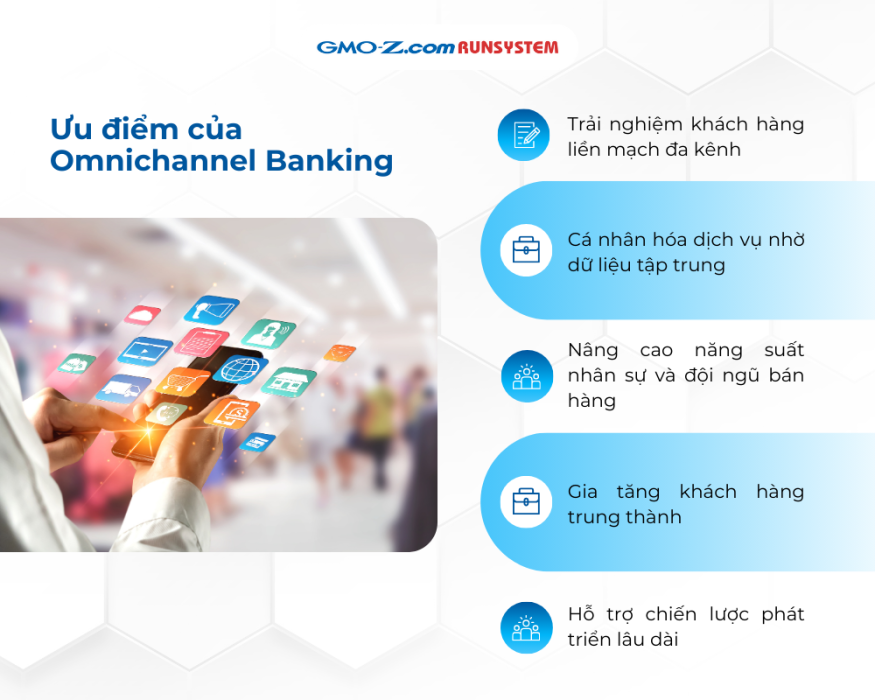
Implementing Omnichannel Banking not only meets customer demands but also delivers strategic benefits for commercial banks. Below are the key advantages financial institutions should focus on: