Family site
Family site
Family site



Hiring a dedicated development team means five decisions, not one: what it costs, who's actually on the team, how long until they're productive, the process to hire one, and the contract terms that decide who carries the risk. Most guides answer the first and call it done.
That gap shows up in month four, not month one. The quoted $25,000-$35,000 team turns out to be a mix of developers, QA, and PM, not four coders. And "staffed in two weeks" measures when billing starts, not when the team actually performs like one that's been together a quarter.
This guide covers all five:
A dedicated development team is a group of engineers a vendor recruits and pays, working full time for one client over multiple quarters, with the client, not the vendor, setting priorities. Two variables define it: who manages daily work and whether the same people stay quarter after quarter. Where they sit doesn't matter.
You're buying three things: continuous engineering capacity, accumulated product knowledge, and control over the backlog. The vendor recruits, pays, retains, and employs the people. That split only pays off across multiple quarters. A one-off build is cheaper under a different model, and that's where the three engagement types actually diverge:
Comparing these three models by how a vendor markets itself just produces noise; every vendor's website makes each one sound ideal. Compare them instead on criteria you can verify in a contract: who runs daily management, whether the same people stay on the account across quarters, how the vendor bills, and what you lose when the engagement ends.
The table below summarizes the three models on those verifiable terms:
Criterion | Dedicated development team | Staff augmentation | Project outsourcing (fixed scope) |
Who manages daily work? | You | You | The vendor |
Who is accountable for the outcome | Shared; you own the backlog, and the vendor owns the delivery capacity. | You | The vendor |
Do the same people stay across quarters? | Yes, by design. | Often, but no contractual guarantee | No; the team disperses after delivery. |
How you're billed | Monthly rate per role, ongoing | Hourly or monthly rate per person | Fixed price against a defined scope |
Best-fit commitment length | Multiple quarters to years | Weeks to a few months | Single project with a defined end date |
Highest cost at contract end | Ramp-down and rehire if you need the capability again. | Minimal; capacity was never yours to retain. | Product knowledge; it leaves with the team |
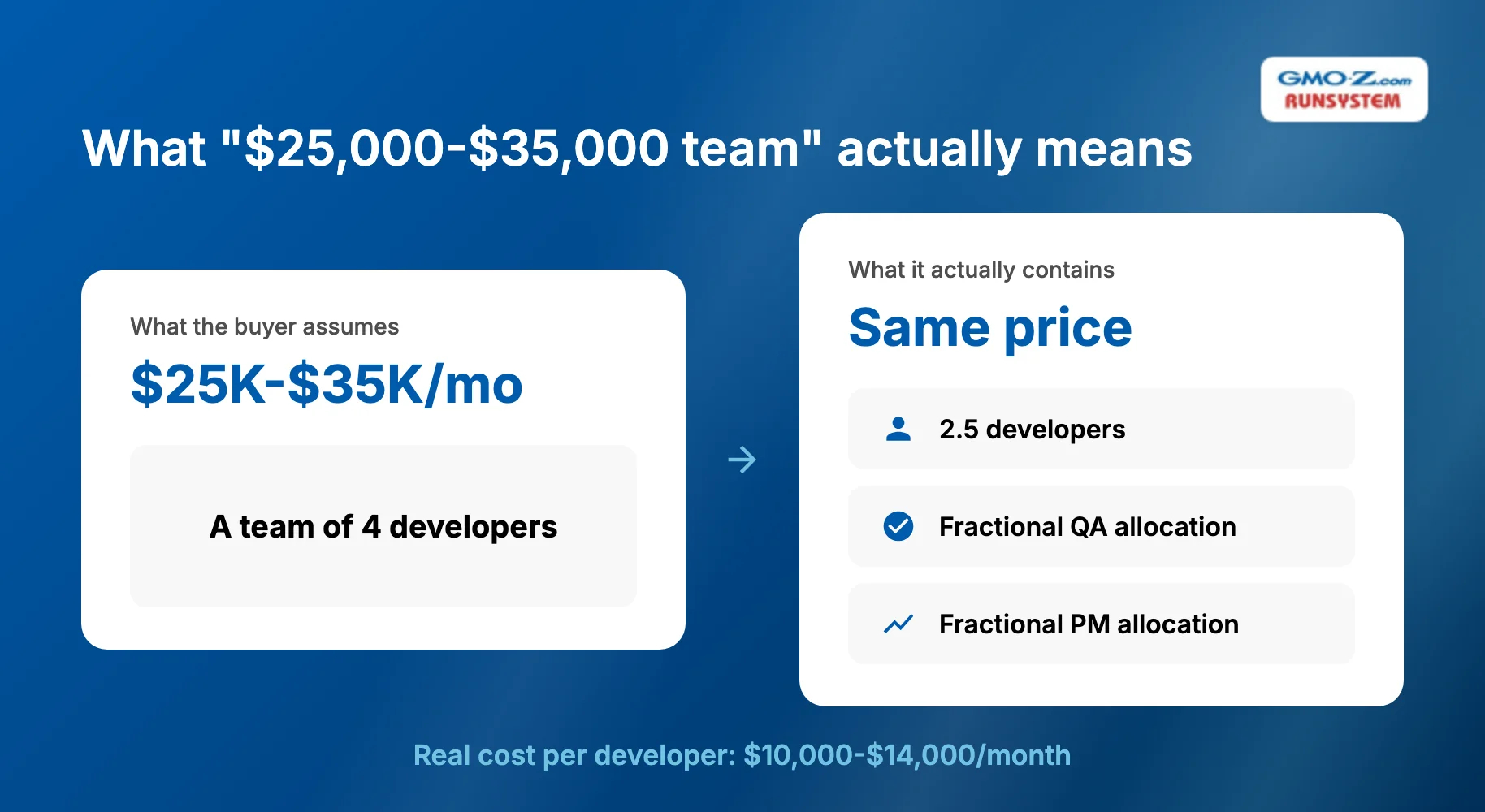
The $25,000 to $35,000 a month you'll see quoted for a four-person team, or $6,250 to $8,750 per person, isn't a lie. It's just answering a different question than the one that matters to your budget: what a team costs, not what a developer costs. That team is a mix of developers, QA, and PM, not four coders. Only 2.5 of the four are actually writing code, which puts real cost per developer at $10,000 to $14,000 a month, nearly double the headline number.
Two questions unbundle a quote so it's actually comparable to another vendor's:
(per PwC and Accelerance's 2026 rate guide). Almost no quote states whether it's included.
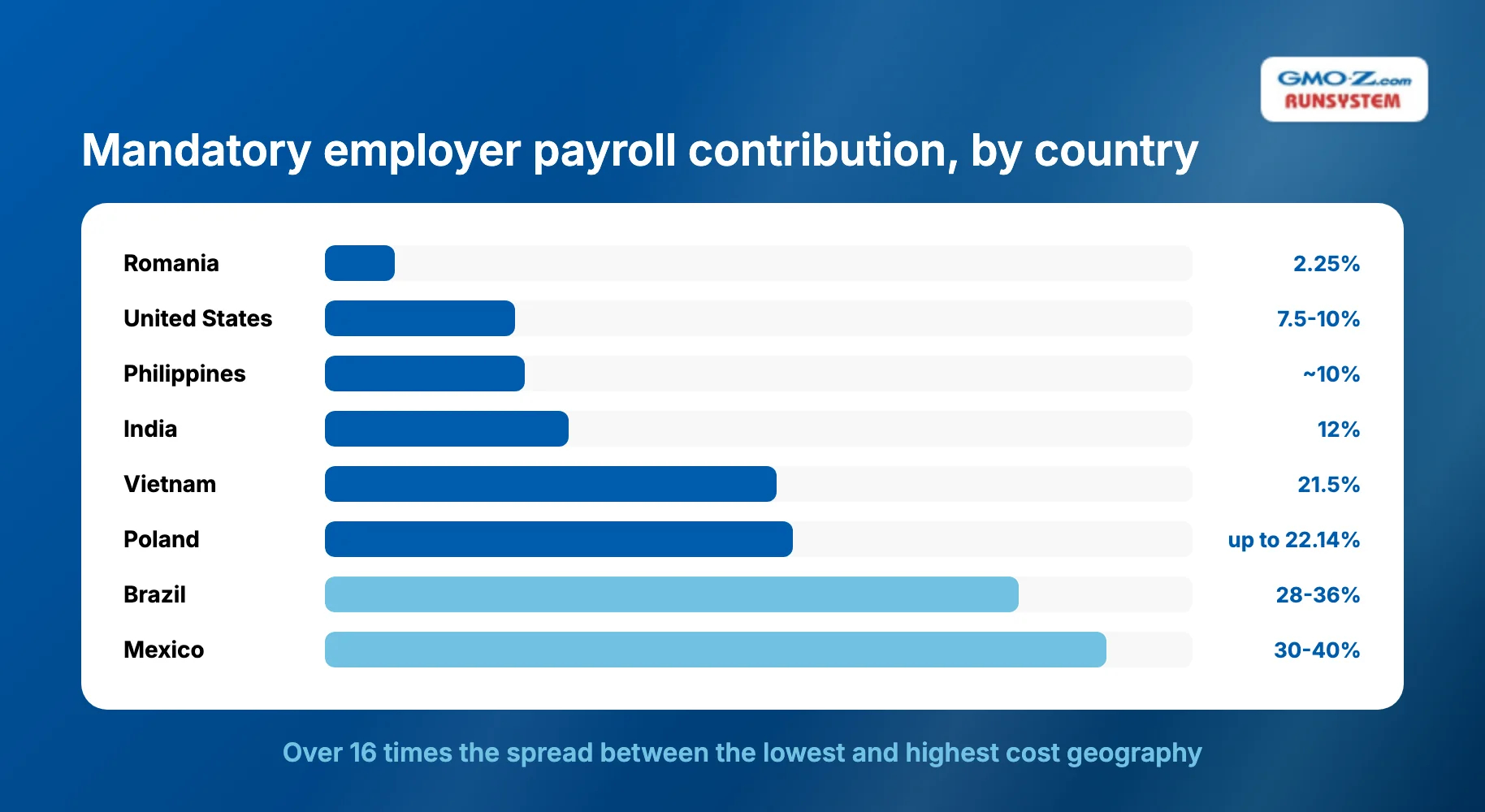
A blended rate also carries bonuses and benefits, training, overhead (seats, licenses, security tooling), bench buffer, and vendor margin, all scaling by percentage rather than a fixed dollar figure per country. Require the vendor to itemize the quote into three lines: full-time developer count, non-technical role allocation, and mandatory employer contributions. That's what makes two quotes comparable.
Back to topTwo separate milestones matter here, and vendors that quote only one are answering a different question than the one that sets your budget:
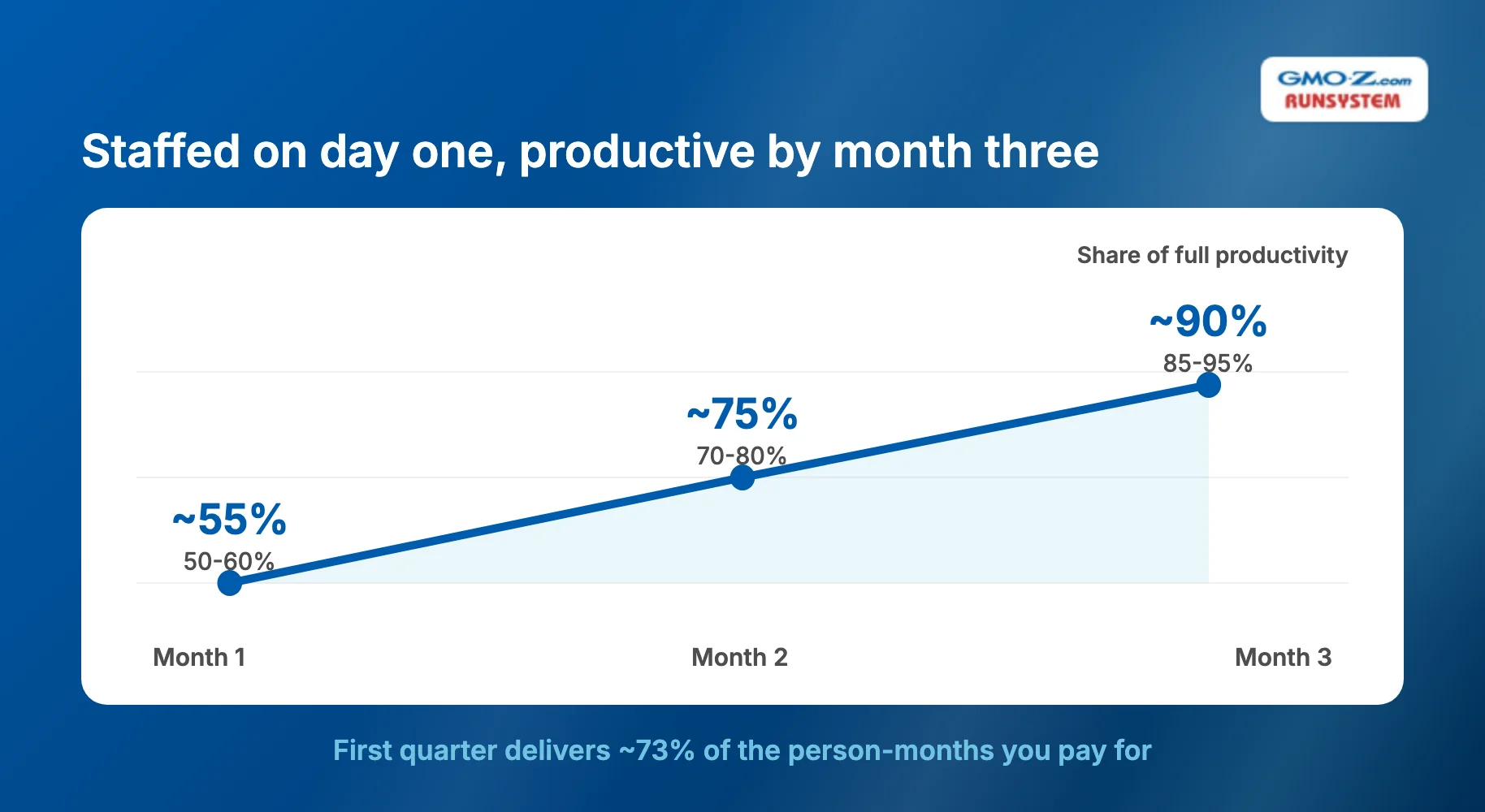
The ramp-up curve vendors report most often: month one at 50-60% productivity, month two at 70-80%, and month three at 85-95%. That's about 73% of the person-months you pay for in the first quarter. Real first-quarter cost lands at $8,500-$11,900 per effective person-month, roughly 36% above the listed rate. Complex domains- fintech, healthcare, infrastructure- can stretch that to 12-16 weeks.
This isn't theoretical: a Phase 1 CRM implementation for a Vietnamese commercial bank went live in roughly three months, syncing 1.6 million customer records across 1,600 relationship managers and the bank's core banking, AML, and loan origination systems.
Set your acceptance milestone at the end of month three, not week two, and negotiate the first-quarter rate against that milestone.
Back to topPM, BA, architect, developer, QA, DevOps, and UX: the familiar role list is accurate, but it doesn't tell you which ones you must pay for full time. Group them by payment structure instead:
One role most vendors don't raise: communication overhead. When your team and the vendor's engineers cross a language or documentation-standard gap, that cost shows up whether or not anyone is formally assigned to manage it. On a cashless payment platform built for a Japanese client, a team of more than 20 staffed it directly, including a Comtor, a translation and interpretation role embedded in the delivery team.
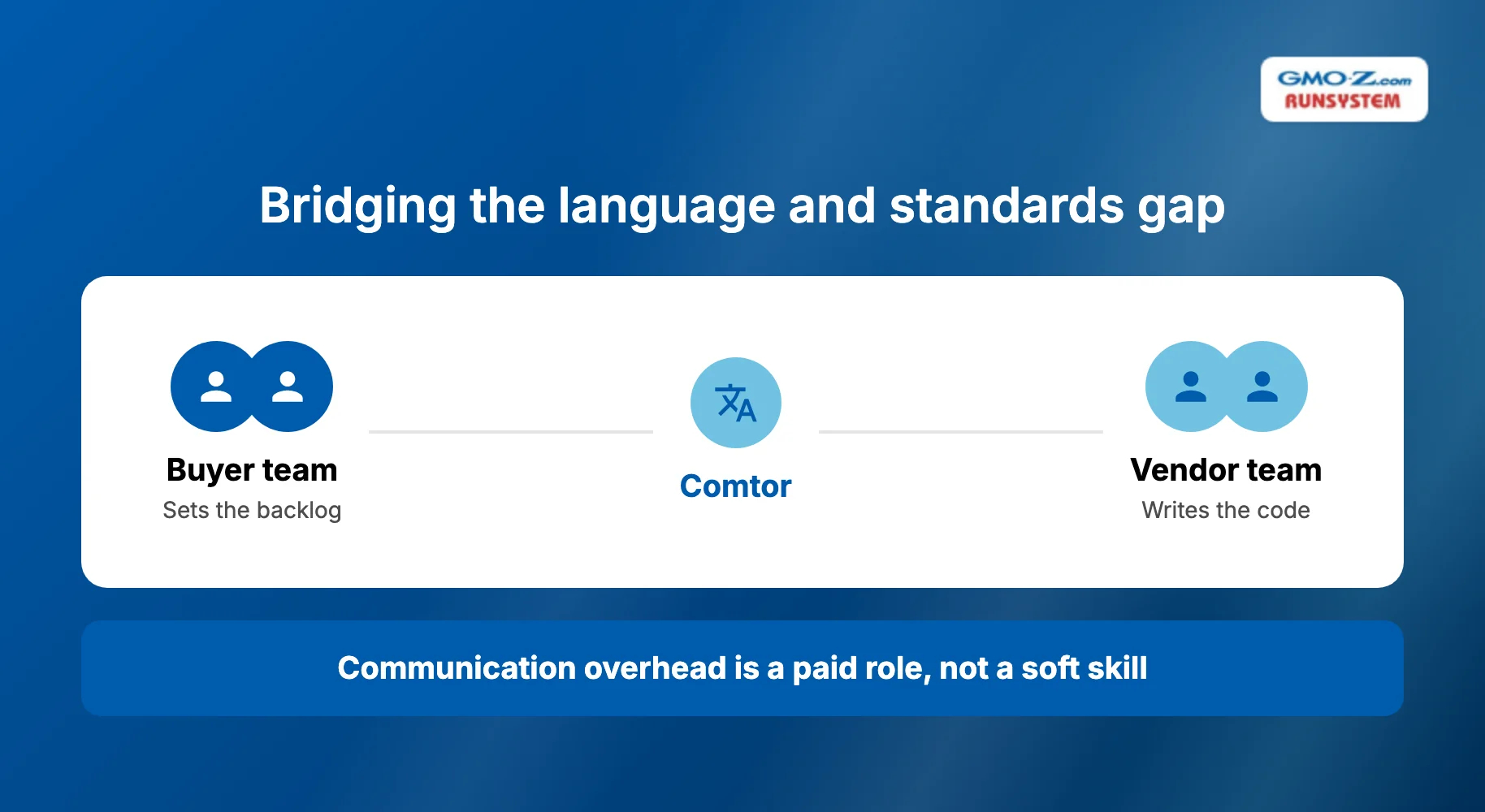
Budgeting that gap as a paid role costs less than letting it silently absorb developer hours: poorly organized offshore collaboration adds 15-25% to timelines from back-and-forth rework, versus 5-10% for well-organized teams (vendor-reported).
Require a team roster that states who is full-time and who is fractional, as a percentage.
Back to topEach step names your action item and the reason it typically slips.
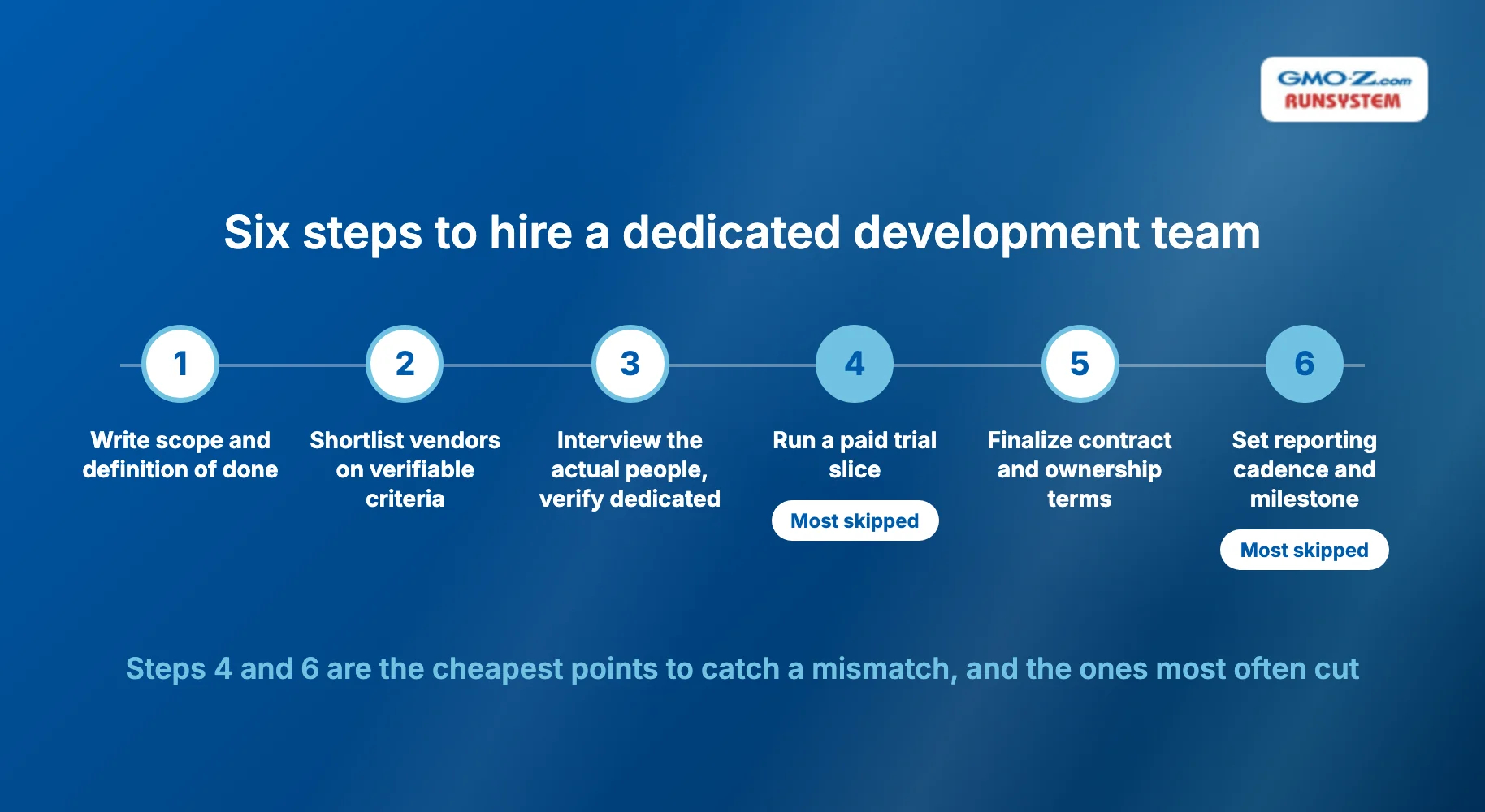
Decide who has authority to add work to the backlog before you talk to a single vendor, and put that person's name in the scope document, not just their title.
This is the step that slips most quietly. No one internally has the standing to say no to scope creep, so every stakeholder request quietly becomes "in scope," and the team you hired for one thing ends up doing another.
Use a review platform to filter the first round. But score finalists on the questions in Step 3 and the contract terms covered later in this guide, not on how the proposal reads.
Teams default to scoring vendors on how polished the homepage or the pitch deck looks. A polished deck says nothing about who actually shows up on your team or what happens when someone leaves it.
Ask to meet the specific engineers proposed and the person who will lead them, not a sales engineer standing in for the team. Every vendor will claim the team works only for you, so verify it with questions answerable by a contract clause, not reassurance:
Two to three weeks, real scope, with a formal acceptance step at the end, not an open-ended "getting to know you" period. It's the cheapest point in the entire process to catch a mismatch. A bad hire here costs a few weeks. A bad hire missed here costs a quarter.
It's also one of the two steps most often skipped under time pressure and the one most worth protecting.
Settle source code ownership, data handling, and certification scope before the team touches your repository, not after. Full details are in the contract section below.
Assign one named person on your side to answer the vendor's questions within 24 hours, and set the acceptance milestone at the end of month three, not the staffing date.
This is the second step most often skipped, and for the same reason as Step 1: no one internally owns it. A team without a fast answer channel loses days to blocked questions instead of shipping.
Back to topEach failure mode below includes the fix and what it costs, named against a real project where the evidence exists.
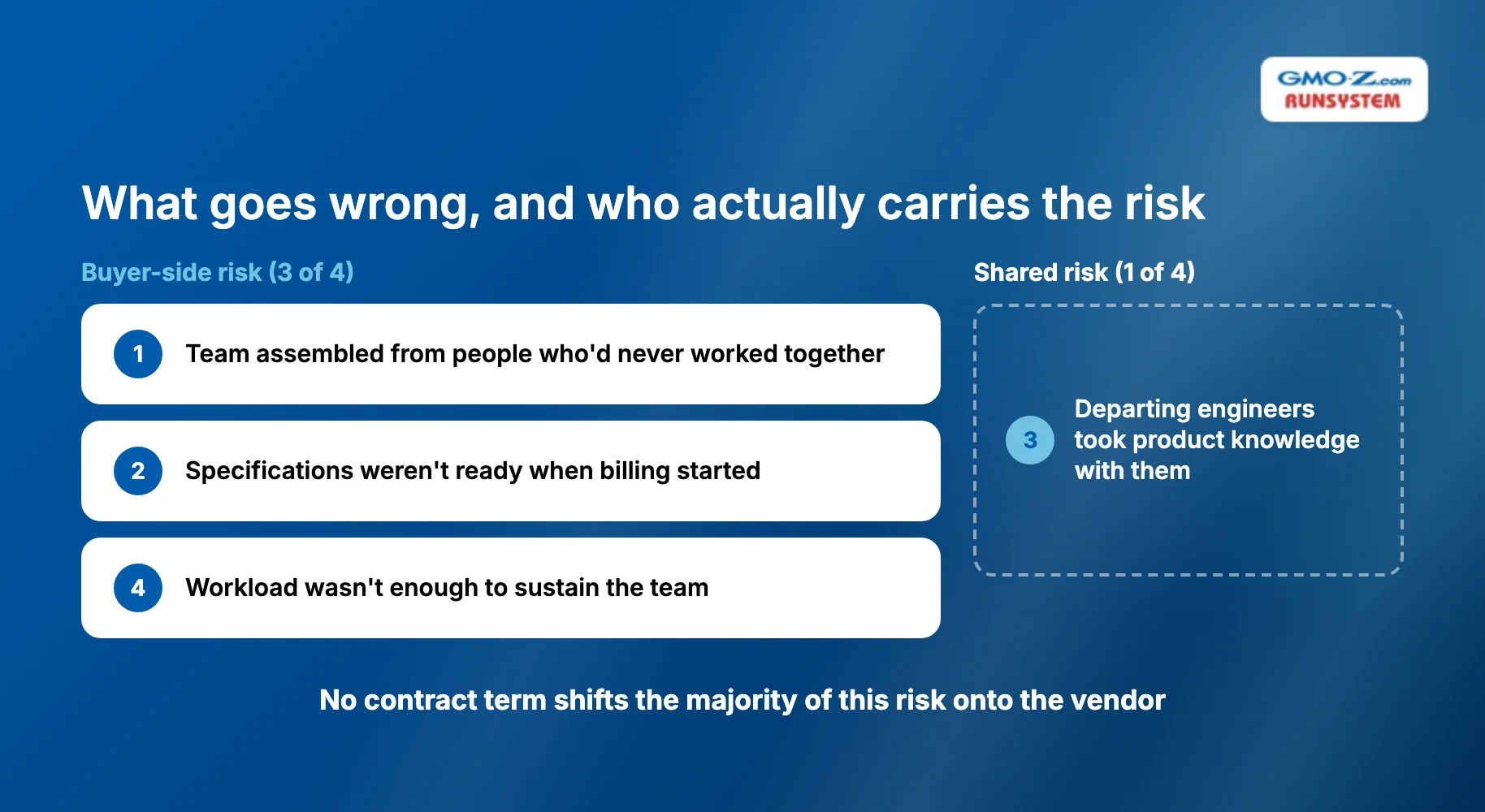
The pattern across these four: three of the four are buyer-side risks, and no contract term shifts them onto the vendor.
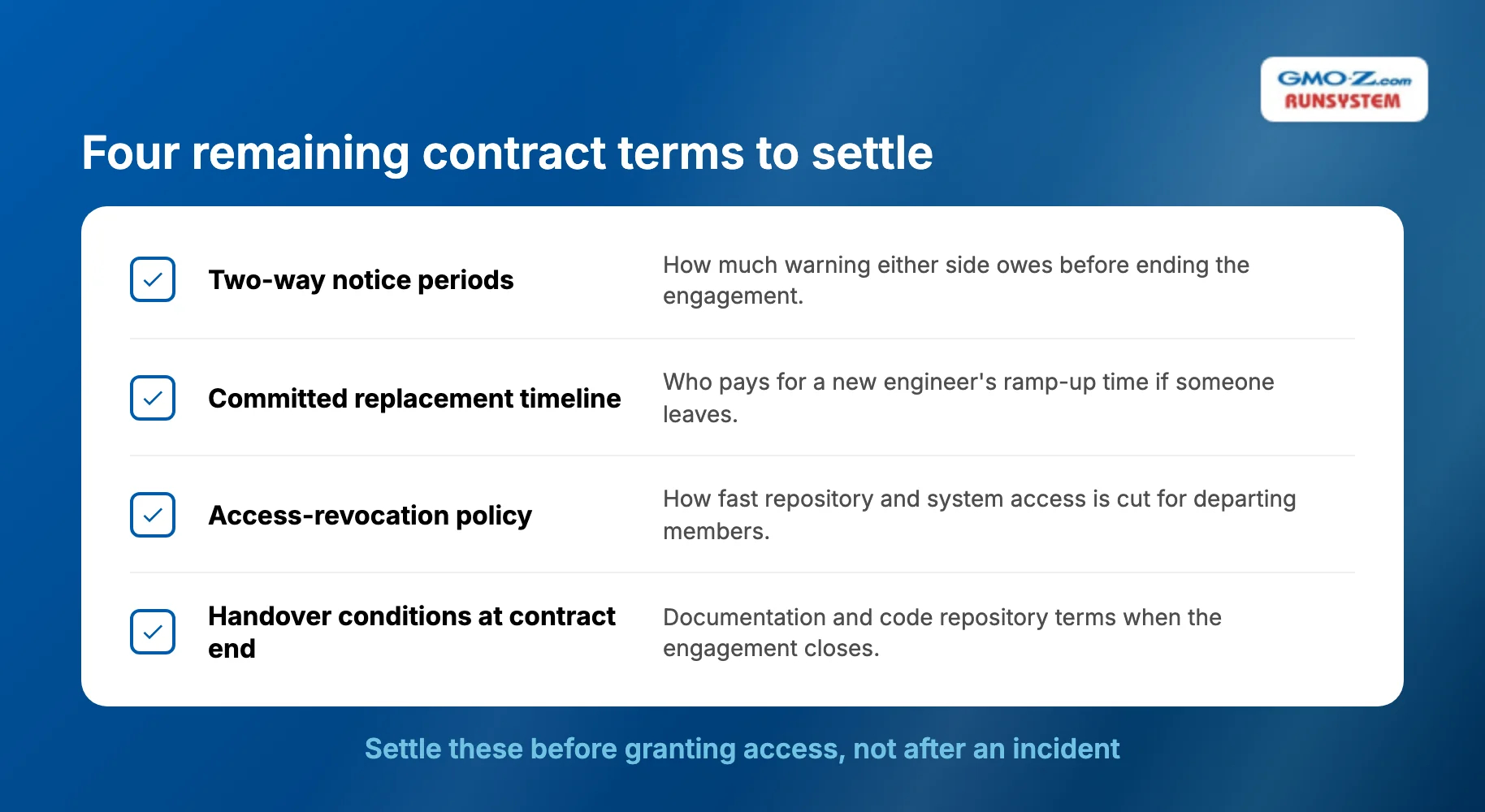
Back to topFive terms to settle before granting access, not after an incident:
GMO-Z.com RUNSYSTEM has held ISO/IEC 27001 since 2014 (2022 revision since 2025) and CMMI Level 3 since 2012, most recently recertified in 2024. That covers information security management and process maturity, not every compliance framework a given industry might require, so confirm scope against your specific regulatory needs.
Back to topThree verifiable numbers from the sections above are what actually belong in a contract negotiation.
Two points get confused most often. "A four-person team" doesn't mean four developers. "A team in two weeks" doesn't mean productivity in two weeks.
Send GMO-z.com RunSystem your scope and timeline, and you'll get back a team roster that states who's full-time, who's fractional, and where the first-quarter acceptance milestone sits, before you sign anything.
Back to topBased on the $25,000-$35,000 team figure, a single developer runs $6,250 to $8,750 a month, or roughly $37 to $52 an hour at 168 working hours. But mandatory employer payroll contributions vary by more than 16 times between countries, so the same monthly rate doesn't buy the same thing everywhere.
Write the scope and definition of done, shortlist vendors on verifiable criteria, interview the actual proposed engineers, run a paid trial slice of real work, finalize contract and IP terms, and then set a reporting cadence. The paid trial is the step most commonly skipped, and it's the cheapest one to catch a mismatch.
A group of engineers a vendor recruits and pays, working full time for one client across multiple quarters. The client controls the backlog, and the same people stay on the account quarter after quarter, unlike project outsourcing, where the team disperses at contract end.
Staffing takes two to four weeks. Stable productivity takes roughly three months. The first quarter typically delivers only about 73% of the person-months billed, based on vendor-reported ramp-up curves, so budget the gap rather than assuming day-one output.
Four to six developers. Below that floor, fixed non-technical costs (PM, QA, overhead) can no longer be spread across enough billable hours to stay efficient, and below three developers, staff augmentation is usually the better-fit model.
Back to top