Family site
Family site
Family site



IT staff augmentation is hiring engineers from an outside provider to fill gaps in a team you already run. They work inside your existing process and report to your managers day-to-day, then roll off when the engagement ends.
The workflow itself is simple. You specify the missing skill, the provider sends candidates, you interview and select, and the engineer joins your team under your management. (Weighing a longer-term dedicated engineering unit instead? That comparison lives in a separate breakdown of offshore delivery centers.)
Four other lists currently rank companies for this keyword. All four score vendors the same way, by star rating, and not one publishes what a quoted rate actually includes. The list below scores on six criteria you can verify yourself instead, not how many five-star reviews a vendor has collected.
Back to topStar ratings measure how satisfied past clients were, not whether a vendor's pricing or delivery model fits your project. Near, the site currently ranked first for this keyword, requires "a minimum of 50 verified reviews with 4.5 stars or higher." PeopleManagingPeople weights client reviews at 10% of its total score.
Both are legitimate signals of client satisfaction. Neither tells you what the hourly rate covers, or how attrition gets handled. (Attrition here means the rate at which a vendor's engineers leave and get replaced. It doesn't tell you what happens when your specific assigned engineer leaves mid-sprint.)
This list scores six criteria instead, all verifiable from public sources:
Each entry below cites the public source behind each data point, so you can verify it independently rather than take our word for it.
The 10 companies here show up repeatedly across existing category rankings, meaning Clutch, G2, and the four competing lists for this keyword, and each has enough public information to score against all six criteria. Vendors with no verifiable pricing or certification data anywhere online got left out.
Note: The list runs alphabetically, not by rank.
The 10 best IT staff augmentation companies in 2026
Ten providers appear consistently across public category rankings for this keyword. Each entry below opens with one line of context, then an at-a-glance table built from the same six criteria. That table includes the gaps where a vendor hasn't published a figure.
Apex Systems runs a proprietary database of 20 million-plus consultants across the US, Mexico, and Canada, and layers "deliverable-based consulting" on top of straight placement rather than billing for headcount alone:
Type | US staffing firm |
HQ and delivery regions | Glen Allen, Virginia, with delivery across the US and Canada |
Published rate | Not published on Clutch |
Minimum engagement | Confidential, per Clutch (0 reviews with pricing disclosed) |
Certifications | Not published |
Attrition disclosed | No |
Notable clients/projects | Not disclosed by name; published case studies use anonymized descriptors only (e.g. "a clinical technology company") |
Best for | Large enterprises running multi-year staffing contracts that need a national US recruiting bench |
Limitation | No public pricing, certification, or named-client data to compare against other vendors on this list |
BairesDev markets a sub-1% acceptance rate on its engineer vetting funnel, and it's run fully remote since founding in 2009, before remote delivery was standard industry practice:
Type | Offshore software development company |
HQ and delivery regions | San Francisco HQ, delivery teams across Buenos Aires, São Paulo, Mexico City, Bogotá and Barcelona |
Published rate | $50-99/hour average, per Clutch; independent client reports cite $80-180/hour for senior or specialist roles |
Minimum engagement | $50,000+ project size, per Clutch |
Certifications | ISO/IEC 27001:2022 and SOC 2 compliant |
Attrition disclosed | Yes: 9% (2025), down from 12% (2023), which the company describes as well below the industry rate |
Notable clients/projects | Google (Android TV launch testing) and Avigilon/Motorola, both published as named case studies |
Best for | US companies that need Latin America-based engineers working in real-time overlap with US business hours, and want a disclosed attrition figure to underwrite continuity risk |
Limitation | Attrition and certification figures are self-reported; the underlying claim isn't independently audited in a public registry |
Connext runs a "co-managed" model rather than acting as a pure placement agency. It bundles employer-of-record payroll and compliance with embedded team support across its own offices in the Philippines, Colombia, Mexico, and India:
Type | Philippines-focused staffing provider |
HQ and delivery regions | US-based HQ, owned delivery offices in the Philippines, Colombia, Mexico and India |
Published rate | Under $25/hour, per Clutch |
Minimum engagement | $1,000 minimum project size, per Clutch |
Certifications | Not published |
Attrition disclosed | No |
Notable clients/projects | Not disclosed by name; published success stories use anonymized descriptors only (e.g. "a leading IT expense management software company") |
Best for | Cost-sensitive roles that don't require close US timezone overlap |
Limitation | Lowest published rate on this list also comes with the least disclosed process and client detail |
GMO-Z.com RUNSYSTEM is the only vendor on this list owned by a publicly traded parent: Tokyo Stock Exchange-listed GMO Internet Group, since a 2011 acquisition. That ownership gives it direct access to Japanese enterprise clients, and Japan-standard process discipline layered on Vietnamese delivery costs:
Type | Offshore software development company |
HQ and delivery regions | Part of GMO Internet Group (Japan), delivery teams in Hanoi, Ho Chi Minh City, Da Nang, and Hue |
Published rate | Under $25/hour, per Clutch; reflects Vietnam's delivery cost base, not a full picture of what a built-up staff augmentation rate includes |
Minimum engagement | $100,000+ project size, per Clutch; the highest minimum on this list, positioned for larger and longer-term engagements rather than single-role augmentation |
Certifications | CMMI Maturity Level 3 (v1.3, first certified 2012, recertified 2024), ISO 9001:2015 (recertified 2019), ISO/IEC 27001:2013, covering all four delivery cities |
Attrition disclosed | No |
Notable clients/projects | ABBank (An Binh Commercial Joint Stock Bank, Vietnam); Phase 1 CRM synchronizing 1.6M+ customer records for 13,000+ internal users, delivered in 3 months |
Best for | Teams needing Japan or Korea market delivery, backed by in-house BrSE (bilingual bridge engineers) and Comtor (Korean-language coordinators), a staffing category few Western vendors on this list carry at all |
Limitation | $100,000+ minimum prices out single-role augmentation requests; attrition rate is undisclosed |
Insight Global runs Evergreen, a separate managed-services division reported at $600 million-plus in annual revenue and layered on top of core staffing, which positions the company as a hybrid staffing-plus-delivery firm, not pure placement:
Type | US staffing firm |
HQ and delivery regions | Atlanta HQ, with 63 branch offices across the US |
Published rate | Not published on Clutch |
Minimum engagement | $5,000+ project size, per Clutch |
Certifications | Joint Commission Gold Seal of Approval, but only for its healthcare staffing division, not general IT staffing |
Attrition disclosed | No specific figure; the company states turnover has "dropped by more than half" since a 2017 peak, without publishing a rate. |
Notable clients/projects | American Express, AT&T, Bank of America, and Goldman Sachs appear on Insight Global's own client-logo list, but without a disclosed case study behind any of them. |
Best for | US-based roles that require on-site presence rather than remote delivery |
Limitation | The branch-office model is built for domestic US placement, not offshore cost savings. |
KITRUM kept roughly 150 Ukraine-based employees and their clients through the 2022 invasion. That continuity story was covered independently by Inc. and the Kyiv Independent, not just self-reported:
Type | Offshore software development company |
HQ and delivery regions | US HQ, delivery teams in Ukraine and Poland |
Published rate | $50-99/hour, per Clutch |
Minimum engagement | $25,000 minimum project size, per Clutch |
Certifications | ISO/IEC 27001 |
Attrition disclosed | No |
Notable clients/projects | Lulalend (digital lending platform) and Turf Tank (robotics/industrial automation), both published with on-record CTO quotes; Scribd and Ziip named as clients as of 2021 |
Best for | Mid-market projects that can absorb a $25,000 minimum and want Eastern Europe-based engineering |
Limitation | Minimum project size prices out smaller staff augmentation requests |
Near sources exclusively from six countries chosen for real-time US business-hour overlap (Argentina, Brazil, Colombia, Mexico, Costa Rica, and Venezuela), a narrower and more deliberate filter than competitors that just market "Latin America" broadly. It also happens to be the site currently ranked first in search results for this exact keyword, a fact worth stating plainly rather than treating as a coincidence:
Type | Latin America-focused staffing provider |
HQ and delivery regions | San Antonio, Texas HQ, talent sourced across Argentina, Brazil, Colombia, Mexico, Costa Rica, and Venezuela |
Published rate | Under $25/hour, per Clutch; unusually low next to other Latin America vendors on this list, worth confirming with Near directly whether this is a candidate pay rate or a fully-loaded bill rate before you quote it |
Minimum engagement | $5,000+ project size, per Clutch |
Certifications | Not published |
Attrition disclosed | No |
Notable clients/projects | CyberFortress; built a 20-person finance/accounting team, publishing $1.2-1.38M in annual savings and a month-end close cut from 15 to 10 days |
Best for | US companies prioritizing Latin America timezone overlap over published pricing |
Limitation | Ranks itself first in its own published ranking for this keyword, a conflict of interest the site doesn't disclose |
Revelo has repositioned twice: it launched in 2015 as job-matching platform Contratado, pivoted into full-stack Latin America staffing, and more recently added AI data-infrastructure work (expert annotators, RL training environments) on top of its 400,000-plus engineer network. None of the other Latin America staffing vendors here have made that second pivot:
Type | Latin America-focused staffing provider |
HQ and delivery regions | Miami, Florida HQ, talent sourced across Latin America |
Published rate | Confidential, per Clutch; secondary sources most commonly cite $50-70/hour, unconfirmed on Revelo's own pricing page |
Minimum engagement | Confidential, per Clutch |
Certifications | Not published |
Attrition disclosed | Yes, indirectly: an 89% three-year retention rate for placed engineers and a 95%+ client retention rate, published on Revelo's own site |
Notable clients/projects | Not disclosed as full case studies; testimonials name Ducky.ai, Harbor and Cabana as clients, but only as quoted logos without verifiable metrics |
Best for | Teams that want pre-vetted candidates filtered specifically for US business-hour overlap, and a disclosed retention figure instead of a rate |
Limitation | No published rate range or minimum engagement to compare against other vendors |
Toptal publishes the one number none of its marketplace competitors disclose: under 3% of applicants pass its five-stage screening funnel. That funnel covers language and communication, technical assessment, live interviews, and a test project:
Type | Talent marketplace |
HQ and delivery regions | San Francisco HQ, global talent network with no fixed delivery region |
Published rate | $100-149/hour average, per Clutch; client-side reports commonly cite $60-200+/hour including markup |
Minimum engagement | $50,000+ project size, per Clutch, though the practical minimum is closer to a 20-hour-per-week engagement |
Certifications | SOC 1, SOC 2 and ISO 27001, but scoped to its Toptal Pay payment platform, not the core talent-matching platform |
Attrition disclosed | No |
Notable clients/projects | WaitWhat (media company behind Reid Hoffman's Masters of Scale); built a mobile app converting 120 podcast episodes into daily practices, delivered in under 7 months |
Best for | Short, individually-scoped roles where you want to select and manage one freelancer directly |
Limitation | Marketplace model means no managed team, coordination across multiple hires is on you |
Vention is the 2023 rebrand of iTechArt Group, a 20-plus-year-old firm. It reports backing 20+ client IPOs and 10+ unicorn exits, a specific track-record claim, unlike the generic "we've helped many startups" positioning most competitors use. Note: this is unrelated to the Montreal-based industrial-automation company that also uses the name Vention:
Type | Offshore software development company |
HQ and delivery regions | New York HQ, delivery teams across multiple offshore regions |
Published rate | $50-99/hour, per Clutch |
Minimum engagement | $50,000 minimum project size, per Clutch |
Certifications | Not published |
Attrition disclosed | No |
Notable clients/projects | PayPal, IBM, Mount Sinai and PwC appear on Vention's own client list, but as logo mentions without a disclosed case study behind any of them |
Best for | Larger-scope engagements that clear the $50,000 project minimum |
Limitation | Highest published minimum project size on this list, out of reach for smaller staffing needs |
Staff augmentation comes in four working models, and knowing which one a vendor is proposing changes how you should negotiate the contract.
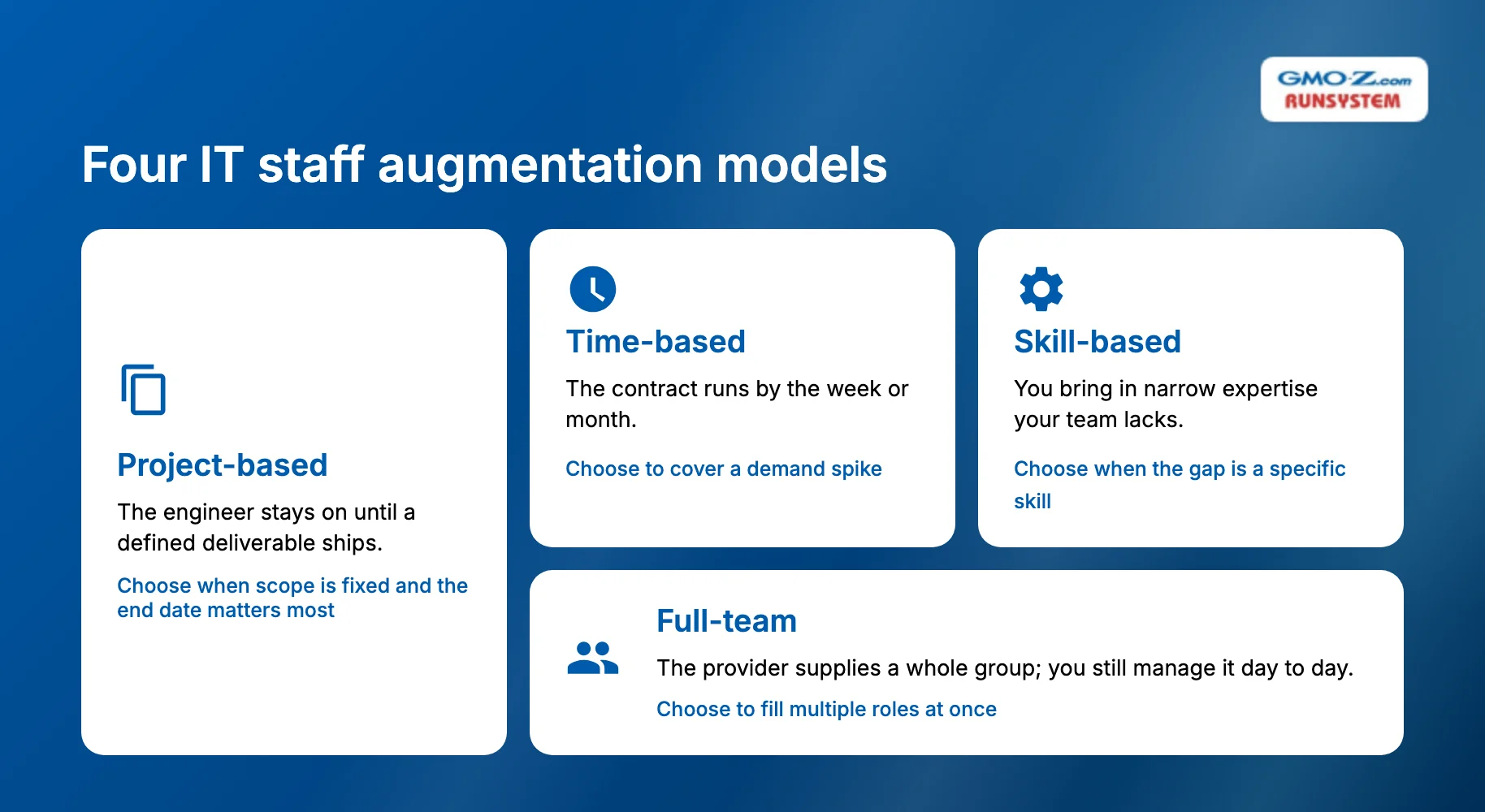
The two models differ on exactly one point: who manages the team day-to-day. In staff augmentation, including the full-team variant above, that's you. In a dedicated team, the provider does.
That distinction maps directly onto the vendor types in the table above: Toptal sells individual freelancers, while the other nine sell teams you still manage. So when does that daily management burden justify switching to a dedicated team? That threshold is covered later, in "The two thresholds where a dedicated team wins." (For a full breakdown of the dedicated model itself, see our companion piece on offshore delivery centers.)
Back to topA quoted hourly rate is a bundle, not a wage. Clutch publishes rate bands for each vendor ("under $25," "$25-49," "$50-99") but doesn't disclose what sits inside that band, and the other three ranking sites don't publish rates at all. None of the four explains what you're actually paying for.
Table 1 breaks down what this bundle, the blended rate, is typically built from. Figures are shown as a share of the rate, not a dollar amount, because the underlying cost varies enormously by country:
Component | Approximate share of blended rate |
Base salary | 45-55% |
Mandatory employer contributions | 10-25% (varies sharply by country, see Table 2) |
Statutory and customary bonuses/benefits | 5-10% |
Training, amortized | 2-5% |
Workstation, equipment, software licenses, and security tooling | 5-10% |
Bench cost (engineers between assignments) | 3-8% |
QA and project management allocation | 5-10% |
Provider margin | 10-20% |
Table 2 shows why the mandatory employer contributions line above isn't comparable across vendors quoting the same rate. This line item makes two identical hourly quotes cost you differently, depending on where the engineer is legally employed:
Country | Mandatory employer contribution |
Romania | 2.25% |
United States | Approximately 7.5-10% (FICA, the payroll tax funding Social Security and Medicare, at 7.65%, plus FUTA, the federal unemployment tax, at 0.6%, plus state unemployment tax; the Social Security portion applies up to $184,500 in wages) |
Philippines | Approximately 14.5% (SSS, the state social security fund, at 10%; PhilHealth, public health insurance, at 2.5%; Pag-IBIG, a mandatory housing fund, at 2%) |
India | 12% (EPF, the Employee Provident Fund, a mandatory retirement savings scheme) |
Vietnam | 21.5% |
Poland | Up to 22.14% (ZUS, the state social insurance system) |
Brazil | 28-36% |
Mexico | 30-40% |
The gap between Romania's 2.25% and Mexico's upper bound of 40% is more than 16 times. A vendor quoting the same $60/hour rate in both countries is not selling you the same cost structure, even if the invoice looks identical.
Three costs sit outside the quoted rate entirely, and none of the four competing lists mentions any of them:
Here's the honest line to draw: the four lists ranking above this article for this keyword score vendors by star rating. None of them explains what a quoted rate includes. This section is that breakdown.
To be equally transparent, RUNSYSTEM doesn't publish its own rate structure publicly either.
Back to topChoosing well means asking questions a sales deck won't answer voluntarily and checking the answer against what's public, not what's promised on a call.
Ask these six questions before signing, and compare the answer to the vendor's public disclosures in the table above:
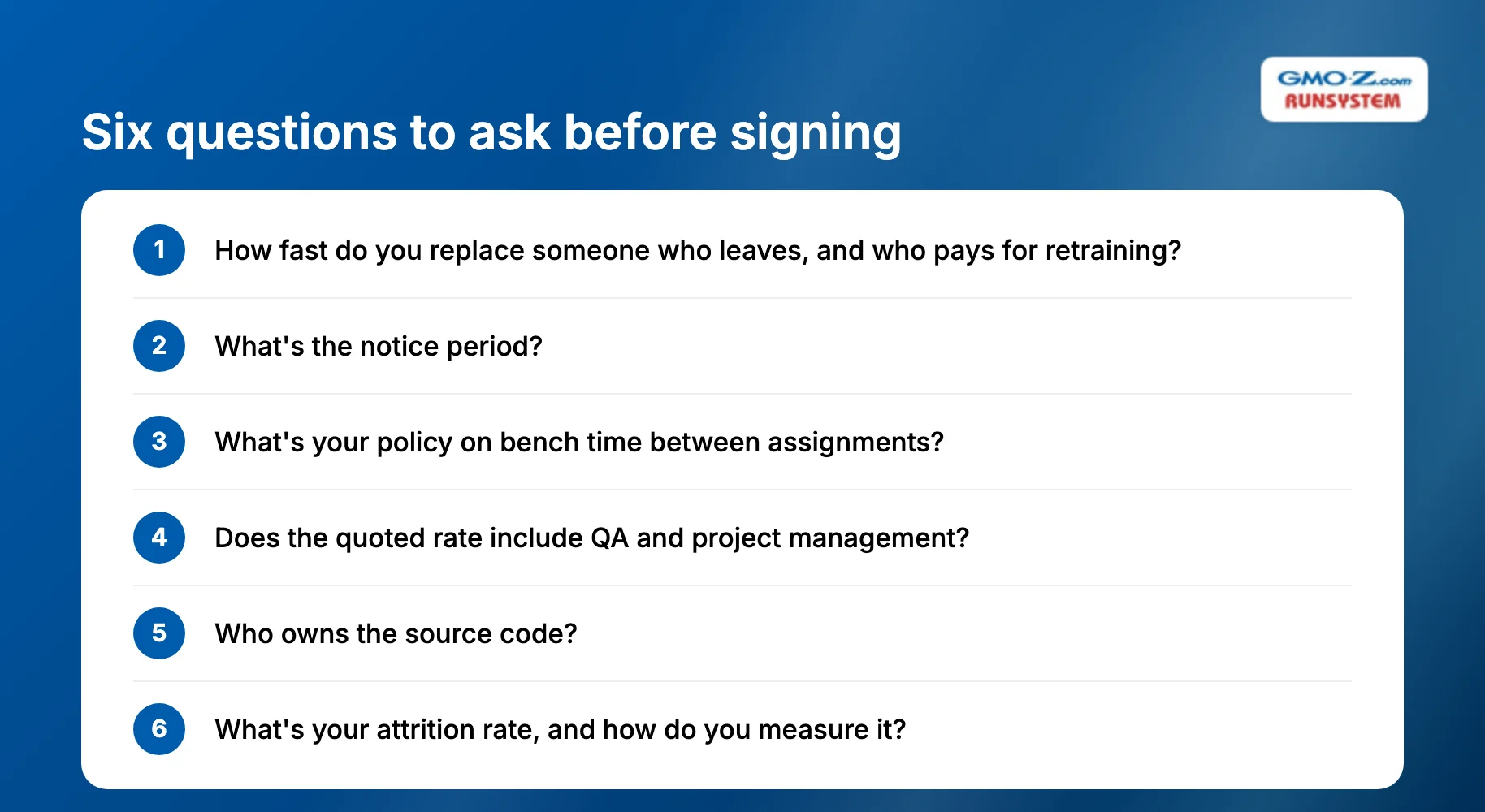
Of the 10 vendors in the table above, none publish an answer to the attrition question. Only three (Connext, KITRUM, Vention) publish enough pricing detail to partially answer the rate-inclusion question. That gap is exactly why these six questions belong in your vendor call, not just in a comparison table.
Ask GMO-Z.com RUNSYSTEM these same six questions, and you get direct answers on replacement speed, notice period, and code ownership in a scoping call, not a promise to follow up. Two of the six, rate structure and attrition rate, stay undisclosed, the same gap most vendors on this list share.
What backs the answers you do get is process history rather than a sales claim: CMMI Level 3 and ISO 9001 certification since 2012, plus ISO/IEC 27001:2022 information security certification since 2025.
And that history shows up in delivery, not just paperwork. On the SmaAD project, a four-engineer team ran continuously for GMO Tech, a Japan-based digital advertising client, starting August 2021. The team closed 135 tickets in 2022 with no missed deadlines, a concrete answer to "how do you actually run a long-running augmented team," not a claim about being the best option available.
A dedicated team becomes the better model once your committed workload or your management overhead crosses one of two measurable thresholds. It's not a switch you make on a vague sense that the relationship "feels bigger now."
The table below compares all three models on the points that actually change your risk exposure:
Staff augmentation | Full-team augmentation | Dedicated team | |
Who manages day to day | You | You | The provider |
Who's accountable for outcomes | You | You | The provider |
How you pay | Per hour or per head | Per hour or per head | Per outcome or fixed monthly scope |
Fits contracts of | Weeks to a few months | A few months to a year | A year or more |
Biggest risk | Losing an engineer mid-sprint with no backfill guarantee | Same risk, multiplied across a larger headcount | Choosing the wrong provider to trust with outcome ownership |
Two thresholds are worth tracking against your own numbers.
First: once your committed workload reaches roughly three person-years, coordinating that many individually-managed engineers costs more of your time than the model saves. Second: once your own managers spend more than about 20% of a working week coordinating the vendor relationship, that cost becomes a hidden line item. It quietly eats into whatever the lower hourly rate was supposed to save you.
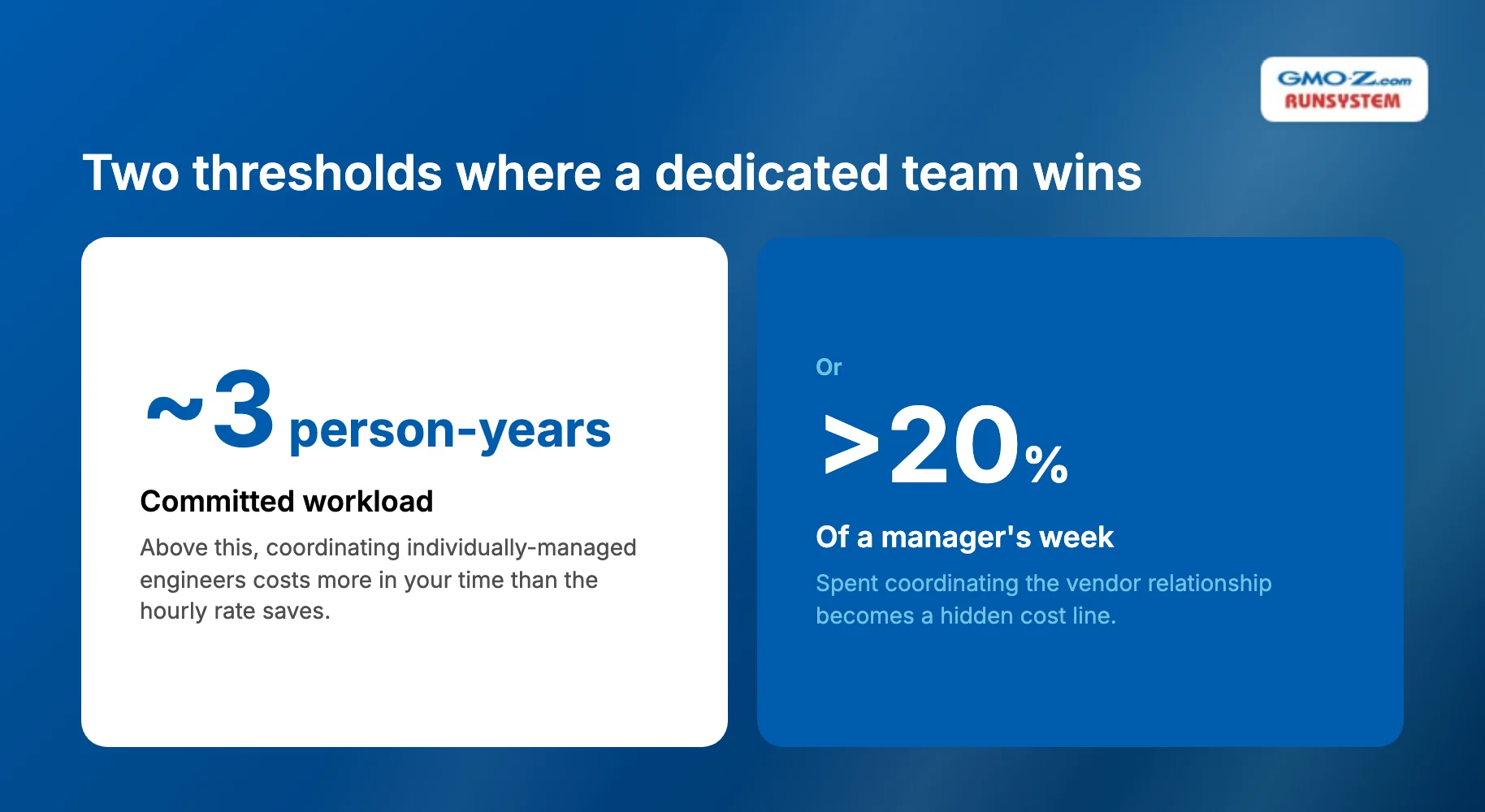
None of the four competing lists for this keyword states either threshold. The one quantified commitment all four do publish is Clutch's minimum project size, ranging from $1,000 to $50,000 depending on the vendor. That number tells you the threshold a vendor requires to take the job, not the threshold at which staff augmentation stops being the right model for you. Those are two different questions, and only one of them gets answered anywhere in the existing search results for this keyword.
Market data backs up the shift at longer contract lengths: staff augmentation held 41.7% of the combined staff augmentation and managed services market in 2025, against 58.3% for managed services, and contracts running 12 months or longer skew increasingly toward the managed model. (See our companion article on offshore delivery centers for the full comparison.)
Back to topA star rating measures how satisfied past clients were, not whether a vendor's pricing structure or delivery model fits your project.
Three traps are easy to fall into when comparing quotes side by side:
Take the six questions from the section above to RUNSYSTEM and to two other vendors from the table. Compare the answers side by side rather than the rate cards. That comparison, not a published price list, is what actually tells you which vendor fits your project.
Back to topIt depends on which of the six criteria matters most for your project: published pricing, certifications, delivery region, or minimum engagement. The comparison table above scores all 10 vendors against the same six criteria. Use it to weigh them for your own situation, rather than relying on a single ranked "best" pick.
Published rates run from under $25/hour (Connext) to $50-99/hour (KITRUM, Vention), per Clutch. That range doesn't include mandatory employer contributions, though, which vary from 2.25% to over 30% of payroll depending on the delivery country. So the same headline rate can carry very different underlying costs.
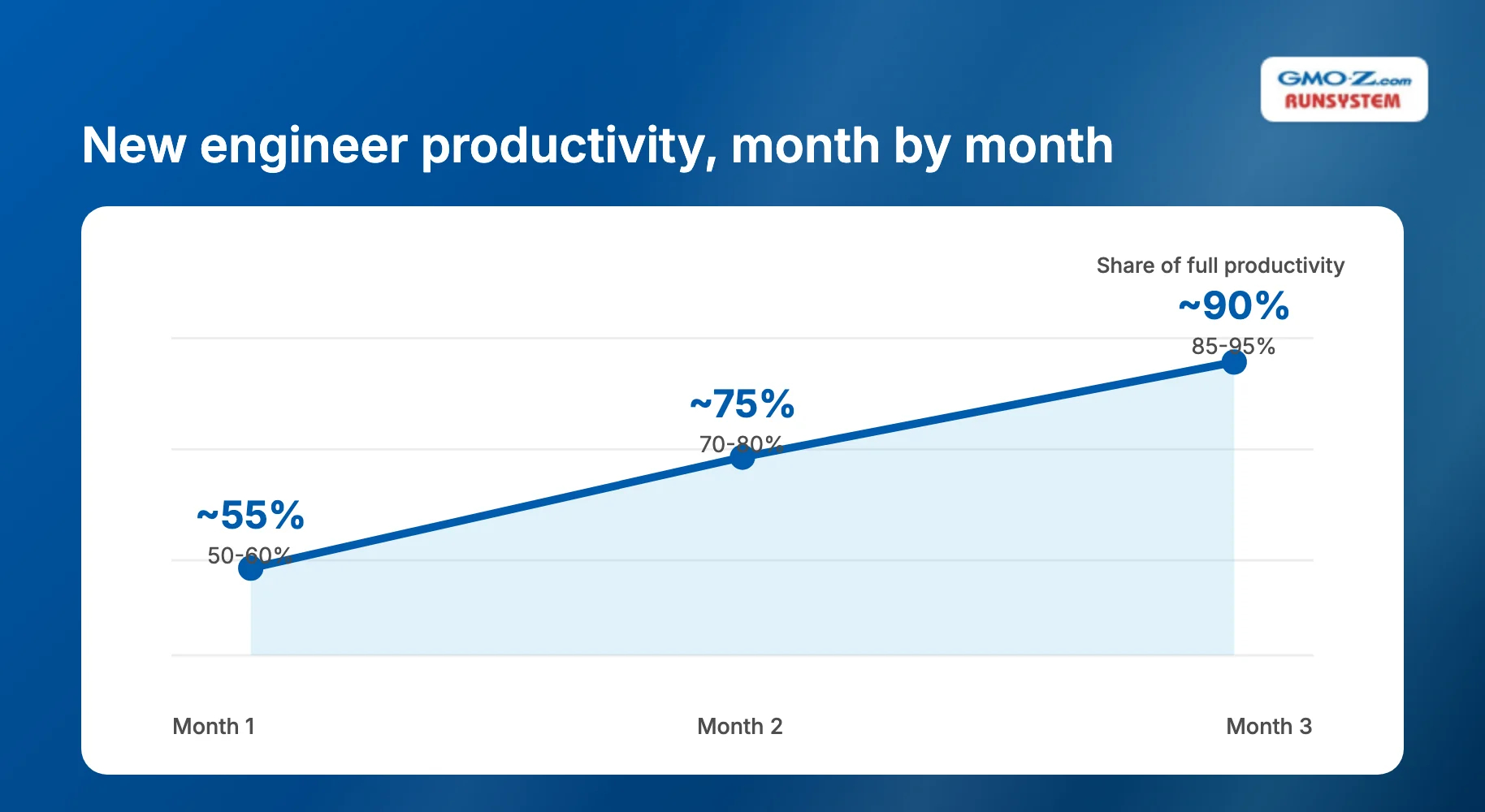
Most vendors can staff a role within days to a few weeks, but staffed and productive aren't the same thing. As a general onboarding curve, new engineers often run at roughly 50-60% productivity in month one, rising toward 85-95% by month three. Budget the ramp-up separately from the start date.
Minimum project sizes on Clutch range from $1,000 to $50,000 depending on the vendor. For a newly filled role specifically, expect most providers to ask for a 3-6 month minimum commitment rather than a single-month contract.
Switch once your committed workload reaches roughly three person-years, or once your managers spend more than about 20% of a working week coordinating the vendor relationship, whichever comes first. Below those thresholds, staff augmentation is typically the more cost-efficient model.
Back to top