ファミリーサイト
ファミリーサイト
ファミリーサイト



Before you hire a developer in Vietnam, you need to settle a question that most hiring guides answer too late: how will that developer legally sit inside your business?
That matters because the employment vehicle changes more than payroll. It affects who employs the developer, who carries compliance obligations, how much control you have, how intellectual property is assigned, and what your total employer cost looks like.
The numbers are also moving. Vietnam changed its personal income tax brackets and deductions from 1 July 2026, while published hiring guides still contain conflicting workforce, salary and employment-rule figures. This guide reconciles the available figures, separates salary from total employer cost, and compares the practical routes for a Japanese or APAC company hiring in Vietnam.
You will leave with three decisions to make in order: choose the hiring group, choose the legal vehicle, then build the cost and operating model around it.
Back to topVietnam has a substantial technology workforce, but published estimates describe different populations. Some sources count the wider technology workforce, while others count IT professionals or software developers specifically. Treating those figures as interchangeable makes the talent pool look more precise than it is. The available sources converge around roughly 530,000 active IT professionals, against demand of about 750,000, while TopDev reports a shortage of roughly 200,000 technology professionals.
Published estimates for Vietnam's technology workforce range from 430,000 to roughly 1 million, while annual IT graduate estimates range from about 50,000 to more than 80,000. The difference is largely definitional rather than evidence that one source is simply wrong. A broad technology-workforce figure can include QA, BA, IT support and other technology roles, while a software-developer figure is narrower.
For planning, the outline's most defensible working figure is approximately 530,000 active IT professionals. That number should not be read as 530,000 immediately available software developers. The more useful hiring signal is the reported shortage of around 200,000 technology professionals.
The shortage is uneven across roles. TopCV's 2026 recruitment report, based on more than 3,000 respondents, identifies AI engineers at 12.2% and bridge engineers at 9.92% among the hardest technology roles to fill. A bridge engineer is particularly relevant to Japanese buyers because the role connects client requirements with a Vietnamese development team.
Use approximately 530,000 as a planning figure for the wider IT professional pool, then size your actual search around the role, stack and seniority you need.
The cost gap is most useful as a planning ratio, not as a marketing percentage. Vietnam can offer a materially lower salary base than major APAC technology hubs, but the difference becomes less dramatic as seniority rises.
The important comparison is therefore not simply “Vietnam versus Tokyo.” A single senior developer can require recruiting effort, technical screening, management time and communication overhead that a salary comparison does not capture. For a small requirement, those costs can outweigh part of the wage difference.
The salary figures themselves belong in the cost model below, where employee salary is separated from the amount a foreign company actually needs to budget. Published guides also mix employee salary with client billing rates, which is one reason their ranges can differ dramatically.
Compare the role and seniority you actually need, not a headline percentage against another country's average.
Back to topBefore choosing a specific employment vehicle, decide what you are actually buying. There are three useful decision groups:
Hiring group | Who employs the developer? | Local entity needed? | What you control | Main cost shape | Best fit |
Direct employment | Your Vietnamese entity | Yes | Employment, team, process and delivery | Salary + statutory costs + entity overhead | Long-term team with sufficient scale |
Managed: EOR + ODC | EOR: local employer; ODC: partner employer | Usually no | Work direction, with different levels of operational control | Per-head EOR fee or partner rate/margin | Small direct hires or managed teams |
Contractor | Individual contractor | No | Contracted deliverable and working relationship | Contract fee | Finite, scoped work |
The table is a decision layer, not a legal taxonomy. EOR and ODC are materially different relationships, but both solve the same first question: you do not need to establish your own Vietnamese employing entity before starting.
Ask three questions.
Do you need to employ the people directly? If yes, narrow the choice to EOR or your own foreign-owned entity. If no, an ODC or contractor may be sufficient.
Do you need a Vietnamese entity now? If you are hiring one or two developers and do not yet have one, creating an entity can add fixed overhead that does not improve the immediate hiring outcome.
Are you buying people or delivery capability? A contractor is primarily a scoped service relationship. An ODC gives you a team and delivery infrastructure. Direct employment gives you the highest employment control but also puts the administrative burden on your company.
Use these three questions to eliminate the wrong group before comparing the five vehicles below.
Back to topThe five vehicles are freelance contract, development partner (ODC), Employer of Record (EOR), local company with a nominee, and foreign-owned entity (FDI). They solve different legal and operating problems, so do not treat them as interchangeable versions of the same hiring model.
A freelance contract is a direct services contract with an individual rather than an employment relationship. It is the lightest structure and can be appropriate when the work is finite, clearly scoped and non-core.
The risk starts when the relationship stops looking like a contractor relationship. A freelancer who works full-time indefinitely under the buyer's direction can create contractor misclassification exposure, including potential retrospective tax and insurance obligations. IP is another separate issue: paying for development does not by itself establish ownership unless the contract assigns the relevant rights.
Use this vehicle for a defined deliverable, a finite period or specialist work where you genuinely need a contractor rather than an employee.
Use a freelance contract only when the scope, duration and working relationship are genuinely contractor-like.
A development partner, or Offshore Development Center (ODC), means contracting with a Vietnamese company whose developers remain its employees. You direct the work while the partner carries employment, payroll, facilities, compliance and team-management responsibilities.
The trade-off is straightforward. You avoid establishing an entity and can start with a team rather than building one employee at a time, but you do not employ the developers directly. Your rate also includes the partner's delivery and operating margin.
This is usually a stronger fit when you need an ongoing team of roughly three or more developers and want delivery capability rather than just payroll infrastructure.
Choose an ODC when you need a managed team and delivery capability, not merely a legal employer.
An Employer of Record arrangement allows a Vietnamese entity to employ the developer on your behalf while you direct the developer's day-to-day work. The EOR handles payroll, statutory contributions and employment filings, so you can employ a developer without establishing your own Vietnamese company.
Published EOR fee figures in the source set range from $150–$400 per employee per month in one source and $229–$704 in another. Treat that spread as a difference in service scope rather than as a single market price.
The trade-off is control. The EOR remains the legal employer, so employment actions such as termination and contract administration run through that party. Because fees are charged per employee, the economics also become less attractive as headcount grows.
For one or a few developers, EOR can be a more practical route than engaging a development partner.
For one to a few developers without a local entity, price EOR against both the per-head fee and the administrative burden of creating your own company.
A local company with a nominee is a Vietnamese-registered company in which a local individual is the shareholder of record for the foreign party. It may appear attractive because it can be faster or cheaper to establish than a foreign-owned entity.
The problem is ownership. The legal ownership position sits with the named shareholder, creating a materially weaker position for the foreign party if the relationship breaks down. The same concern extends to IP created by the company unless the structure and contracts protect it properly.
This is the highest-risk vehicle in the comparison. The potential saving is difficult to justify against an ownership structure that the foreign party does not directly control.
Do not use a nominee structure without Vietnamese legal counsel independently reviewing the ownership, control and IP arrangements first.
A foreign-owned entity gives your company its own Vietnamese legal entity, allowing you to employ developers directly and retain direct control over employment, operations and IP.
The price is fixed overhead. Establishment, licensing, tax registration, accounting, audit and reporting obligations continue even when hiring volume is low. That makes FDI more compelling when you expect a sufficiently large and durable team rather than one or two initial hires.
You can later move developers from an EOR arrangement to your own company, but treat this as a new employment relationship, not an administrative transfer. New contracts, seniority and leave treatment, and social insurance registration need to be handled explicitly.
Profit repatriation is also a separate corporate and tax question and should be confirmed with Vietnamese counsel before you build the business case around it.
Choose FDI when the expected headcount and time horizon justify permanent Vietnamese corporate overhead and direct employment control.
Back to topA developer's salary is only the starting point. Your budget needs to separate gross salary from statutory contributions, expected annual compensation, the selected employment vehicle and one-off hiring costs.
Published mid-level salary ranges in hiring guides can span from roughly $800 to $3,500 per month, which is too wide to function as a single benchmark. A more useful baseline is ITviec's Vietnam IT Salary & Recruitment Market Report 2025–2026, based on 1,839 respondents, which reports employee salary medians in VND.
Role | Reported median | Approx. USD at VND 26,105/USD |
Back-end developer | VND 37.8m/month | ~$1,448 |
Back-end developer, senior >8 yrs | VND 54.9m | ~$2,103 |
Front-end developer | VND 34.8m | ~$1,333 |
Front-end developer, senior | VND 46.3m | ~$1,774 |
Tech lead | VND 51.8m | ~$1,984 |
Tech lead, senior | VND 68.45m | ~$2,622 |
Data engineer | VND 41.3m | ~$1,582 |
Tester | VND 28.8m | ~$1,103 |
CTO/CIO/VPoE | VND 101.25m | ~$3,879 |
USD conversions use VND 26,105 per USD on 26 August 2026 and should be recalculated using the exchange rate on the publication date. These are gross monthly employee salary figures, not the amount a foreign company pays after statutory costs and vehicle fees.
Ho Chi Minh City is reported as roughly 10–15% above Hanoi, while Da Nang is below both. Niche stacks can command a premium, particularly where the talent pool is thinner.
Use the ITviec median as your employee-salary baseline, then add every cost that belongs to your chosen employment vehicle.
Build the cost model in this order:
Gross salary → employer statutory contributions → expected 13th-month salary → employment vehicle cost → one-off setup costs.
For a developer below the contribution cap, the employer statutory contribution rate in the source data is 21.5%. A 13th-month salary adds approximately 8.3% when annualised, although it is not a statutory requirement. Recruitment can add another one-off cost, with the source benchmark putting agency fees at 15–25% of annual gross salary and a 3–6 month replacement guarantee.
For example, take the reported VND 37.8m monthly back-end developer median. Twelve months of salary is VND 453.6m. Add one additional monthly salary for the 13th-month expectation and 21.5% employer contributions on the 12 regular months, and the annualised employment cost before vehicle and recruitment costs is approximately VND 588.9m, or about VND 49.1m per month when spread across 12 months.
That is not an EOR price, an ODC rate or a fully loaded project price. It is the employee-cost layer. Your selected vehicle then changes the final number.
Put salary, statutory costs, annual compensation, vehicle fees and one-off hiring costs into separate spreadsheet lines before comparing vehicles.
Back to topVietnam's payroll rules changed on 1 July 2026, which makes older hiring guides unreliable for current cost planning. The most important changes concern personal income tax and deductions, while social insurance still needs to be modelled against its contribution ceiling. The figures below should receive a Vietnamese accountant or employment lawyer review before publication or contractual use.
The employer statutory contribution rate in the source data is 21.5%, comprising retirement and death insurance at 14%, sickness and maternity at 3%, occupational accident and disease insurance at 0.5%, health insurance at 3%, and unemployment insurance at 1%.
The employee contribution is 10.5%, comprising 8% retirement, 1.5% health and 1% unemployment insurance. These employee deductions should not be added again to total employer cost.
The contribution base is capped at 20 times the reference level. Using the VND 2.34m reference level in the source data gives a monthly ceiling of VND 46.8m. Unemployment insurance uses a separate ceiling based on 20 times the applicable regional minimum wage.
That cap matters when hiring senior developers. Once the relevant contribution base reaches the ceiling, the employer contribution no longer rises proportionally with salary, so the effective contribution percentage falls as salary increases.
The source also states that foreign employees are exempt from unemployment insurance and that late social-insurance payments attract interest of 0.03% per day. The 2% trade union fund should be treated separately from the 21.5% social-insurance figure rather than silently adding it to the same rate.
Recheck the reference level and contribution rules with Vietnamese payroll counsel before using the VND 46.8m ceiling in a live budget.
From 1 July 2026, the source data reports a reduction in Vietnam's progressive personal income tax structure from seven brackets to five:
Monthly taxable income | Rate |
Up to VND 10m | 5% |
VND 10m–30m | 10% |
VND 30m–60m | 20% |
VND 60m–100m | 30% |
Over VND 100m | 35% |
Personal deductions increased from VND 11m to VND 15.5m per month, while the dependent deduction increased from VND 4.4m to VND 6.2m per month.
The practical point is more important than the table itself: PIT is withheld from the employee, so it is not an additional employer cost in the cost model. At the same gross salary, higher deductions can increase employee net pay, which can matter when competing for talent without increasing gross salary.
Do not calculate a net-pay example without stating residency and dependent assumptions.
Rebuild your payroll model using the post-1 July 2026 PIT structure, and keep employee PIT separate from employer cost.
Vietnam's probation limits depend on role classification, which explains why hiring guides can legitimately show different maximum periods.
Role classification | Maximum probation |
Enterprise managers | 180 days |
Roles requiring junior-college qualification or above | 60 days |
Vocational/technical roles and skilled workers | 30 days |
Other roles | 6 working days |
A typical software developer role requiring a university-level qualification generally falls into the 60-day category, subject to the actual job classification. Probation salary must be at least 85% of the job salary, and the source states that either party can end the probation contract without prior notice or compensation under the cited Labour Code provision.
The source outline also identifies 45 days for indefinite-term notice, 30 days for definite-term employment, 12 days of annual leave as the minimum, and 0.5 month of severance per year for qualifying service. These figures should be checked directly against the applicable Labour Code provisions before publication because the outline flags them as requiring primary-source verification.
The same applies to the common “three-day probation notice” claim. The source notes that this comes from the repealed 2012 code and should not be carried into a 2026 guide without qualification.
Finally, a 13th-month salary is not statutory but is treated as a strong market expectation and is commonly paid before Tết. Budget it rather than discovering it during compensation negotiation.
Classify each role before setting its probation period, notice terms and annual employment budget.
Back to topPayroll compliance protects your company from employment and tax exposure. It does not protect your source code. IP needs its own contractual and technical controls.
Paying for development does not automatically establish ownership of the resulting code. The contract should contain an explicit assignment of work product rather than relying on an assumption that payment equals ownership.
At minimum, ask counsel to review:
The five vehicles do not create equal IP positions. FDI gives you the most direct control, while the nominee structure creates the weakest ownership position. Freelance, ODC and EOR arrangements depend heavily on how the contracts assign rights.
This is legal information, not legal advice. The contract language should be reviewed under Vietnamese law before signing.
Have Vietnamese counsel review the assignment chain from developer to employer, and from employer to your company, before the first production commit.
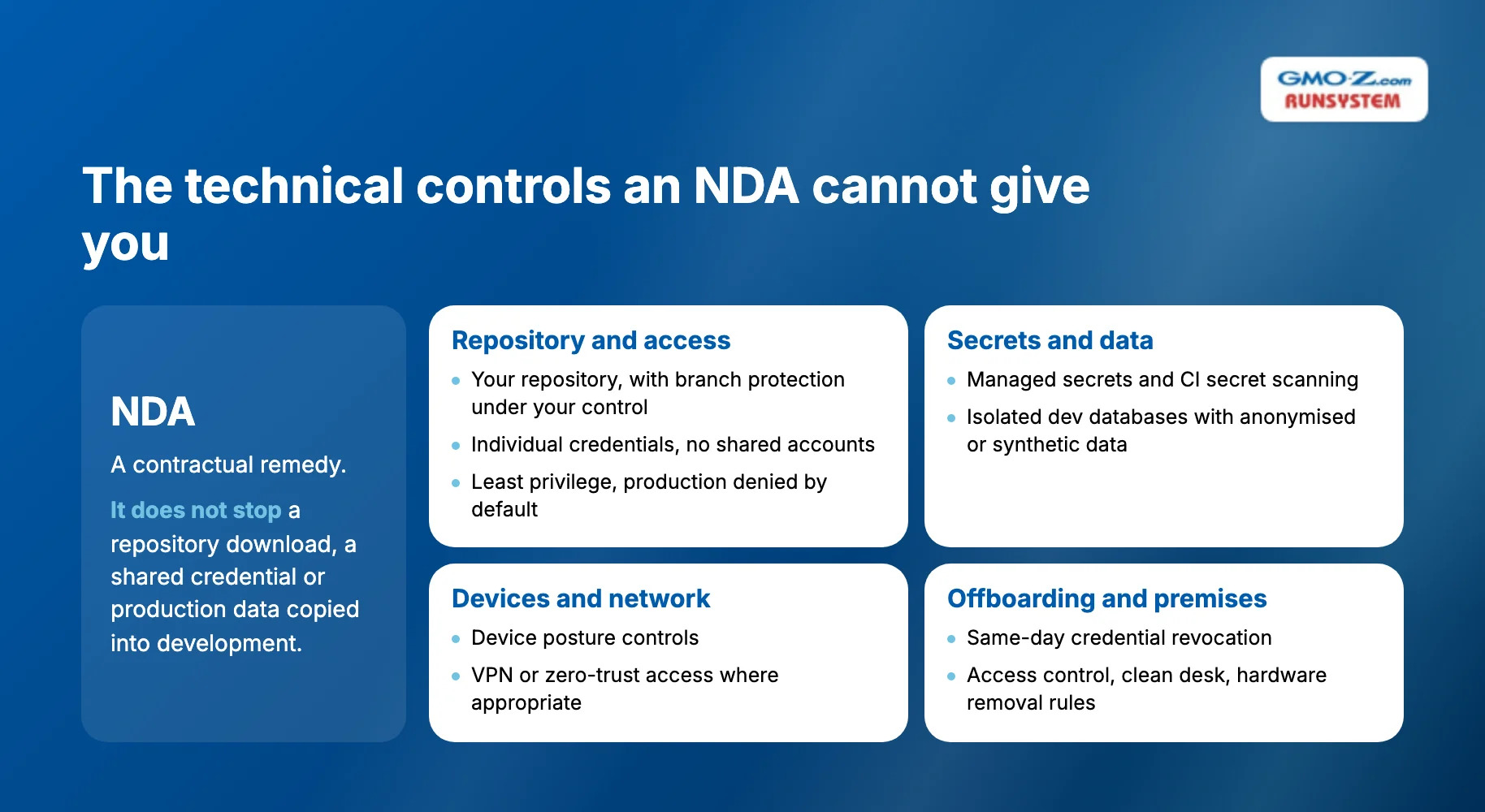
An NDA gives you a contractual remedy. It does not stop someone from downloading a repository, using a shared credential or copying production data into a development environment.
The technical baseline should therefore include:
ISO 27001 should be read as evidence of an audited information-security management system, not as proof that your particular repository cannot be breached. For example, an audited partner such as GMO-Z.com RUNSYSTEM can be evaluated by asking for the current certificate, scope and validity rather than treating the certification name alone as sufficient evidence.
Require repository ownership, individual access, production restrictions and offboarding controls in the security checklist, not only in the NDA.
 Back to top
Once the vehicle, budget and IP structure are clear, recruitment becomes a much narrower problem. You can now search for the people who fit the actual employment arrangement instead of screening an undefined talent pool.
Use channels according to the hiring problem.
ITviec and TopDev are useful for engineering roles and salary transparency. VietnamWorks provides broader candidate volume. LinkedIn is more useful for senior and passive candidates, while specialist recruiters and referrals become increasingly important for senior or niche roles.
The pattern matters more than the platform list. Job boards can provide junior and mid-level volume, but senior candidates are often passive. A foreign company entering Vietnam also lacks the local employer brand that established Vietnamese technology employers already have.
Universities such as HUST, VNU, FPT University and Bach Khoa HCMC are more useful as long-term pipeline signals than as a solution to one urgent senior hire.
The mainstream stacks are easier to source: Java, PHP, Python, JavaScript and Node.js have broader availability. Rust, Solidity, embedded systems and advanced ML are thinner markets. AI engineers and bridge engineers are particularly difficult roles to fill according to the cited 2026 recruitment data.
Match each hiring channel to your seniority and stack instead of treating every candidate source as equivalent.
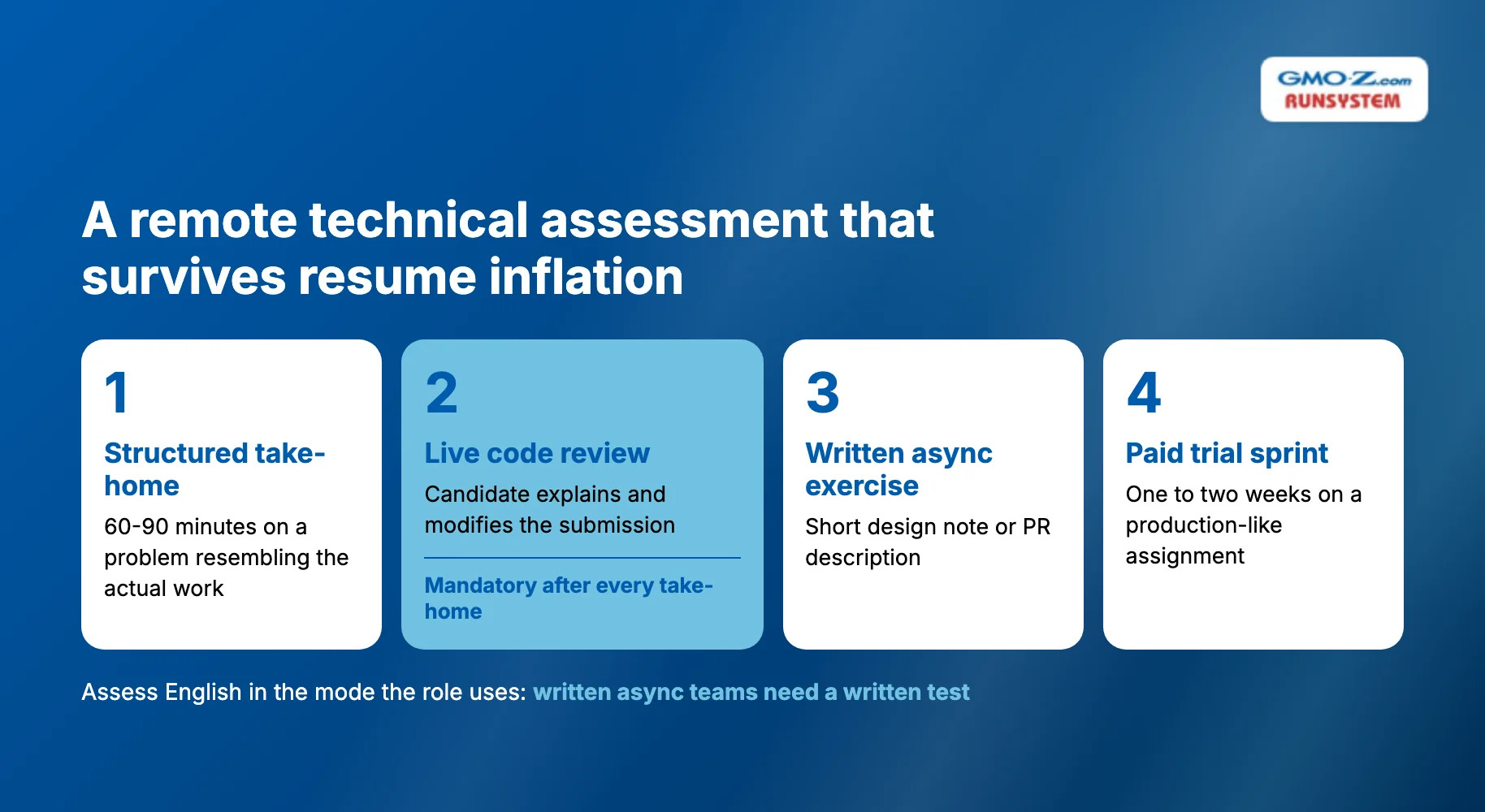
A CV and verbal interview are weak evidence on their own, particularly when the entire hiring process is remote. The assessment should test the work itself and then verify that the candidate can explain it.
A practical sequence is:
Platforms such as HackerRank, Codility and CoderPad can support assessment or live sessions, but the platform is not the important part. The live review is. Widely available AI assistance makes an unsupervised take-home weaker evidence than it once was, so the candidate should be able to explain the decisions in their submission.
Assess English in the same modality the role uses. If the team works primarily through written asynchronous communication, test written communication rather than treating conversational fluency as the only proxy.
Make live review mandatory after every take-home, and use a paid trial to validate the final shortlist.
 Back to top
Hiring solves the legal relationship. It does not automatically solve day-to-day delivery. For a Japanese or APAC company, Vietnam's timezone is one of the easier variables to control.
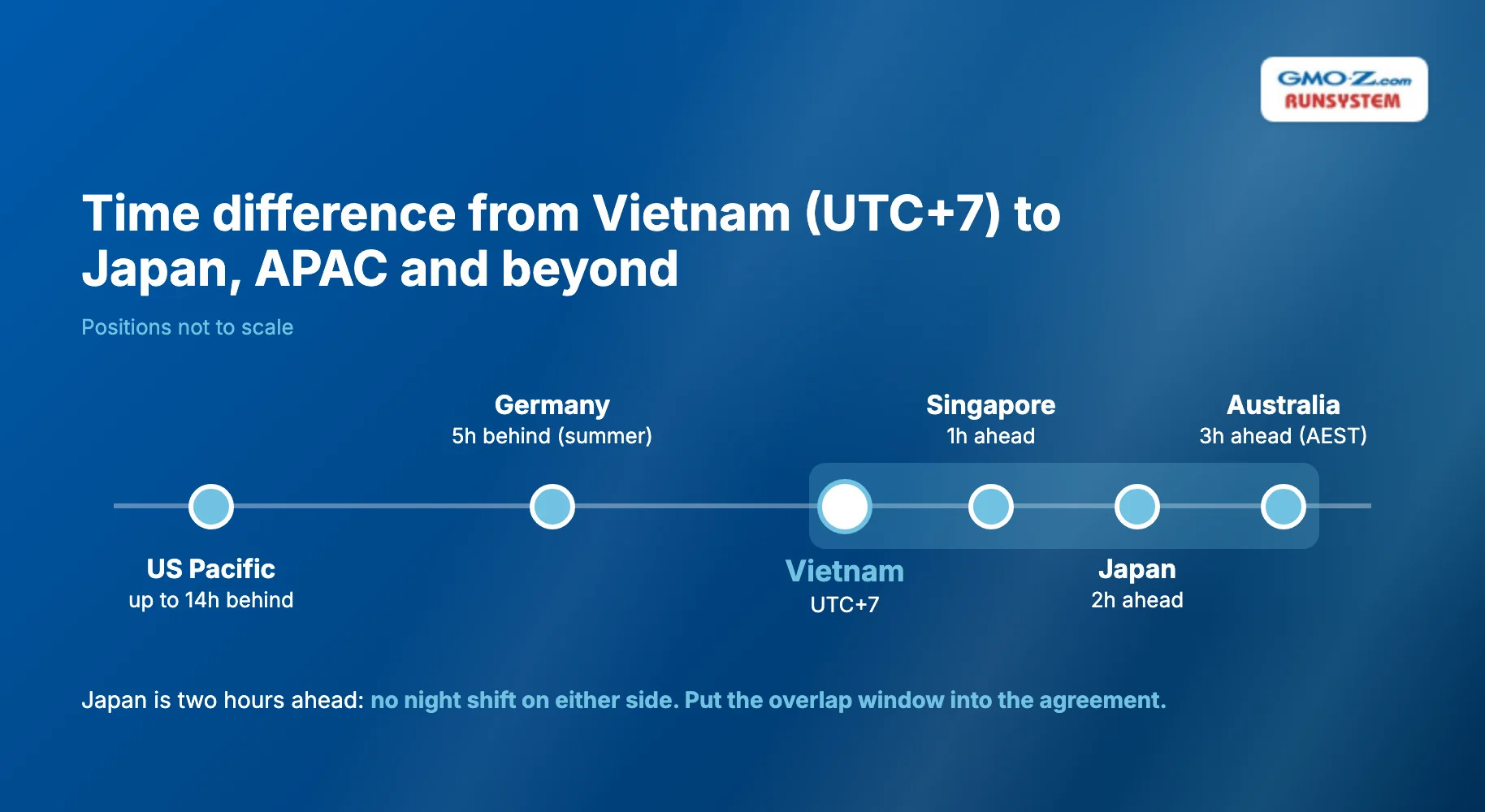
Vietnam operates at UTC+7. Japan is UTC+9, giving a two-hour difference. Singapore is UTC+8, one hour ahead of Vietnam, while Australia's AEST is UTC+10, three hours ahead. Germany reaches UTC+2 during summer, creating a five-hour difference, and US Pacific time can be 14 hours behind Vietnam depending on daylight-saving periods.
For Japan, that makes the working-day overlap unusually straightforward. A Japanese team can work with a Vietnamese team without forcing either side into a night shift.
Do not leave that advantage as an informal expectation. Put the required overlap window into the agreement and name the decision-maker on each side. If a delivery partner advertises JST-aligned flexible hours, ask whether those hours apply to the actual software or ODC team you are buying rather than another business unit.
Tết is the other planning variable to address early. Obtain the team's annual holiday calendar and plan releases around the period when availability will be reduced.
Contract the overlap hours, name decision-makers and align your release calendar before the team starts.
The gap between “hired” and “productive” is your cost, not the candidate's. A developer who has a contract but cannot access the repository, accounts or development environment is consuming budget without producing useful output.
Prepare equipment and accounts before day one. Give the developer a named local point of contact in addition to the technical lead. Assign a small real task in the first week so the team can validate access, tooling and deployment flow together.
Then create a written 30-day plan with explicit success criteria and keep a decision log from the beginning. Define what “ramped” means before the developer starts. For example, first PR merged by day 5 and independent ticket delivery by day 20 can be useful internal criteria, but these are planning examples rather than industry benchmarks.
Define the ramp criteria before the start date, then use the first 30 days to measure against them.
Back to topNo. You can hire without your own Vietnamese entity through an EOR, development partner or other appropriate structure. For one to three developers, an EOR can be simpler than establishing an entity or engaging a larger development partner. The right choice depends on whether you want to employ individuals directly, buy managed delivery or establish a long-term local operation.
Start with gross salary, then calculate total employer cost rather than using salary as the final budget. Add employer statutory contributions, expected 13th-month compensation, the selected vehicle's cost and one-off recruitment or setup costs. The salary benchmark should be role- and seniority-specific, using current Vietnamese market data rather than a generic agency billing range.
Yes, but the working relationship must genuinely fit a contractor structure. A finite, clearly scoped assignment is easier to distinguish from employment than a full-time developer working indefinitely under the client's direction. If the relationship resembles employment, contractor misclassification becomes a risk that should be reviewed before signing.
Do not assume that payment alone gives you ownership. Put the IP assignment in writing, cover the individual developers who create or modify the work, address derivative work and third-party components, and have the assignment reviewed under Vietnamese law. Technical controls should then reinforce the contractual position.
Yes, but treat the move as a new employment relationship rather than a simple transfer. Each developer needs a new employment contract with the new employer, and seniority, leave accrual and social-insurance registration should be handled explicitly. Get Vietnamese legal and payroll advice before executing the transition.
Use a staged assessment that ends with live verification and, ideally, a paid trial. A short take-home tests initial judgement, a live review verifies authorship and reasoning, written work tests the actual communication modality, and a paid trial shows how the developer performs in your environment.
Back to topTo hire developers in Vietnam safely, choose the vehicle before you choose the candidate. Start by deciding whether you need direct employment, managed delivery through EOR or ODC, or a genuine contractor relationship; then compare the five legal vehicles against headcount, control, IP and time horizon.
Build the cost model from gross salary rather than a vendor's headline rate, and rebuild it using the rules in force after 1 July 2026. Separate employee salary from total employer cost, and separate contractual IP ownership from the technical controls that protect the repository.
For a Japanese or APAC buyer, also contract the working-hour overlap instead of treating timezone compatibility as automatic.
At GMO-Z.com RUNSYSTEM, we believe the practical starting point is the same: choose the employment vehicle, make the cost visible, protect the code, then hire the developer.
Back to top