Family site
Family site
Family site



About six months and a second ramp-up. That's how long a bad match takes to surface, and by then your leverage is gone.
Most guides to software outsourcing in Vietnam won't help, because they're still arguing whether to come here at all. You settled that before you opened this.
The variation that costs money sits inside the country. Published Vietnamese rates run from $15 to $80 an hour for work described in the same words, so choosing the country barely narrows the field.
This guide starts where the others stop. You'll find what a specialist tech stack costs against a standard one, a not ideal for line on all ten firms listed, and what Tet does to your Q1 through the shutdown and then the resignations behind it.
If your shortlist is still forming, start with the broader IT outsourcing decision, then come back to narrow it.
Back to topFour engagement models exist for building software offshore. They differ on who owns scope, who manages the team day to day, and who absorbs the cost when requirements move. Rate is not what separates them.
Offshore, nearshore and onshore describe delivery distance. They don't describe quality tiers.
Definition | Time-zone gap | Fits when | |
Onshore | Same country | 0 hrs | Regulated work, on-site presence needed |
Nearshore | Adjacent region | 1–3 hrs | Daily collaboration, moderate budget pressure |
Offshore | Distant region | 5+ hrs | Sustained delivery against settled scope |
The three differ on management cost. A team at a third of the rate costs you more in total if your project manager spends fifteen hours a week compensating for a four-hour overlap window. So the binding variable is your own management capacity, and it's worth establishing that before you look at a single rate card.
One point changes how the rest of this article reads, depending on where you sit. Vietnam is offshore relative to the US and Europe, and nearshore relative to Japan, Korea and Singapore. If you're buying from Tokyo or Singapore, every overhead figure below is smaller for you.
Owns scope | Manages daily | Time to start | Primary risk | Fits when | |
Project-based | Vendor | Vendor | 4–8 weeks | Change orders | Scope is fixed and specified |
Dedicated Team | You | Vendor | 3–6 weeks | Drift without a product owner | Scope moves, capacity is ongoing |
Staff Augmentation | You | You | 1–3 weeks | Your management becomes the bottleneck | You have PM capacity and a skill gap |
ODC / BOT | You | Shared, then you | 8–16 weeks | Transfer terms left open | You intend to own the team |
BOT (build-operate-transfer) means you contract a vendor to build and run a team, with a price and a timetable for moving that team into your own entity, both agreed at signing. It fails in two ways. Either the transfer price is left undefined, or the people you wanted leave during the handover. Both are contract failures rather than delivery failures.
Three vendor tiers appear throughout the rest of this guide. Enterprise-scale means 1,000 or more engineers with multi-country delivery. Mid-market specialist means 100 to 1,000, deep in two or three domains. Boutique product team means under 100, product-led. The list in this article covers the first two, because verification data below 100 engineers is thin enough that a published shortlist would be guesswork.
Two things buyers routinely get wrong here. Staff augmentation doesn't reduce your management load, it moves the load onto you. And ODC economics only clear their setup cost above roughly eighteen months of commitment, so below that you're paying to build a structure you'll dismantle. Where the capacity genuinely is long-term, an offshore delivery center is the model that formalises it.
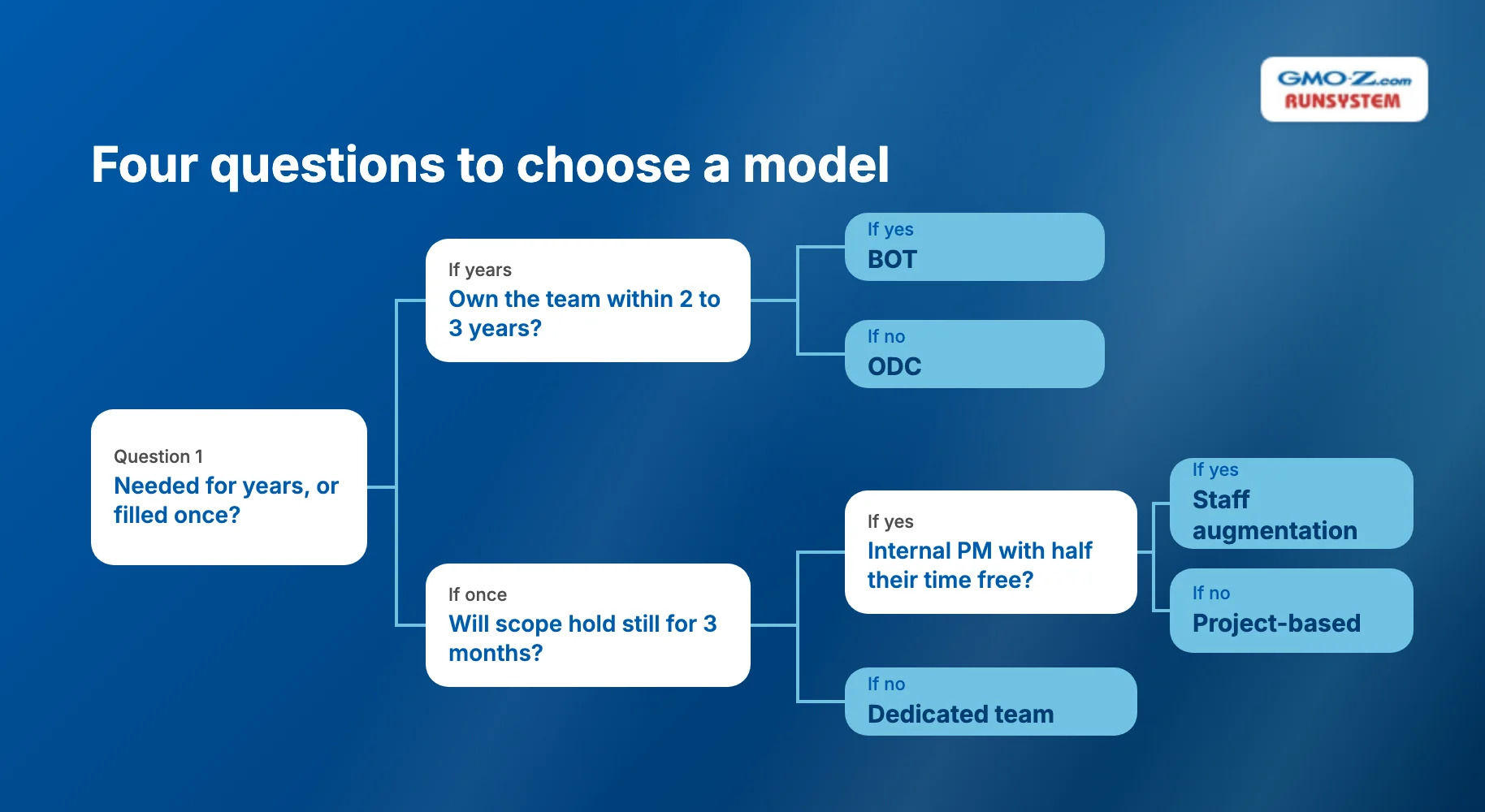
Model choice follows your management capacity and your time horizon. Four questions settle it, and the order matters because each one filters the ones below it.
Sixteen combinations of answers, four outcomes, no path that lands in two places.
 Back to top
Vietnam is strong at some of those models and weak at others. The honest version of that answer is more useful to you than another list of reasons to come here.
Vietnamese vendors charge roughly $20 to $45 an hour for most roles, and $50 to $80 for senior engineers and scarce specialisms. That range is compiled from six 2026 rate publications, which between them span $15 to $80, and the width of that spread is itself the finding.
Set against other regions: US rates run $95 to $180 or more, Eastern Europe and Latin America $30 to $80. That puts Vietnam 60 to 75% below US rates but only 20 to 35% below Eastern Europe, which is a narrower gap than most guides claim.
Below about $20 an hour you're buying less seniority. More than 45% of Vietnamese developers sit at fresher-to-junior level, 28 to 30% at middle, and senior developers make up close to 20% (TopDev, 2024–2025 report). A quote well under market reflects team composition.
There's also a case where the advantage disappears entirely. For one small, fully specified task, a senior freelancer in your own country is usually cheaper once you count coordination and onboarding. Offshore economics come from a team you keep using.
Vietnam has 530,000 to 560,000 software developers, and the government is targeting 100,000 ICT graduates a year by 2030 to 2035, with 15% at master's or doctoral level.
Those figures describe how many people exist. They don't describe how many of the people you need exist. With 45% of the pool below mid-level, the senior layer is thin, and that's the layer your architecture decisions sit on. The graduate pipeline will help, though a 2030 graduate reaches senior level around 2036, which is well past the horizon of anything you're signing now.
So plan on senior hiring taking two to three times longer than junior, and ask any vendor a specific question before you sign: how many senior engineers do you currently have unallocated? On a bench of several hundred, fewer than two or three means your team gets assembled from people already committed elsewhere.
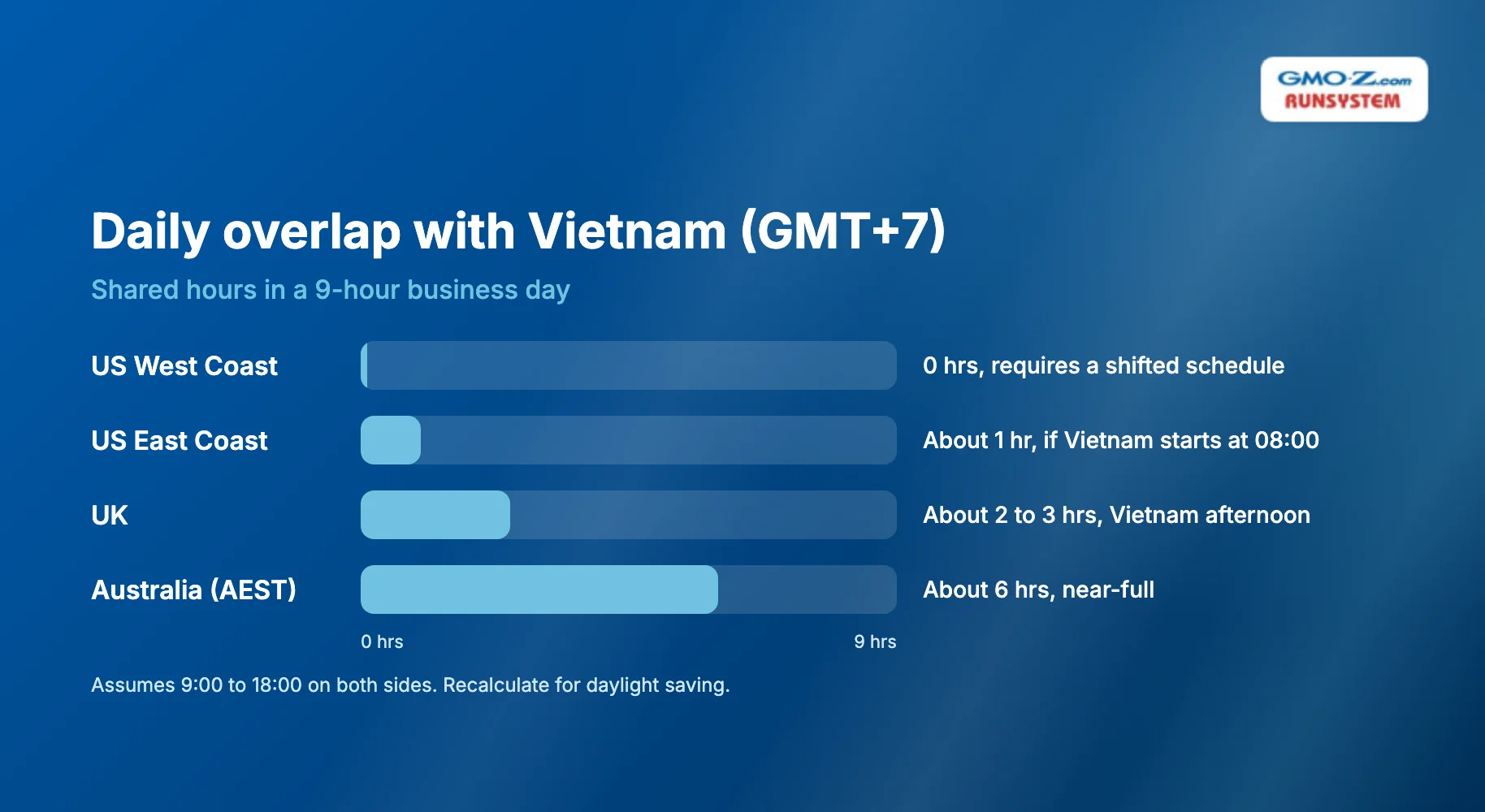
Overlap is measurable, so measure it. Calculated against 9:00 to 18:00 local business hours on both sides:
Your market | Overlap with Vietnam |
US West Coast | 0 hrs, requires a shifted schedule |
US East Coast | ~1 hr, if Vietnam starts at 08:00 |
UK | ~2–3 hrs, Vietnam afternoon |
Australia (AEST) | ~6 hrs, near-full |
Assumes 9:00–18:00 both sides. Recalculate for daylight saving.
Two hours covers decisions and escalation. It doesn't cover pair programming or live debugging. Many Vietnamese vendors will shift hours on request, which is standard practice, so ask about it explicitly and write the agreed window into the contract.
ISO 27001 certifies that a documented information security management system exists and is audited. It doesn't certify that your source code is safe, and it doesn't cover engineers working outside the certified scope.
CMMI measures process maturity. Level 3 means processes are defined and standardised across the organisation. Level 5 adds quantitative process management and continuous optimisation. In Vietnam, Level 5 is held by a small number of firms including TMA Solutions and FPT Software, which makes Level 3 the realistic bar for a mid-market vendor. GMO-Z.com RUNSYSTEM, ISO 27001, ISO 9001 and CMMI Level 3 certified, is one example among several.
Ask three questions of any certificate. Which body issued it. Which business units and locations fall inside the certified scope. When the last surveillance audit took place. Scope is the variable that decides what the certificate is worth, and it's the one buyers almost never check.
Vietnamese teams are strong on sustained delivery, deep technical execution and long-lived platform ownership. They're weaker on product discovery, on ambiguous scope, and on products that repoint weekly.
That gives you a scoping rule. Keep product decisions and discovery in-house, and outsource execution against decisions you've already made. Buyers who outsource discovery report the highest failure rates, and that's a scoping error rather than a vendor failing.
City choice affects cost and specialisation directionally. The differences aren't decisive, so confirm them through vendor quotes and a paid pilot.
That's the capability picture. Here's what it costs.
Back to topThe hourly rate is the cheapest line item on your invoice. This section covers the rate anyway, because you need it to compare quotes, and then covers the four things that sit on top of it.
Role | Hourly rate |
Junior developer | $20–28 |
Mid-level developer | $25–38 |
Senior developer | $40–60 |
Tech lead / architect | $50–80 |
QA engineer | $18–30 |
DevOps engineer | $35–55 |
BA / project manager | $30–50 |
Cross-check against local salary data before you accept a quote. ITviec's 2025–2026 salary report puts tech leads at a median of 51.8 million VND a month and back-end developers reaching 54.9 million VND at high seniority, which is the ground the vendor's rate is built on.
Then do the thing that matters more than the table. Ask every vendor the same question in the same words: does this number include PM, QA and post-launch maintenance? Published averages describe development only. Most quotes silently exclude the rest, so the cheapest one usually turns out to be development-only and the comparison is worthless until you've normalised scope.
A cost range without stated assumptions carries no information. The same MVP figure can differ threefold on team composition, so every row below states what it assumes.
Project | Cost | Assumes |
MVP | $30,000–80,000 | 3 engineers, part-time QA and BA, 10–14 weeks, one platform, no integrations beyond payments and auth |
Web application | $60,000–150,000 | 4–5 engineers, 4–6 months, one third-party integration |
Mobile application | $50,000–130,000 | 3–4 engineers, 4–6 months, iOS and Android from one codebase |
SaaS platform | $150,000–400,000 | 6–8 engineers, 9–12 months, multi-tenant, billing, admin tooling |
Enterprise system | $250,000–700,000+ | 8–12 engineers, 12–18 months, ERP or core-system integration |
AI platform | $200,000–600,000 | 6–10 engineers including ML specialists, 9–15 months, data pipeline included |
If you can't specify a row's assumptions, the row shouldn't exist.
Region | Rate range | Overlap with US Eastern | Genuine strength |
Vietnam | $20–45 | ~1 hr | Cost-to-quality ratio in sustained delivery |
India | $15–45 | ~1–2 hrs | Scale and round-the-clock coverage |
Philippines | $25–50 | ~1 hr | English-first support, BPO adjacency |
Eastern Europe | $30–80 | ~2–3 hrs | EU legal alignment, senior depth |
Latin America | $35–75 | 4–7 hrs | US overlap |
Vietnam sits mid-band on rate, and it loses outright on overlap to Latin America and on scale to India. Pick your region on overlap requirements first, then on rate.
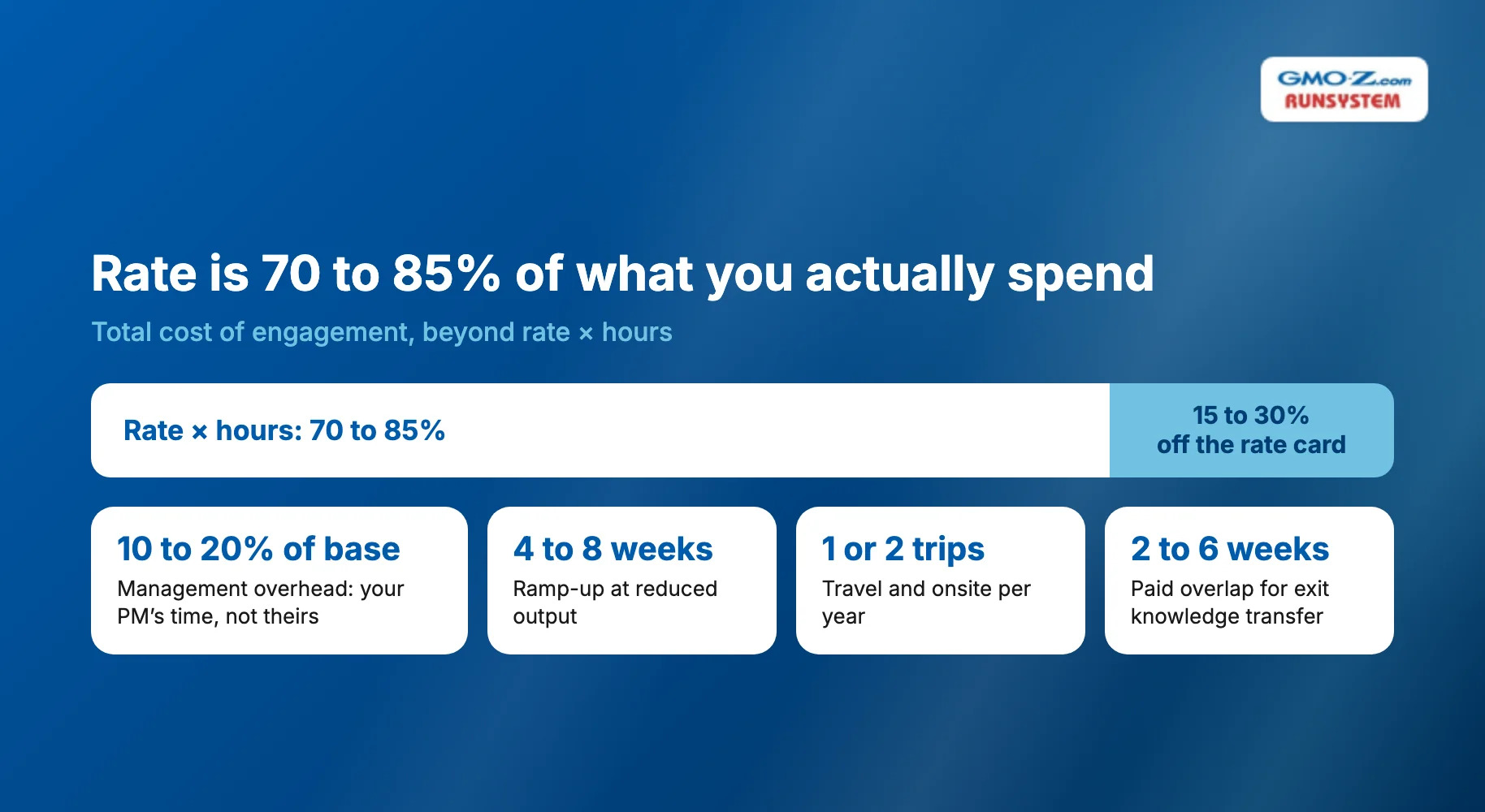
Total Cost of Engagement = (rate × hours) + management overhead + ramp-up + travel and onsite + knowledge transfer at exit.
Each term, with a planning percentage:
One Vietnam-specific detail most guides get wrong. Employer statutory contributions are 21.5% of the contribution base (20.5% for foreign employees), plus a 2% trade union levy, and the base is capped at 50.6 million VND a month from 1 July 2026 under Decree 161/2026/ND-CP. Guides that multiply a flat percentage across a senior engineer's whole package overstate the cost, and many still quote the superseded 46.8 million ceiling.
Rate is 70 to 85% of what you actually spend. The remaining fifth decides whether outsourcing paid off, and the exit term is the one nobody negotiates.
Ready to test these numbers against real scope? Get a scoped estimate for your project.
Those bands map to different tiers of firm. Here's the landscape.
Back to topFour criteria, each with a source. Clutch and GoodFirms ratings filtered by project size. Certifications checked against issuing bodies rather than vendor marketing. Headcount from public company statements. Service coverage from vendor sites.
This list is not ranked. It's grouped by buyer fit, and ordering within a tier carries no judgement. You should be able to eliminate firms with it, not just browse them.
Disclosure: this article is published by GMO-Z.com RUNSYSTEM, which appears in the list below.
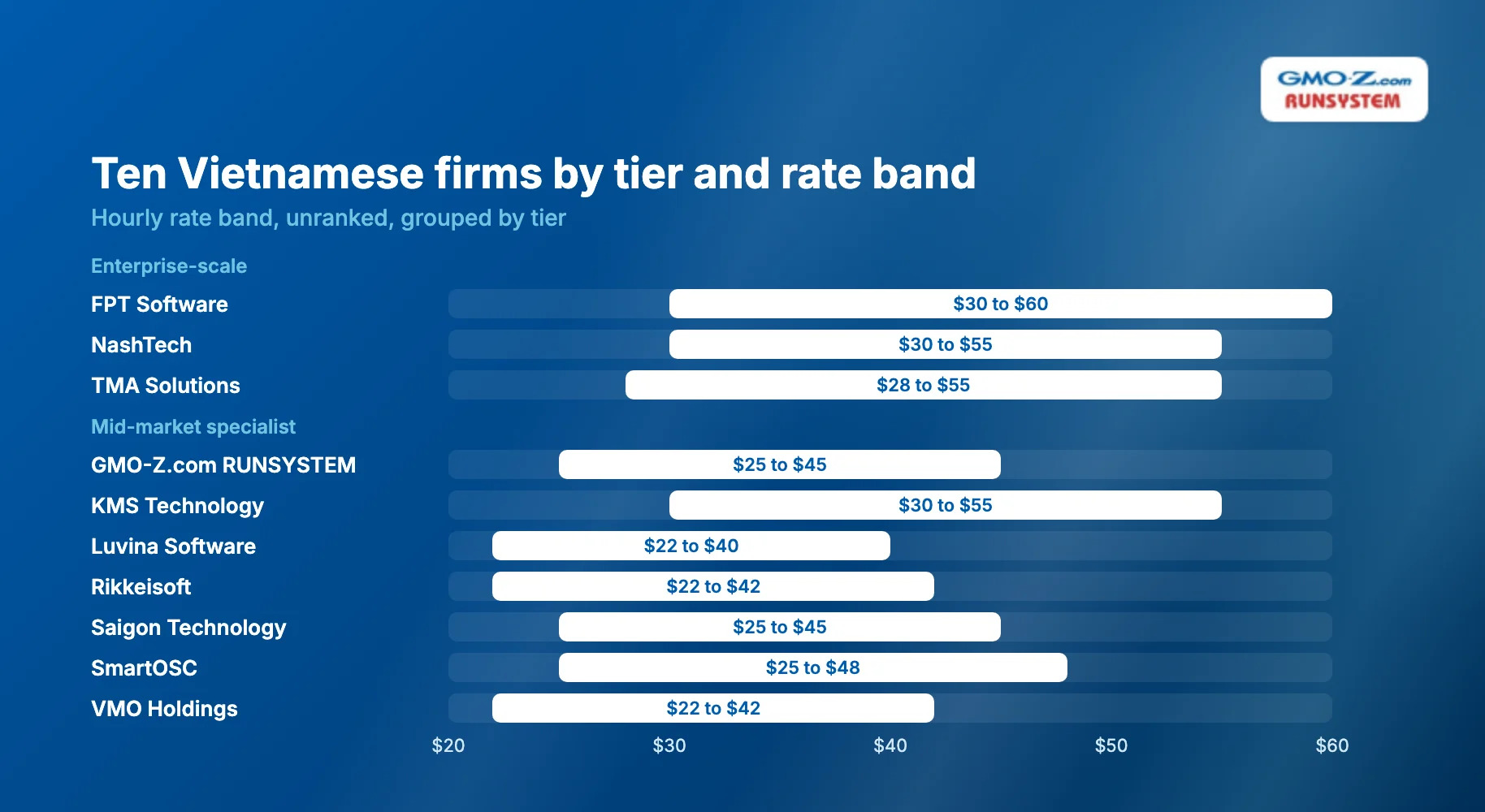
Firm | Tier | Founded | Headcount | Certifications | Rate band | Best for |
GMO-Z.com RUNSYSTEM | Mid-market specialist | 2005 | [VERIFY] | CMMI L3, ISO 9001, ISO 27001:2022 | $25–45 | Japan-market delivery, long-run platforms |
FPT Software | Enterprise-scale | 1999 | 30,000+ | CMMI L5, TMMi L5, ISO 27001 | $30–60 | Multi-country programmes |
NashTech | Enterprise-scale | 2000 | 2,000+ | [VERIFY] | $30–55 | UK and EU buyers |
TMA Solutions | Enterprise-scale | 1997 | 4,000 | CMMI L5, TL 9000, ISO 9001, ISO 27001 | $28–55 | Telecom, 5G, embedded |
KMS Technology | Mid-market specialist | 2009 | 1,000+ | [VERIFY] | $30–55 | US product engineering |
Luvina Software | Mid-market specialist | 2004 | 500+ | [VERIFY] | $22–40 | Japanese enterprise systems |
Rikkeisoft | Mid-market specialist | 2012 | 1,500+ | [VERIFY] | $22–42 | Japan-market volume delivery |
Saigon Technology | Mid-market specialist | 2012 | 300+ | [VERIFY] | $25–45 | Western SMEs, web and mobile |
SmartOSC | Mid-market specialist | 2006 | 1,000+ | [VERIFY] | $25–48 | Digital commerce platforms |
VMO Holdings | Mid-market specialist | 2012 | 500+ | [VERIFY] | $22–42 | Fintech and BFSI builds |
Every rate band sits inside the ranges published above. [VERIFY] markers must be resolved against issuing bodies before publication.
GMO-Z.com RUNSYSTEM has built software from Hanoi since 2005 and has been part of GMO Internet Group since 2011, with a Tokyo office running since 2007. Its depth is in AI and OCR engineering and long-lived enterprise platforms for Japanese clients.
Best for: multi-year platform ownership for Japanese and APAC mid-market enterprises, with client case studies covering that pattern.
Not ideal for: teams under three people, products repointing scope weekly, or buyers optimising for the lowest rate in the market.
FPT Software is Vietnam's largest software exporter, operating in roughly 30 countries as part of FPT Corporation. It's the only Vietnamese firm at both CMMI Level 5 and TMMi Level 5.
Best for: large multi-country programmes needing formal process maturity.
Not ideal for: small engagements, where you'll sit low in the account hierarchy.
NashTech is the Vietnam delivery arm of UK-parented Nash Squared, giving it Western management layered over Vietnamese engineering.
Best for: UK and EU buyers wanting a familiar contracting counterparty.
Not ideal for: Japan-market work, and price-sensitive buyers paying for that structure.
TMA Solutions has 4,000 engineers across six Vietnamese offices and seven countries, with 27 years in telecom, 5G, automotive and embedded work.
Best for: telecom, IoT and embedded systems needing deep domain continuity.
Not ideal for: consumer web and mobile products, which aren't its centre of gravity.
KMS Technology is US-facing product engineering, and has spun out its own products including Katalon and KMS Healthcare.
Best for: US software companies building a product rather than a project.
Not ideal for: Japan-market delivery and fixed-scope contract work.
Luvina Software has focused on Japanese enterprise systems since 2004, with the language capability that implies.
Best for: Japanese enterprise system maintenance and modernisation.
Not ideal for: greenfield product work for Western startups.
Rikkeisoft grew quickly on Japan-market delivery and now runs offices in Japan and the US.
Best for: Japan-market volume delivery where scaling speed matters.
Not ideal for: buyers needing a long, stable senior bench, given the growth rate.
Saigon Technology is a smaller HCMC firm serving Western SMEs directly, with unusually flat account handling.
Best for: Western SMEs wanting direct access to the delivery team.
Not ideal for: enterprise programmes needing formal governance layers.
SmartOSC specialises in digital commerce and holds platform partnerships across Adobe and Shopify ecosystems.
Best for: commerce platform builds and replatforming.
Not ideal for: embedded, data engineering or non-commerce enterprise systems.
VMO Holdings works across fintech and BFSI, with delivery in Vietnam, Japan and the US.
Best for: fintech and banking builds needing regulated-sector familiarity.
Not ideal for: consumer products and early-stage MVPs.
Building a shortlist is easy. Verifying it is the hard part.
Back to topSelection criteria are easy to publish and hard to use. These five are tests you can run, most of them inside a single call.
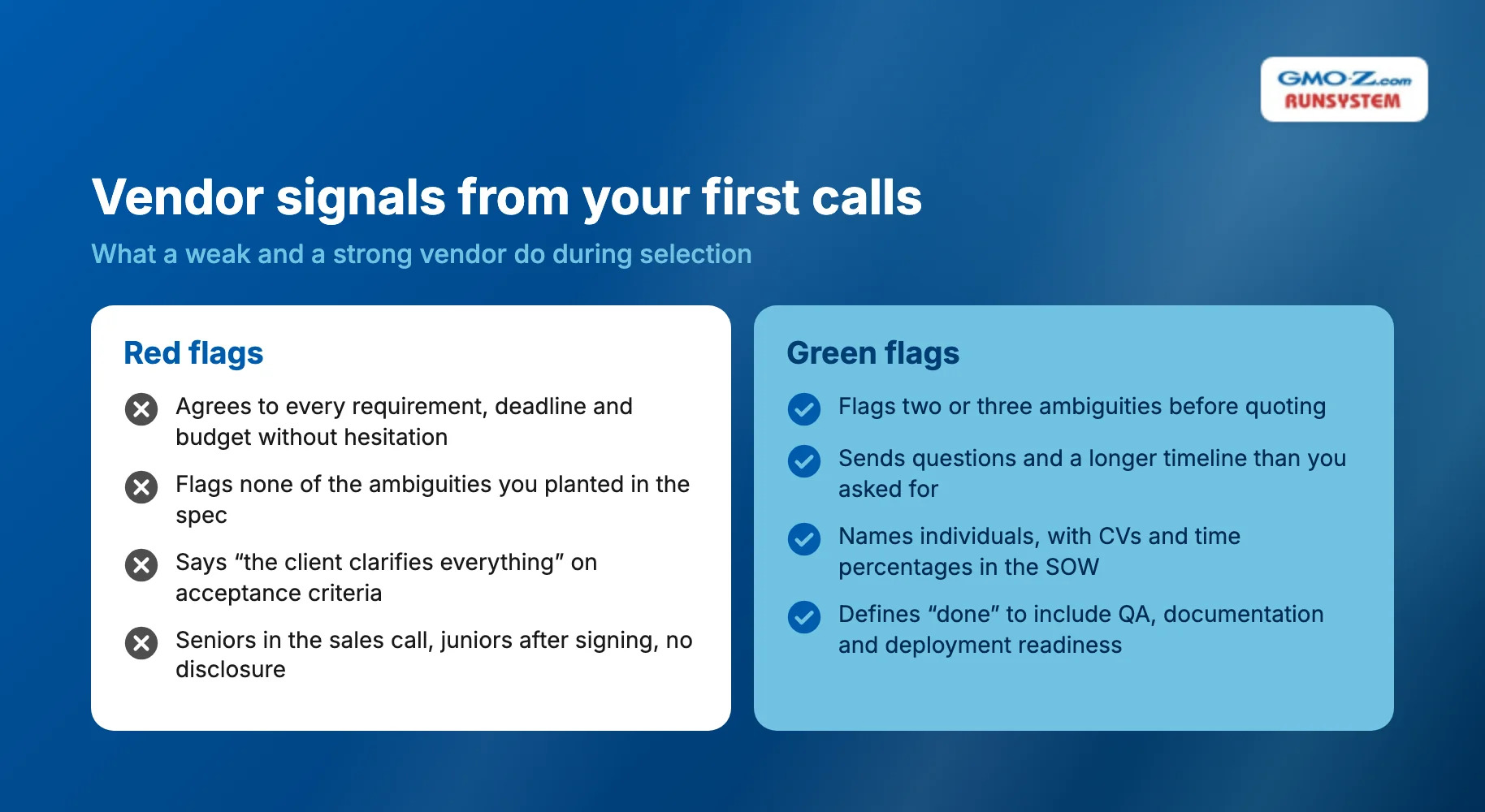
Take a two-page brief and plant three specific ambiguities. One undefined scope boundary (does "user management" include SSO?). One unstated non-functional requirement (give no target concurrency). One missing dependency owner (say nothing about who supplies the payment gateway credentials).
Then count how many they flag before quoting. Two or three is a strong signal. Zero is disqualifying.
What a good response looks like: questions attached, and a timeline longer than the one you asked for. A vendor who agrees to every requirement, deadline and budget without hesitation has either misread the scope or is planning to cut something. Silence on an ambiguous brief predicts silence on a failing sprint.
Pose the same substantive question in three phrasings at three separate points in the conversation, and listen for hesitation rather than for the answer.
"Can your team deliver this in ten weeks?" Later: "What would have to go wrong for this to slip past ten weeks?" Later still: "If the budget only covered eight weeks, what would you cut?"
The second and third make it safe to surface a problem that the first made expensive to admit. If they accept your first proposal outright, you haven't negotiated. You've confirmed they're being polite.
Take these into the call verbatim, and listen for the weak answer as much as the strong one.
A vendor who can't explain how they handle bad news will hide bad news until the deadline is gone.
Senior staff appear during the sales process and junior staff arrive after signing. The problem isn't junior developers, it's the absence of disclosure, and the pattern is industry-wide rather than specific to Vietnam.
Your defence is contractual: named individuals, CVs attached to the SOW, and committed time percentages per person written in. Then ask directly whether engineers rotate between clients week to week. You want people accumulating context on your codebase over months.
Four terms decide more than the rate does.
Watch the commitment length too. Contracts demanding more than two months upfront are excessive, and vendors confident in their delivery offer month-to-month terms after an initial 30 to 60 days. It's a confidence signal about them.
Give the exit clause the most attention. It's the least negotiated term in offshore contracts and the one that determines what switching costs you eighteen months from now. Where source code protection is part of the risk picture, cyber security and source code protection belongs in the same conversation.
This is general information, not legal advice, and terms vary by jurisdiction.
Vetting removes the risks you can see before signing. Here are the ones that arrive later.
Back to topVietnamese workplace communication is high-context and shaped by face-preservation norms, so direct refusal is rare. Three responses commonly function as no: "let me review it," "this is a bit difficult," and silence. A blunt yes-or-no question makes an honest answer socially expensive, which is precisely why it tends to produce a yes.
A European client was told "everything is good, but maybe it would be better if…" and heard a friendly suggestion. It was an instruction. Six months of misalignment starts in the gap between those two readings.
Three fixes you can apply this week. Send a written summary after every call and treat it as authoritative. Ask "what could go wrong here?" instead of "any questions?" Deliver negative feedback one-to-one and never in front of the team.
This is a working context you design around, not a skills deficit. Managers who adapt consistently report strong retention and output quality.
Three mechanisms do most of the work. End-of-day handoff notes in a fixed template. A written decision log that both sides treat as the single source of truth. One fixed two-hour overlap window that neither side books over.
Use the overlap figures from the section above to set that window. Remember what two hours buys you: decisions and escalation, and nothing that needs live collaboration.
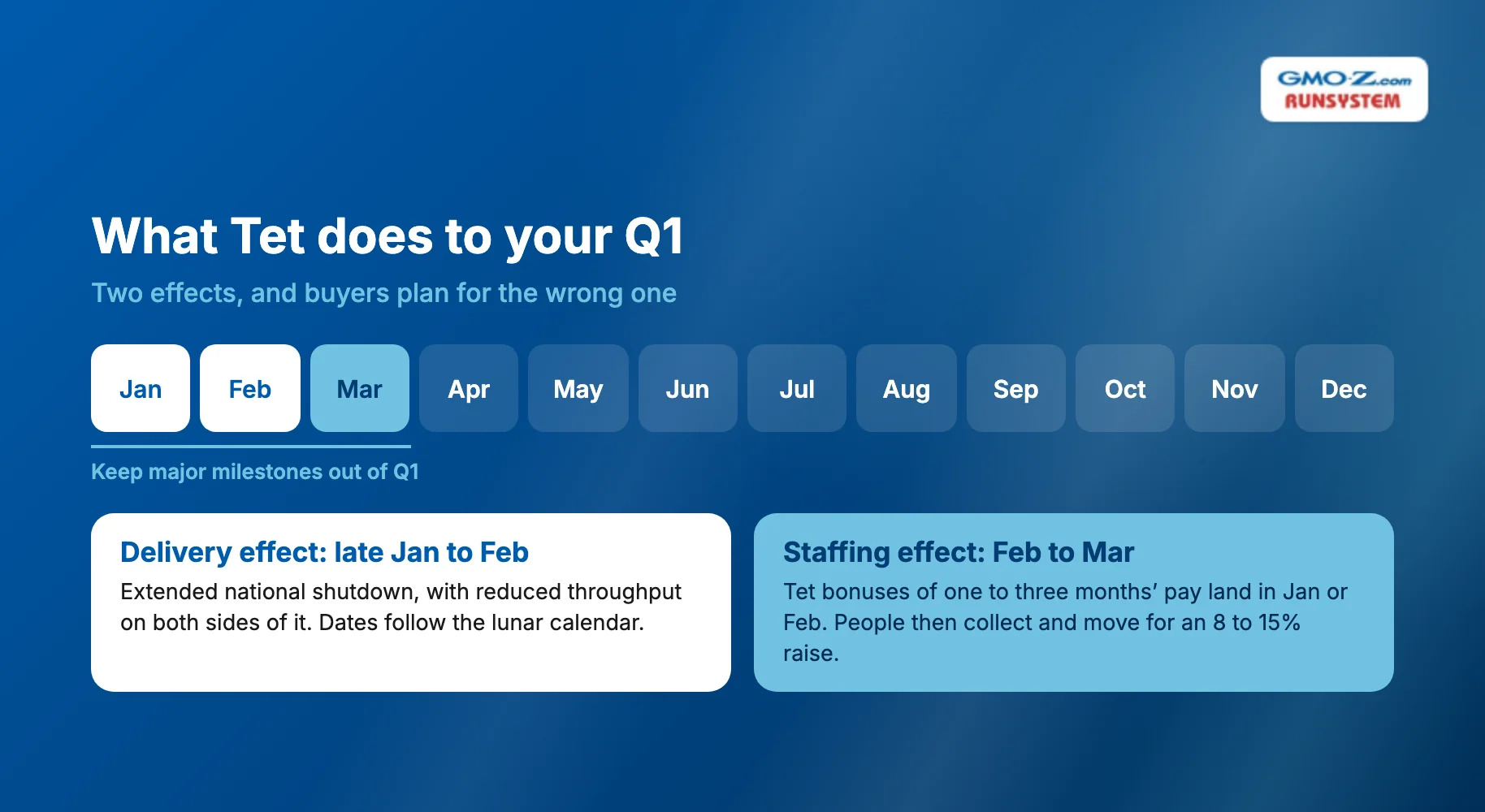
Tet compounds two effects, and buyers plan for the wrong one.
The delivery effect is an extended national shutdown with reduced throughput on both sides of it, typically running from late January through February depending on the lunar date. It's visible and most people schedule around it. Vietnam's General Statistics Office recorded the labour force falling by 232,900 people quarter-on-quarter in Q1 2026, a movement it attributes to the normal pattern of a quarter containing Tet.
The staffing effect is the one that costs you continuity. The 13th-month salary isn't legally required but is near-universal practice, and Tet bonuses typically add one to three months of pay. Those bonuses land in January or February. February and March then see people collect and move, in a market where a job change is worth 8 to 15% and considerably more in scarce specialisms.
Two actions. Keep major milestones out of Q1 entirely. And ask the vendor what their post-Tet retention plan is before you sign, not after.
Vietnamese vendors commonly publish IT turnover below 5%, presented as evidence of stability against competing destinations. Independent HR research points elsewhere. Anphabe recorded national turnover reaching 24% against an optimal rate of 10%, with quit rates rising alongside salary at team leader, manager and director level, and IT among the most affected sectors. Its 2026 survey found 43% of leavers citing advancement and 40% citing skills development, both sharply up on the prior year.
The mechanism that explains the divergence is wage movement. General IT salary growth runs 8 to 15% a year, with 20 to 35% premiums for AI, machine learning and cloud specialisms, and those increases are mostly realised by changing employer. In that market, staying put costs money.
Don't try to resolve the contradiction. The two figures measure different things and neither is verifiable from outside, which is exactly why you should measure it yourself. Four questions: senior-level turnover over the past twelve months, average developer tenure on a single project, how many people on the proposed team have been there more than two years, and what backup arrangement covers your critical roles.
Where continuity matters most, long-term system maintenance and monitoring is the engagement that exposes attrition fastest.
And the economics underneath all of this are moving.
Back to topAssisted coding tools raise junior output faster than senior output, which narrows the productivity gap that justified the price gap. With 45% of Vietnam's developer pool at fresher-to-junior level, vendors built on junior volume are structurally more exposed than specialists built on senior depth. A vendor whose rate advantage rests on headcount may not hold that advantage through your contract term.
IT salaries in Vietnam are rising 8 to 15% a year, faster in scarce specialisms. A three-year fixed rate looks like a win at signing and becomes a retention problem for the vendor by year two. At that point your team quality degrades quietly rather than your price changing visibly, which is the worse of the two outcomes because you won't see it in an invoice.
Rate stability and team stability pull against each other, and most buyers optimise the wrong one.
Low-code works genuinely well for internal tools, workflow automation and admin interfaces, anything with stable requirements and a known user base. It becomes debt on customer-facing products, on anything needing integration depth, and on anything expected to change substantially after launch.
The break-even is the first major requirement change. Low-code lowers build cost and raises change cost, so the calculation turns entirely on scope stability, which loops back to question three of the decision tree above.
Contract length should track the rate of market change, and that rate has increased. Two provisions follow. Terms of 6 to 12 months rather than 24. And a rate review clause at each renewal, so wage movement gets negotiated openly instead of absorbed through staffing changes.
Read alongside the model choice and the exit clause, contract duration is a risk variable in its own right.
Back to topThree decisions carry the weight in software outsourcing Vietnam, and none of them is the one you spent the most time on.
Your engagement model follows your time horizon and your management capacity, settled by four questions rather than by budget. Your vendor tier follows what you're building, and the ten firms above each have a defined mismatch as well as a sweet spot. Your exit terms decide what all of it costs eighteen months from now, which is why they deserve more attention than the rate card, the certifications and the trends taken together.
Before any of that, run a paid pilot of four to six weeks. It costs a fraction of a wrong eighteen-month commitment, and it surfaces the communication, Tet and attrition risks while you still have leverage to act on them.
At GMO-Z.com RUNSYSTEM, we'd rather you ran that pilot with us and found the mismatch early than signed on a rate card and found it in month six.
Back to top