Family site
Family site
Family site



You have probably seen the same outsourcing stories before.
A startup built its first product with an external team. Another company cut costs. Another opened an engineering centre overseas.
But what was actually outsourced? Who did the work? When did it happen? And what changed afterwards?
Those details matter more than the headline result. A case from 2010 may tell you something useful about how to structure an outsourcing decision, but its rates, labour market, and delivery model may have little to do with what you can buy today.
So this list focuses on the details you can actually compare:
Your situation | Case | Year |
Existing IT function running in firefighting mode | Franchisor IT turnaround | 2022 |
No first version, non-technical founder | Calendly | 2013 |
Need to test demand before building | AppSumo | 2010 |
Have a product, need one component built | Expensify | 2008 |
Want a permanent engineering base abroad | Opera | 2006 |
Product exists, need a mobile app fast | Pricena | 2015 |
Need capacity in a skill you can't hire | CuriosityStream | 2019 |
Prototype exists, needs to become a product | Slack | ~2013 |
Regulated product, compliance workstream | FairMoney | Not stated |
Cheap labour for a data-heavy task | SeatGeek | ~2009 |
Cases are grouped by what they are evidence for, not by company fame. Each case identifies its source and the source's relationship to the work.
Pick your row. If two fit, read the more recent one first.
Back to topYear: 2022 published; engagement year not stated
Company: Private-equity-backed commercial cleaning franchisor, 35+ years old, 8,000+ franchises, 50,000+ customers, 90 markets, estimated revenue above $70M.
Situation: IT spending was 0.8% of revenue, roughly half the benchmark cited for comparable midsize firms. Operations depended heavily on individual knowledge, there was no dedicated help desk, tickets were not consistently logged, infrastructure was bloated, and security practices were insufficient.
Source: Auxis, the vendor; client anonymous.
Take this if: Your existing IT function is under-resourced and you need a benchmark to start a business case.
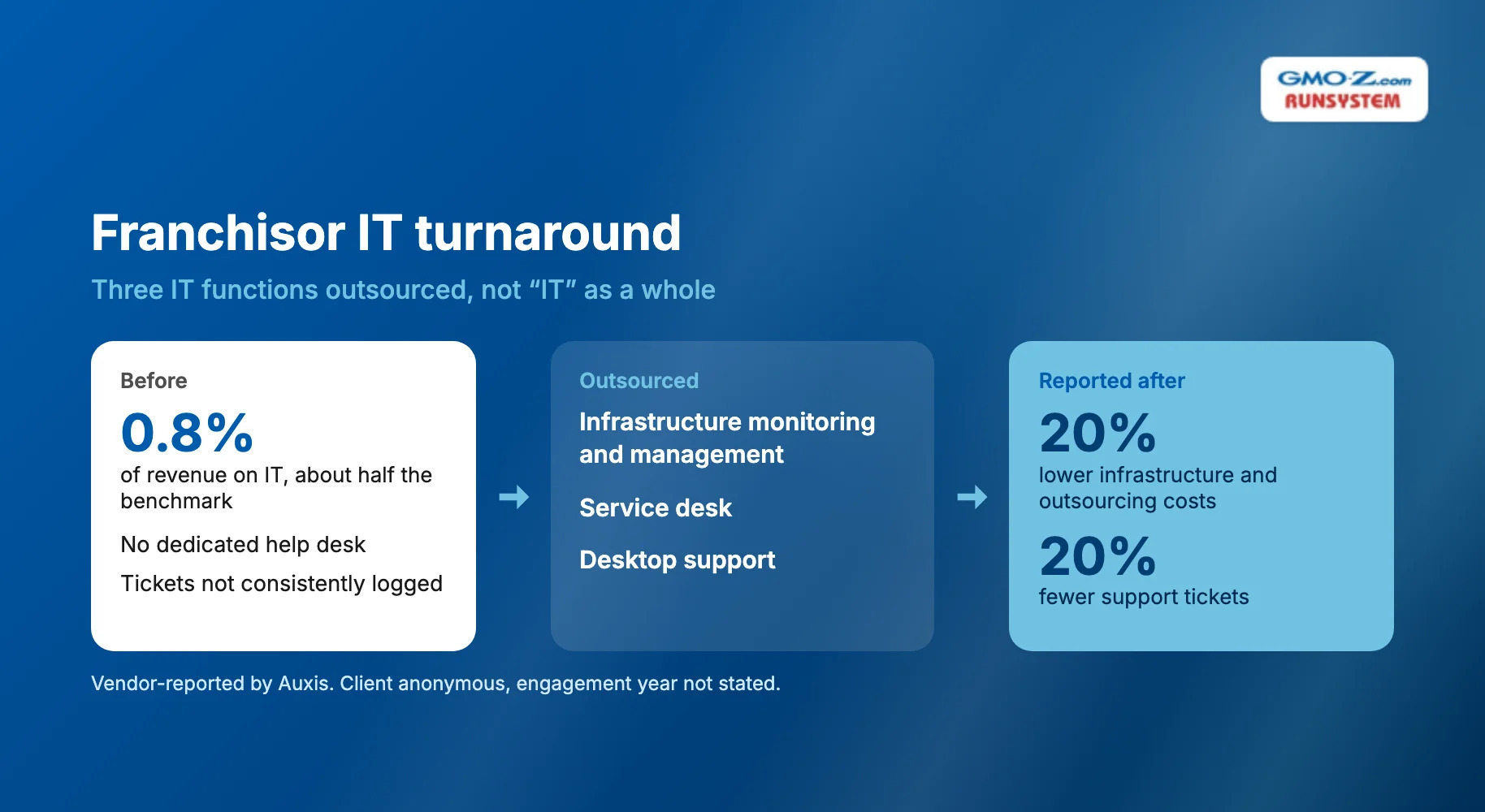
What was outsourced: Infrastructure monitoring and management, service desk, and desktop support.
What happened: The engagement introduced ITIL processes, documented architecture and governance, consolidated physical servers, moved Exchange to Microsoft 365 and backups to Azure, implemented ITSM, and added 24×7 monitoring and SLA reporting. The reported result was 20% lower infrastructure and outsourcing costs, 20% fewer technical support tickets, and an IT organisation that quadrupled in size with service-desk QA and a dedicated NOC team.
Take this if: You need to translate an outsourcing case into a concrete operations scope.
This case is useful for an under-resourced IT function, but it is not a forecast. The client is anonymous, the figures are vendor-reported, the starting point was unusually low, and the engagement year is not stated. A 20% improvement from 0.8% of revenue is not directly transferable to a normally funded IT organisation.
Take this if: You use the numbers as a ceiling and build your own expected range.
Back to topYear: 2010
Company: AppSumo, founded by Noah Kagan.
Situation: Kagan had identified a market opportunity but had a tight budget and needed to test whether customers would actually pay.
What was outsourced: PayPal payment integration and initial website functionality.
To whom: A remote developer, not named in the source.
What happened: The work reportedly cost $50, was delivered within days, and allowed Kagan to launch within 48 hours. AppSumo generated its first revenue within a week. The important decision was not the $50 price; it was buying only the smallest component capable of producing a real transaction.
Take this if: You need to test demand before committing to a full product build.
Year: 2013
Company: Calendly, founded by Tope Awotona.
Situation: Awotona had no programming background and had spent six months researching the market without finding an existing tool that worked.
What was outsourced: Complete product development and design.
To whom: Railsware, Kyiv, Ukraine.
What happened: Railsware ran a structured BRIDGeS session before coding began. The MVP launched after six months of development. The product initially shipped without payment features because there was not enough budget to build them, which later supported organic adoption. By 2021, Calendly had raised $350M at a $3B valuation.
Take this if: You are non-technical and have no first version; separate product scoping from development.
Year: 2008
Company: Expensify, a receipt-tracking and expense-reporting product.
Situation: The team needed to handle a complex backend while maintaining a strong frontend and user experience.
What was outsourced: The complete backend.
To whom: An international software house, not named in the source.
What happened: Expensify kept frontend and UX internally while the outsourced team handled the backend, allowing both sides to progress in parallel. The source says the backend scaled from startup to public company without a fundamental rewrite.
Take this if: You already have a product and need one component built without making both teams dependent on the same workstream.
Back to topYear: Wrocław 2006; Warsaw 2009
Company: Opera, Norwegian browser maker.
Situation: Opera needed more engineering capacity without relying entirely on Western European cost structures.
What was outsourced: Nothing. This was offshoring through Opera's own R&D centres, not third-party outsourcing.
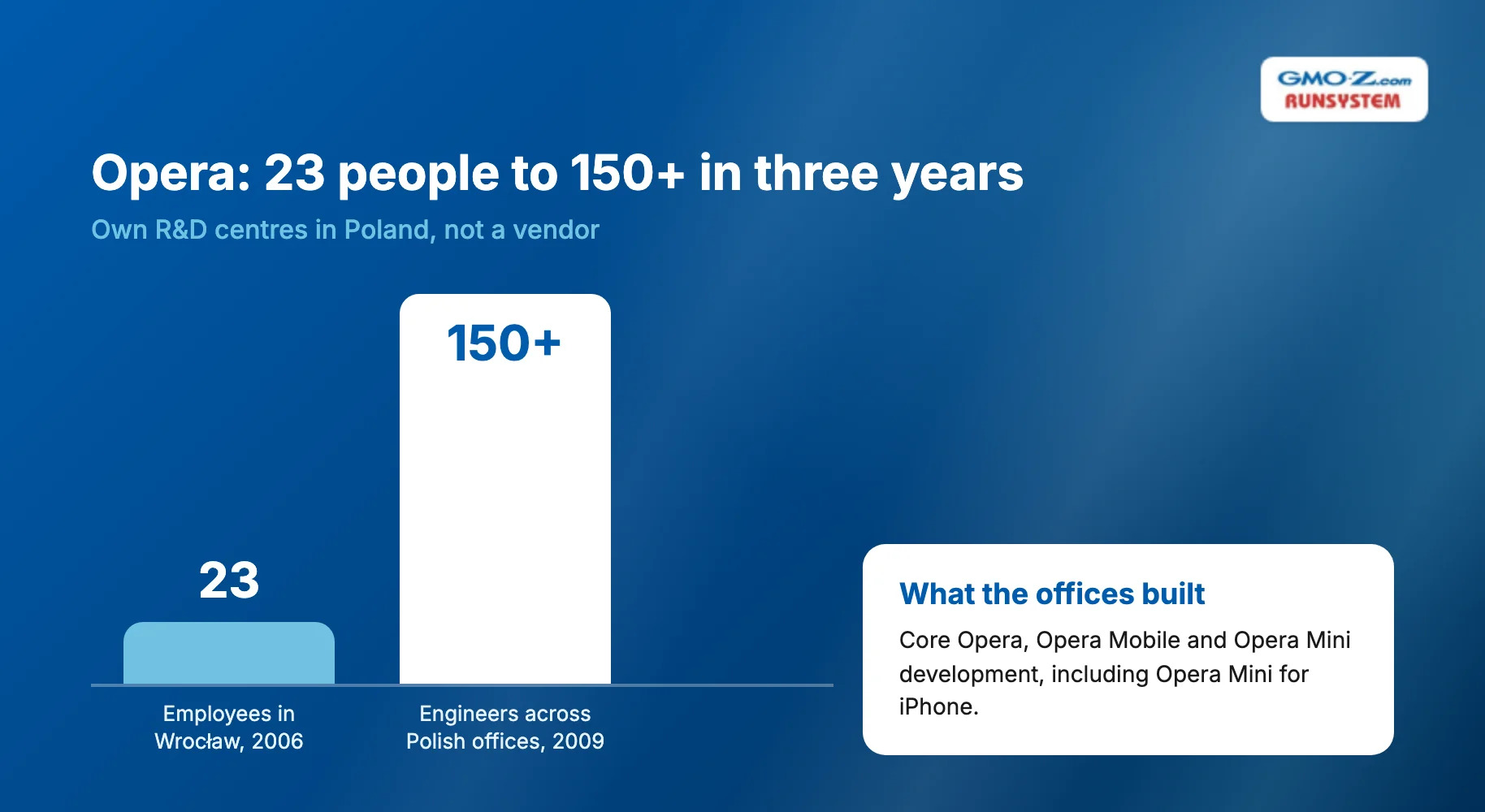
What happened: Opera started with 23 employees in Wrocław in 2006 and reached 150+ engineers across its Polish offices by 2009. The offices handled core Opera, Opera Mobile and Opera Mini development, including Opera Mini for iPhone.
Take this if: You want a permanent engineering base abroad and are prepared to build your own operation rather than hire a vendor.
Pricena
Year: 2015
What was outsourced: iOS and Android development, later a full-stack web engineer.
What happened: Within six months, the Android app had 50,000+ downloads and a 4.3-star Google Play rating.
CuriosityStream
Year: 2019
What was outsourced: A team of six programmers working on web video and mobile background playback.
What happened: The source reports a significant increase in hours watched, without providing a figure. Both cases came from Grid Dynamics, the vendor that performed the work.
Take this if: Your product already works and the problem is engineering capacity rather than product discovery.
Back to topYear: ~2013; engagement year not stated in the sources
Company: Slack, pre-launch.
Situation: Slack had an early prototype that still needed to become a polished product.
What was outsourced: Logo design, marketing website development, and web and mobile application release.
To whom: MetaLab, a Canadian design team.
What happened: MetaLab helped turn the prototype into a polished product and provided product feedback that shaped the MVP. Slack reached 15,000 users within two weeks of launch.
Take this if: Your prototype works technically but still needs product and design judgement to become something users can adopt.
UBS: Complete mobile banking UX redesign. No agency named, no metric, no date.
Zabka: Complete MVP mobile app. The source reports thousands of downloads and a launch within months, but provides no vendor and no date.
Both are plausible outsourcing engagements. Neither gives enough information to compare cost, delivery model, vendor performance, or outcome.
Take nothing operational from these. If a case has no vendor, no metric and no date, treat it as an illustration, not evidence.
Back to top
Year: Not stated in the source
Company: FairMoney, a digital bank in Nigeria.
Situation: Growing users and tighter regulation were putting pressure on KYC processes and app stability while the internal team still needed to ship customer-facing features.
What was outsourced: KYC process optimisation, compliance infrastructure, and app stability work.
To whom: Netguru.
What happened: The source reports a 30% reduction in time-to-market, improved app stability, and compliance with evolving Nigerian banking regulations without hiring specialist compliance engineers. The engagement also included knowledge transfer. The 30% figure is self-reported by the vendor.
Take this if: A compliance workstream is competing with your product roadmap and needs a separate delivery boundary.
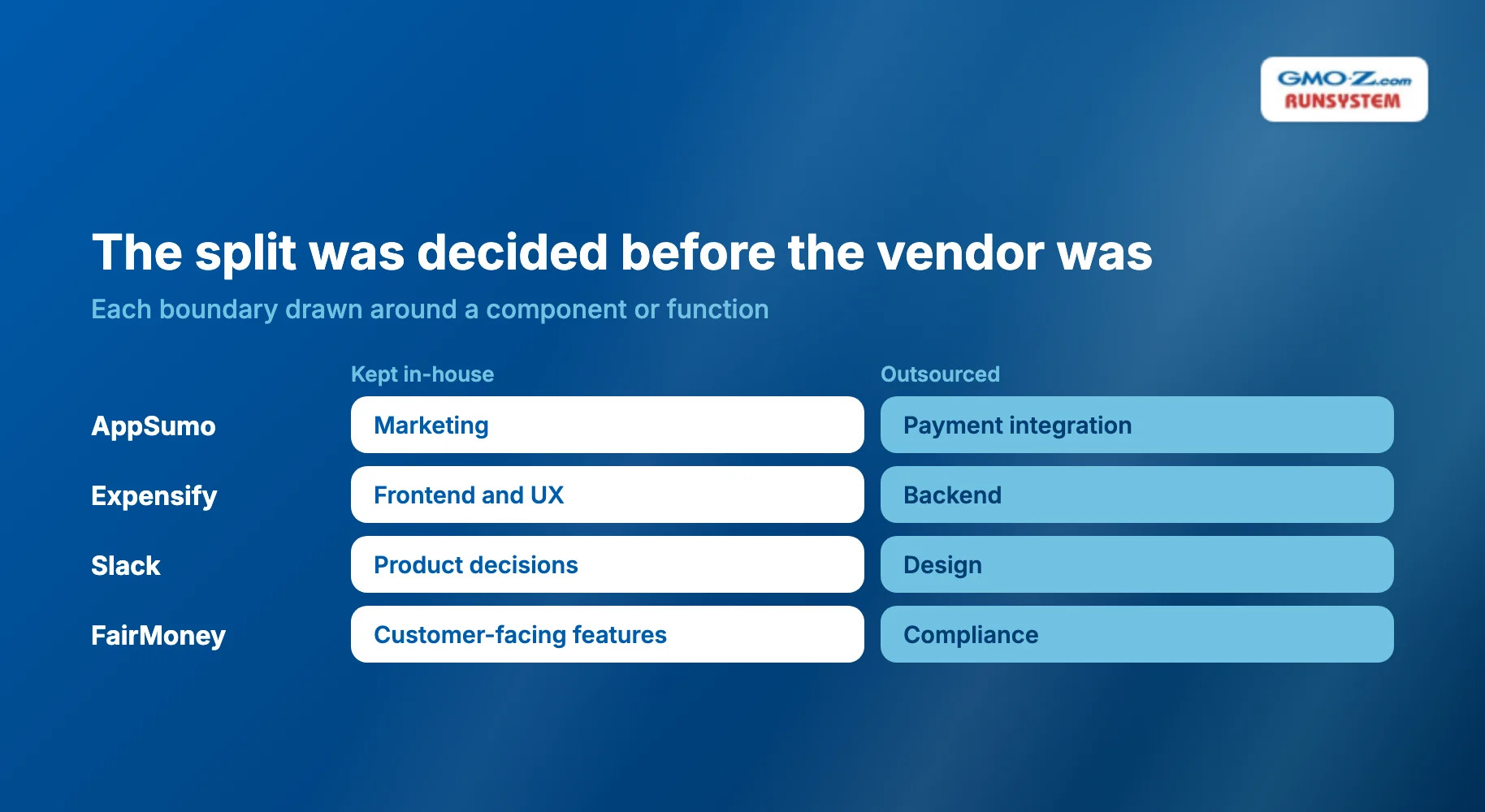
Back to topAcross the cases, the outsourcing boundary was defined around a component or function: AppSumo kept marketing while outsourcing payment integration; Expensify kept frontend and UX while outsourcing the backend; Slack outsourced design while retaining product decisions; FairMoney outsourced compliance while retaining customer-facing features; the franchisor outsourced three specific IT functions rather than "IT" as a whole.
Write your split in components before you shortlist vendors.
The cases that report meaningful outcomes also show someone on the client side owning the thing being bought. Kagan owned distribution, Awotona participated in product definition, Expensify's team owned the frontend, and CuriosityStream's CTO identified team integration as critical. The two cases without reported outcomes, UBS and Zabka, also provide no named internal owner.
Name the person on your side who owns the outcome before kickoff.
Back to topCopy the decision structure: bounded scope, clear system boundaries, scoping before development, an internal owner, and knowledge transfer where the client must operate the result.
Do not copy the historical economics. SeatGeek's reported $1/hour data-collection rate around 2009 is not a current benchmark, while Calendly's Ukraine cost base in 2013 and Opera's Polish expansion in 2006 belong to very different markets. The older the case, the more useful it is as evidence about a decision and the less useful it is as evidence about today's market.
Use old cases to support the decision. Use a current quote to support the number.
Back to topMost public cases are available because the companies became well known. For a vendor you are actually considering, ask for the evidence directly.
Request | What it tells you |
A case from your industry and engagement size | Whether the comparison is relevant |
Engagement year and whether it is still running | Whether the relationship lasted |
Before numbers | Whether the result has a baseline |
Team composition by seniority | What you would actually buy |
One case that went badly and what changed | How the vendor handles failure |
A reference call with the named client contact | What the vendor cannot control |
For the reference call, ask three questions: What did the first month look like? Who from the vendor's team is still on the account? What did you have to do internally that you had not planned for?
An NDA, regulatory restriction, or private-equity ownership can legitimately prevent a vendor from naming a client. Having no reference at any size, in any industry, at any date is a different signal.
Send the same six requests to every shortlisted vendor and compare their answers, not just their published case studies.
Back to topThese ten cases are records of ten different outsourcing decisions. They become useful when you know when the decision happened, where the outsourcing boundary was drawn, and who remained accountable on the client side.
We are a Vietnamese IT outsourcing vendor, so we have a commercial interest in the decision, but the cases above are not ours and are labelled by source. If you are comparing vendors, use the vendor-request checklist above or start with a scoped conversation around the specific component you need to outsource.
Back to top