ファミリーサイト
ファミリーサイト
ファミリーサイト


Enterprise transformation is an organization-wide change to how a company decides, works, and runs its systems, aimed at a new strategic goal. Many large companies have one underway. Few rate the results highly: in KPMG's June 2026 survey of 1,750 senior transformation leaders, only 14% considered their organizations top performers.
Strategy is rarely the missing piece. Programs stall where the operating model (who decides and how work flows) meets old systems, because technology is the easiest part to buy and the hardest to absorb. Below you'll find the four types, the five stall causes with a self-scoring diagnostic, and a roadmap with KPIs (key performance indicators) plus stop rules for ending stalled initiatives.
Back to topEnterprise transformation is a fundamental, organization-wide change to how a company operates (its structure, processes, technology, data, and culture) to reach new strategic goals rather than to improve one function.
Rolling out a new CRM (customer relationship management) system in sales is a project. Changing how the company sells, prices, and serves customers, then changing the systems to match, is a transformation.
Change management is the discipline of helping people adopt a change, which makes it a tool that a transformation uses. Digital transformation, by contrast, is one part of the whole. Gartner says it "can refer to anything from IT modernization (for example, cloud computing), to digital optimization, to the invention of new digital business models."
The table below compares the three terms on scope, owner, timeframe, and success measure:
Enterprise transformation | Digital transformation | Change management | |
Scope | Whole operating model | Technology in products, processes, or business model | People side of a specific change |
Typical owner | CEO and executive team | CIO (chief information officer) or CDO (chief digital officer) with business leaders | Change leads and line managers |
Timeframe | Multi-year, delivered in waves | A program or portfolio of initiatives | Runs alongside each change |
Success measure | Strategic outcomes such as growth and cost-to-serve (the cost of serving each customer) | Digital adoption and the results it drives | Adoption by the people affected |
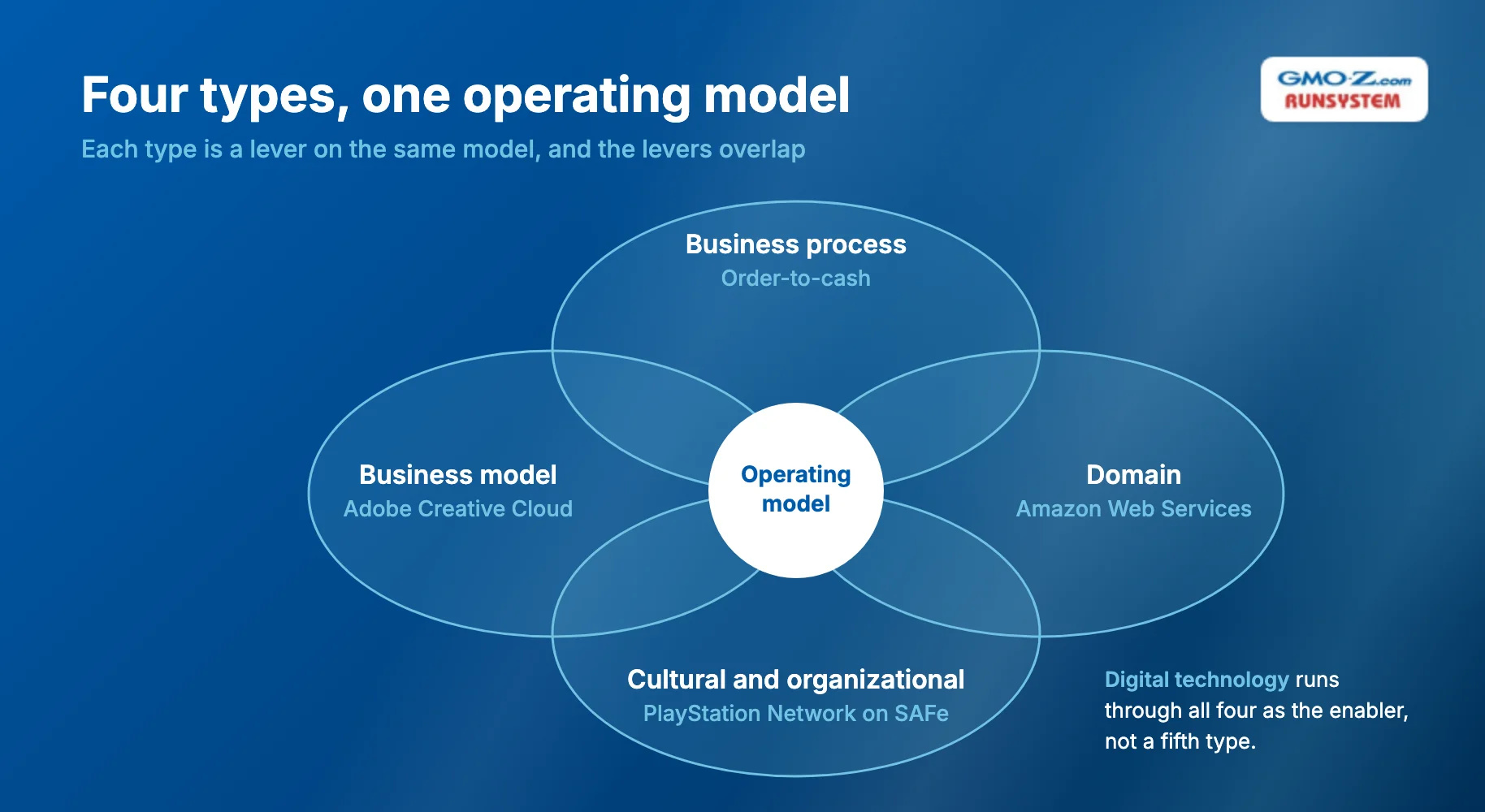
A widely repeated four-type framework is adapted from Andy Annacone of TechNexus, who wrote it in 2019 about digital transformation. His warning carries over to the enterprise version: "Failure to address all four types leaves significant value on the table." Annacone's framework names four types:
Business process transformation redesigns how core work flows end to end, such as order-to-cash (sales order to payment) or procure-to-pay (purchase request to supplier payment). The goal, in Annacone's words, is "lowering costs, reducing cycle times, or increasing quality" in the processes that matter most. Back-office automation is the usual example, and it disappoints when the automated steps still sit waiting on the old approval chain.
Business model transformation changes how the company earns revenue. In fiscal 2013, Adobe stopped new releases of its perpetually licensed Creative Suite to focus on Creative Cloud subscriptions, according to its FY2013 10-K annual filing. The same filing expects the shift to increase the share of its recurring revenue that is reported ratably, over each subscription term.
Microsoft went through a similar shift toward cloud services. Its fiscal 2023 annual report shows Microsoft Cloud revenue of $111.6 billion, a little over half of total revenue of $211.9 billion.
Domain transformation takes an existing capability into a new market. Annacone's example is Amazon Web Services, which he described in 2019 as "now the largest cloud computing/infrastructure service" in a domain formerly owned by Microsoft and IBM. He credits capabilities Amazon had already built for its retail business, so domain moves tend to work when the capability already runs at scale inside the company.
Cultural and organizational transformation changes structure, decision-making, and ways of working. Sony Interactive Entertainment's PlayStation Network adopted the Scaled Agile Framework (SAFe) in early 2014 to coordinate more than 1,000 engineers across eight cities. Scaled Agile's case study reports a 28% cut in initial planning time, though Scaled Agile is the framework's own vendor.
In practice the four types overlap. Adobe's model shift, for one, also meant moving existing users from licenses to subscriptions. Digital technology runs through all four as the enabler, not as a fifth type.
 Back to top
Enterprise transformations tend to stall when strategy and tools change while decision rights and legacy systems stay the same. "Stall" fits better than "fail" here, because the failure numbers are softer than their reputation suggests.
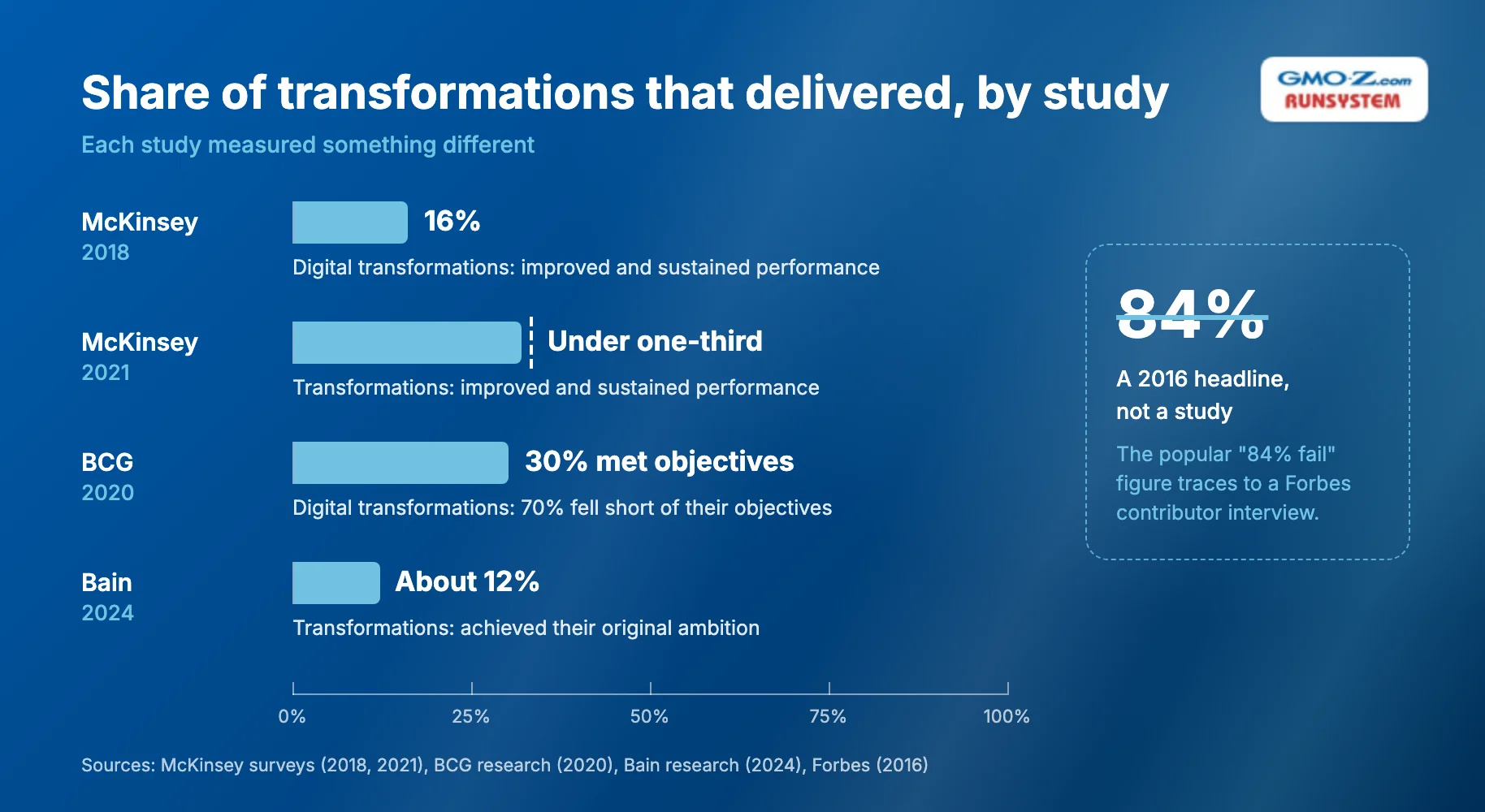
Take the popular "84% fail" figure. It traces to the headline of a 2016 Forbes contributor interview, not a published study. The closest survey data describes missed targets and faded gains rather than collapse:
Five causes recur behind those shortfalls:
New goals arrive, but the same people decide the same things at the same pace. KPMG found just 12% of organizations can launch a strategic initiative in under three months, and argues leaders "have to change how they operate before introducing new technology."
In practice, that means naming who owns each outcome, who can move budget between initiatives, and who has the authority to stop one.
A new platform goes live, and the old process simply keeps running on top of it. That often happens because a legacy system still holds the master data (core customer, product, and supplier records).
In its digital transformation research, BCG found more than half of the companies studied struggled with inflexible technology platforms. The fix is to change the application and how teams run it together.
A multi-year program that shows nothing for several quarters often loses its sponsors before it runs out of budget. One remedy is easy to state: each wave ships one change that a customer, an employee, or the CFO (chief financial officer) can actually see.
Status reports that count projects launched or tools deployed measure motion, not outcomes. McKinsey's Jon Garcia puts it bluntly: "Too often, managers focus on the activities surrounding the transformation, rather than remaining laser-focused on the outcomes."
Middle managers run the processes a transformation changes. BCG warns that without their involvement in planning and execution, "middle managers often become sources of resistance, defending functional siloes and power bases."
You can score your own program against these five causes:
Is your transformation stalling? Score 1 point for each "yes".
Three or more points means you should pause new initiatives and fix ownership, milestones, or the blocking system first.
Back to topA good enterprise transformation roadmap fixes the operating model before it sequences technology. It also says, in advance, what gets stopped. Five steps cover both:
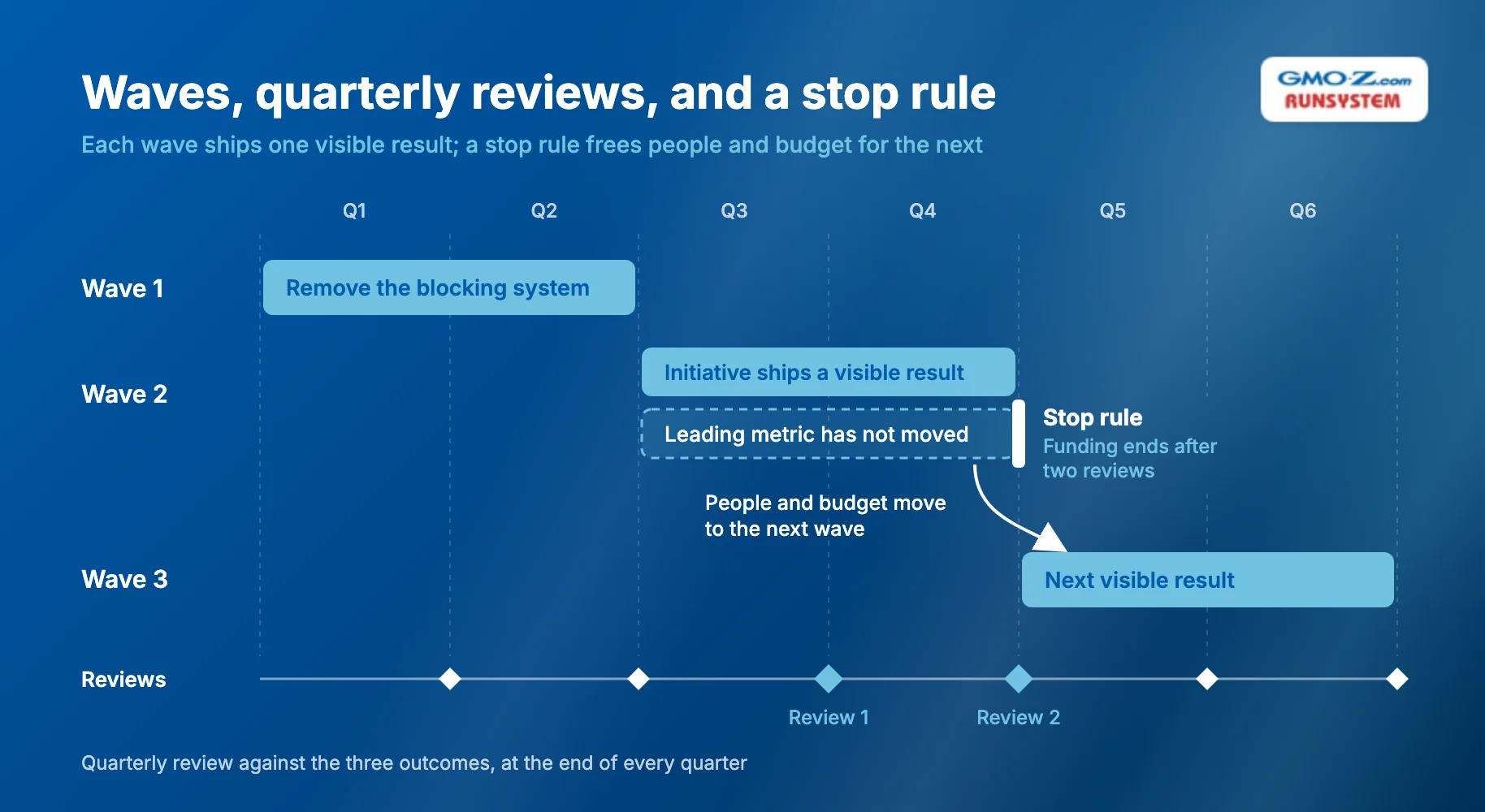
Stop rules are the step most published roadmaps leave out. KPMG found the average organization juggles 3.5 concurrent transformation initiatives, and without stop rules that number tends to creep up. Each stop rule also frees people and budget for the next wave.
Back to topMeasure the transformation against outcome metrics you baseline before wave one starts, and track them at both program and initiative level. In its digital transformation study, BCG found only two out of five organizations monitored progress toward defined outcomes adequately, compared with 90% of organizations with winning programs.
The table below lists example KPIs for each dimension and what each one tells you:
Dimension | Example KPIs | What it tells you |
Customer | NPS (Net Promoter Score), retention, digital channel share | Whether customers feel the change |
Financial | Revenue from new offerings, cost-to-serve | Whether the change pays for itself |
Operational | Cycle time, process automation rate | Whether work actually flows differently |
Technology | Time to launch a new capability, share of systems on supported platforms | Whether systems still block the new way of working |
People | Adoption rate, engagement, skills coverage | Whether managers and teams work the new way |
Treat the people and technology rows as leading indicators (early signals of change), since customer and financial results tend to trail behind. Keep the list short (two or three KPIs per outcome) so quarterly reviews stay about decisions. And agree who owns each KPI's data source before setting the baseline, or the first review can turn into a dispute over the numbers.
If a wave replaces core platforms, add system-level metrics for the migration itself.
Back to topTechnology is seldom the only cause of a stall, but it often keeps one going, because old systems encode the old process. It gets in the way in three places:
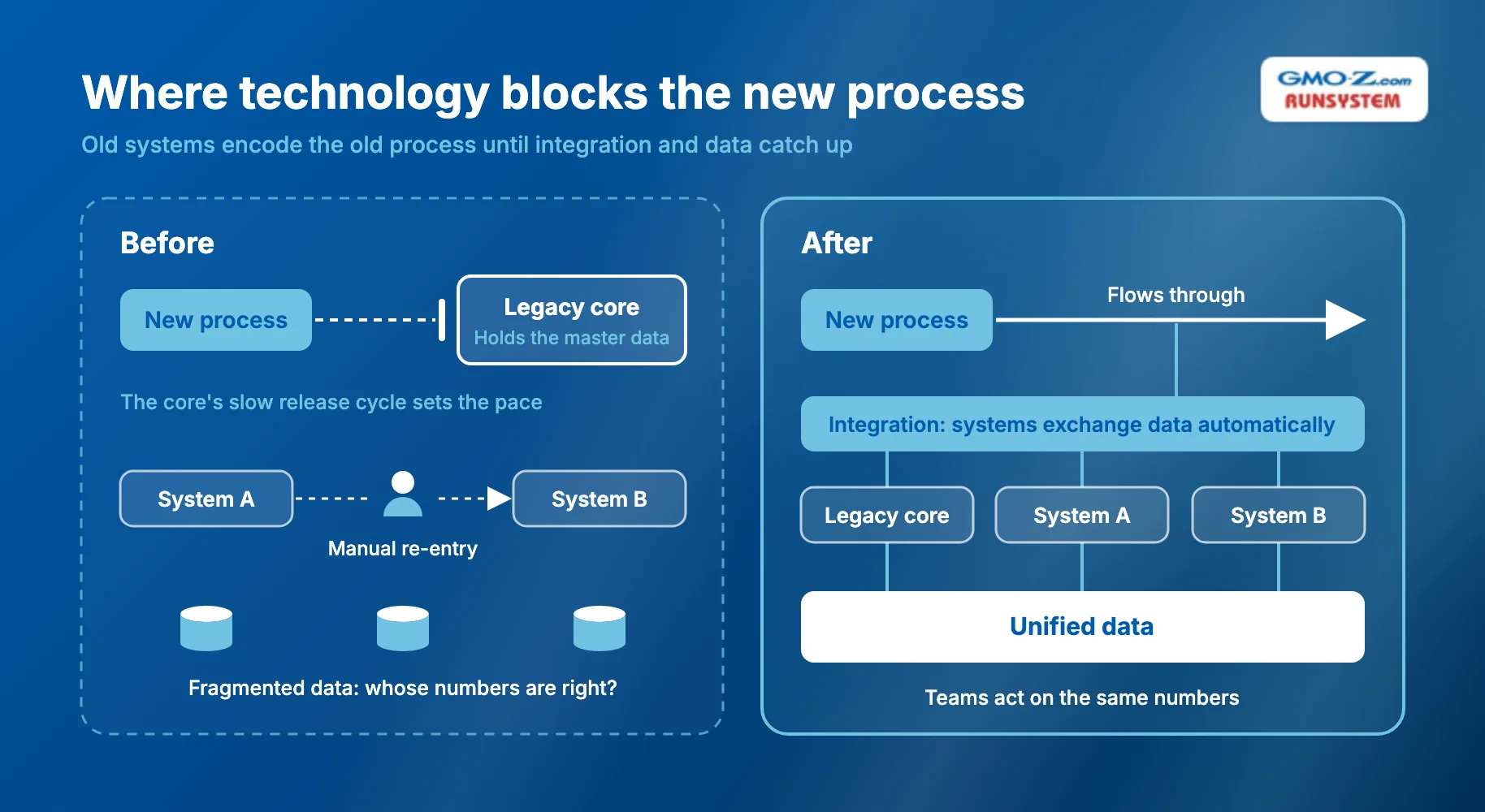
The cost shows up in budgets. In 2020, McKinsey surveyed 50 CIOs at financial-services and technology companies with revenues over $1 billion. Those CIOs reported that their companies divert 10 to 20 percent of the new-product technology budget to tech debt (fixes for past shortcuts and outdated systems).
Bring in a partner when you lack the capacity to build or run the new systems, or when you need to scale faster than hiring allows. Buy delivery capacity, but keep ownership of outcomes and decision rights in-house.
Is your next wave waiting on a legacy migration, an ERP (enterprise resource planning) or CRM rollout, or engineers you cannot hire fast enough? GMO-Z.com RUNSYSTEM works on that technology side, from legacy system migration to ERP and CRM implementation, for organizations in banking, manufacturing, retail, and logistics.
Back to topEnterprise transformation succeeds when it changes how decisions get made, and technology follows that design. In KPMG's survey, the average organization already runs 3.5 initiatives, and only 14% of leaders consider their organizations top performers. Adding more initiatives is rarely the answer.
Before you approve the next initiative, answer three questions:
If any answer is fuzzy, sit down with your leadership team and run the five-question stall diagnostic above. Assess readiness first. Fund the next wave second.
Back to topEnterprise transformation is a fundamental, organization-wide change to a company's structure, processes, technology, data, and culture to reach new strategic goals. Unlike improving a single function, it changes who decides and how work flows across the whole organization.
A common framework, adapted from Andy Annacone's 2019 model for digital transformation, names four types. Business process transformation redesigns workflows, and business model transformation changes how revenue is earned. Domain transformation enters new markets, while cultural or organizational transformation changes structure and ways of working.
Enterprise transformation usually runs as a multi-year program, but duration depends heavily on scope, so be wary of any single average figure. Plan it in waves that each deliver a visible result within one or two quarters, and review progress against three outcome metrics every quarter.
Digital transformation is one part of enterprise transformation. It changes how a company uses technology, while enterprise transformation also changes structure, decision rights, and culture. In McKinsey's 2018 survey, only 16% of respondents said their digital transformation improved performance and sustained it.
Back to top