ファミリーサイト
ファミリーサイト
ファミリーサイト



Most companies never decide whether to outsource IT. They decide it piece by piece, across five or six years, and end up with a boundary nobody designed.
That accumulation is what goes wrong with IT outsourcing in Vietnam, and the vendor is usually not the cause of it. Revenue in the sector is forecast to rise from USD 0.7 billion in 2024 to USD 1.28 billion by 2028, a compound annual growth rate (CAGR) near 17% (Statista). What breaks is the shape of the purchase. A company buys "run" using a contract written for "build", and finds out at month nine that a delivery agreement governs nothing operational.
Four things are missing from the other guides: a scope map separating build, run, support and process; a decision matrix for what to keep in-house; SLA structures and governance mechanics for the period after signature; and the Tet cycle, which reshapes your coverage every February. This is written for the CIO, IT director or COO who owns the whole function.
Before deciding what to outsource, you have to define what the category contains.
Back to topIT outsourcing covers four kinds of work that behave nothing alike: Build, Run, Support and Process. A flat service list gives no basis for treating one differently from another. Each layer carries its own contract basis, cost unit and failure mode.
Build is project work with a deliverable at the end: custom software development, mobile and web applications, quality assurance (QA) and test automation, and legacy modernisation.
The contract basis is deliverable-based, usually a statement of work (SOW). The cost unit is hours or a fixed scope. The primary risk is scope drift.
Buyers understand this layer best because it looks like procurement: a start, an end, a specification to argue about, and visible failure on a known date. That familiarity teaches them to contract every other layer the same way, and deliverable-based contracts govern build well and nothing else.
Run is continuous operation of existing systems: infrastructure and cloud operations, platform monitoring, security operations, and release and deployment management.
The contract basis is availability-based, which means a service level agreement (SLA). The cost unit is a monthly subscription. The primary risk is continuity.
How Run fails is the distinction the rest of this article turns on. It degrades gradually: response times drifting each quarter, patches slipping from a week to three, a monitoring alert nobody reconfigured after the person who understood it left. By the time anyone names it, it has been a problem for two quarters.
So Run needs an SLA with a measurable target. An availability-based service bought under a deliverable-based contract has no enforceable standard, because "we'll take care of it" defines nothing.
Support is the human interface to those systems: service desk, L1 to L3 escalation, end-user assistance and incident response. Contract basis is volume-based, cost unit is per-seat or per-ticket, and the primary risk is quality drift under volume.
Process, or business process outsourcing (BPO), is the layer most IT outsourcing guides leave out: data entry and processing, finance back office, advertising operations, document processing, and robotic process automation (RPA). Contract basis is outcome-based, cost unit is per-transaction or per-FTE, and the primary risk is accuracy at scale.
Process belongs here because its boundary with engineering has dissolved. A document processing operation running optical character recognition (OCR) and RPA is a business process and an engineering system at once. That convergence has a Vietnam-specific edge: Japanese-language capability plus OCR and RPA maturity separates Vietnamese vendors from regional alternatives, and it is invisible in every English-language guide on this topic. The layer covering data processing and back-office operations is the one buyers most often discover they needed after the master agreement was signed.
Because each layer fails differently, each needs its own definition of good.
Layer | Contract basis | Cost unit | Primary risk | How failure shows up |
Build | Deliverable (SOW) | Hours or fixed scope | Scope drift | Missed date, visible |
Run | Availability (SLA) | Monthly subscription | Continuity | Gradual degradation, late |
Support | Volume | Per-seat or per-ticket | Quality drift | Rising reopen rate |
Process | Outcome | Per-transaction or per-FTE | Accuracy at scale | Error rate at volume |
A company that outsources all four layers under one deliverable-based master agreement (MSA) has an enforceable standard for exactly one of them and nothing for the other three.
The vendor is not at fault when Run degrades under a Build contract. Nothing in the agreement defined what good looked like, so nothing was breached. Most disputes filed as vendor underperformance are contract-structure failures, settled by rewriting the agreement. Replacing the vendor changes nothing.
Now you can see the layers. The question is which of them should leave the building at all.
Back to topTwo questions decide the boundary, and neither is technical difficulty: how much the capability differentiates you, and how mature the process is.
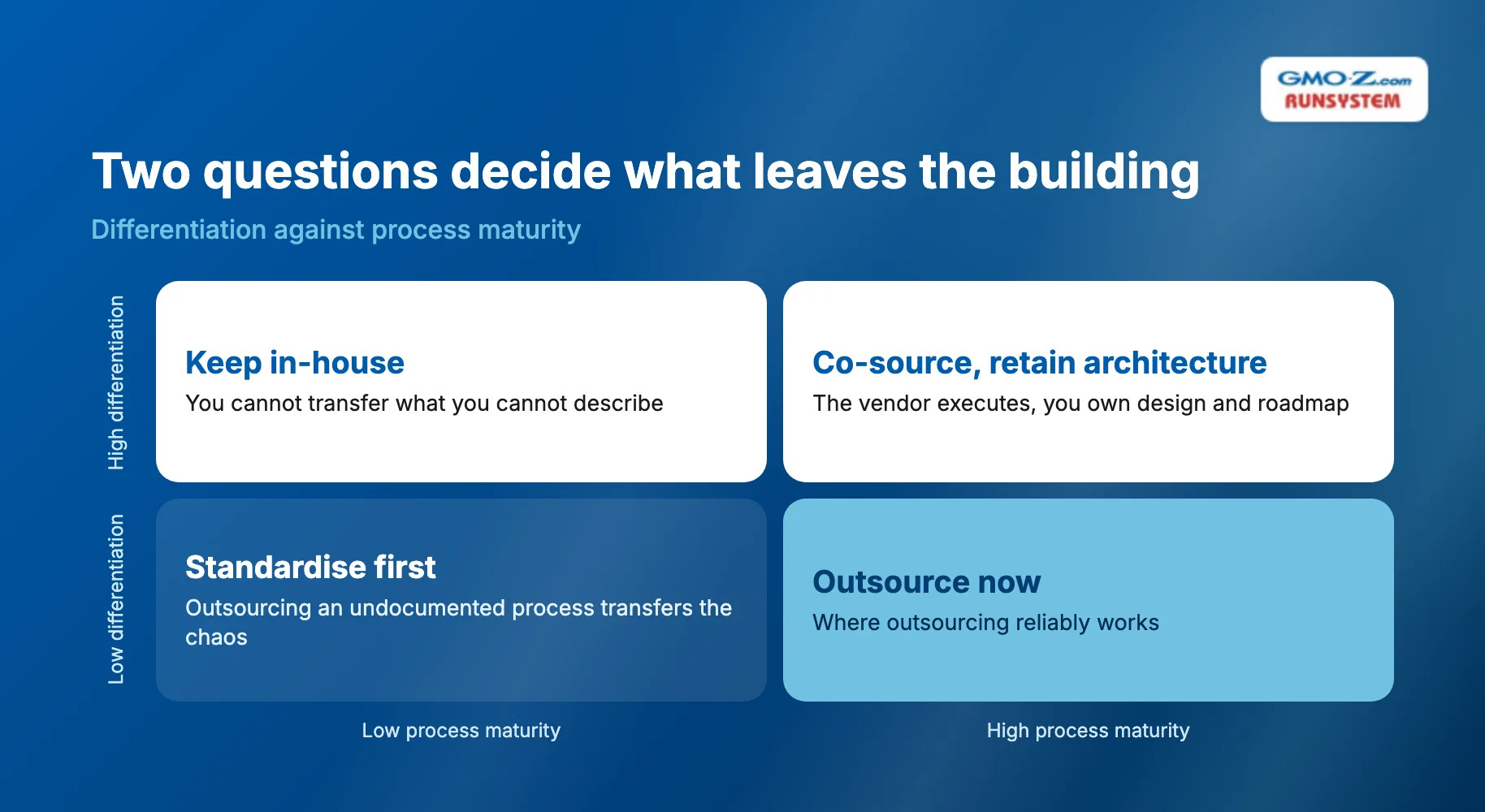
Differentiation asks one thing: would a competitor gain anything by having exactly this capability? If not, it is a commodity, however technically demanding it is to run.
Process maturity asks a second: could someone outside the team execute this work from the documentation alone?
Four quadrants come out of that, and two of them say do not outsource.
High differentiation, low maturity: keep it in-house. You cannot transfer what you cannot describe, and here the tacit knowledge is the advantage itself.
Low differentiation, high maturity: outsource now. This is where outsourcing reliably works, and where most companies under-outsource.
Low differentiation, low maturity: standardise first. Handing an undocumented commodity process to a vendor transfers the chaos and adds a contract to it. This is the most expensive single mistake in the decision.
High differentiation, high maturity: co-source and retain architecture. The vendor executes, you own the design decisions and the roadmap.
Three things stay in-house regardless of quadrant: architecture ownership, vendor selection itself, and the person who knows why the system is the way it is.
Most companies get this backwards, over-outsourcing the differentiating work and under-outsourcing the commodity work, because the differentiating work is more interesting to discuss.
Each layer has a default placement and an exception.
Build usually lands in low differentiation and high maturity for standard platforms, so outsource it. The exception is the core product that is the business.
Run is almost always commodity and mature, so outsource it. The exception is regulated infrastructure carrying data residency constraints, where separation is the requirement.
Support is commodity by definition, the highest-return layer to outsource first, and the one companies delay longest because it is the most visible internally.
Process depends entirely on maturity. A documented, measurable process transfers cleanly. An undocumented one does not, however routine it looks.
Sequencing matters as much as selection. Companies that outsource Support first, then Run, then Build report the smoothest transitions, because each step builds the vendor-management capability the next step needs. That pattern comes from practitioner experience. No published research confirms it.
Four capabilities stay internal at every level of outsourcing.
Architecture ownership. The vendor implements, you decide. Lose it and every future vendor decision gets made for you by the current vendor.
Vendor management capacity. At minimum, one person whose job includes governing the relationship. Outsourcing without it means buying a service you cannot supervise.
Escalation authority. Someone internal empowered to stop work. If the vendor's project manager is the most senior person in the room, there is no escalation path.
Exit readiness. Current documentation, credentials held by you, and a transition plan maintained continuously, so it is current in the month the relationship ends.
Budget roughly 8-15% of outsourced spend for retained capability, a planning heuristic drawn from the four roles above with no published benchmark behind it. It is the line item companies cut first and regret most, and Section 7 covers what the cut costs.
Once you know what leaves, the model determines how it leaves.
Back to topSix engagement models are in common use, and four of them were designed for Build. That mismatch is why Run and Support get contracted badly.
Model | Build | Run | Support | Process |
Project-based | Native fit | No | No | No |
Dedicated team | Native fit | Partial | No | Partial |
Staff augmentation | Native fit | Partial | Partial | No |
ODC / BOT | Native fit | Partial | Partial | Partial |
Managed services | Partial | Native fit | Native fit | Partial |
Hybrid | Native fit | Native fit | Native fit | Native fit |
ODC is an offshore delivery centre, a dedicated team and facility operating as an extension of your organisation. BOT is build-operate-transfer, the same arrangement with a contractual handover of the entity at the end.
Managed services is the only model that natively fits Run and Support, and it is the model buyers understand least. Four of the six were built for project delivery, so they get applied to continuous operation by habit.
Hybrid is what most real arrangements become anyway: a dedicated team for Build alongside managed services for Run, under two contract structures. It works better designed at the start than arrived at through amendments.
Managed services is a subscription for an outcome, meaning availability, response and resolution. Break-fix support is reactive and priced per incident. Managed services is proactive, priced per period, and the premium buys a shift in who carries volume risk.
Three questions expose a weak managed services proposal. Use them as a script:
Managed services contracts also routinely define what is covered and stay silent on what is excluded. Ask for the exclusion list in writing. If it does not exist, the scope is whatever the vendor says it is during your first serious incident.
GMO-Z.com RUNSYSTEM runs Build, Run, Support and Process engagements under a single reporting and escalation structure, with separate service standards written per layer.
Whatever the vendor, system maintenance and monitoring is the scope line where exclusion lists matter most.
An enforceable SLA has six components, and most published SLAs are missing at least two.
Availability target, with the measurement method stated. Severity definitions from P1 to P3, defined by business impact rather than technical symptom. Response time per severity. Resolution target per severity. Coverage window, with time zone and holidays named explicitly. Service credits, with the remedy defined.
Tier | Availability | P1 response | P1 resolution | Coverage | Indicative multiplier |
Bronze | 99.0% | 4 hours | Next business day | Business hours, GMT+7 | 1.0x |
Silver | 99.5% | 1 hour | 8 hours | Extended, 07:00-22:00 | 1.6x |
Gold | 99.9% | 15 minutes | 4 hours | 24/7 | 2.4x |
These tiers are an illustrative structure for comparing quotes, not a market standard. Vendors define tiers differently and the labels carry no external meaning.
The measurement clause decides whether any of it is enforceable. An availability target with no stated measurement method cannot be enforced. Write down who measures, at what interval, from where, and what counts as planned maintenance excluded from the calculation. A 99.9% target measured by the vendor inside its own network is a different commitment from the same number measured externally every sixty seconds.
The coverage window is where Tet stops being a cultural fact and becomes a contractual one. Section 8 covers the language.
One rule per layer.
Build takes a deliverable-based contract with a dedicated team or project structure. Run takes managed services with an SLA. Support takes managed services priced per-seat or per-ticket with volume tiers. Process takes an outcome-based contract carrying an accuracy standard measured in error rate.
The mixed case, which is most companies, has a clean form: separate agreements per layer under one master agreement, governance unified and standards distinct. One relationship, one escalation path, four definitions of good.
If you cannot say numerically what good looks like for a layer, you are not ready to outsource that layer yet. Write the number first. The same test applies whether you are buying support or enterprise application development.
Each of those models prices on a different basis, and not one of them prices by the hour.
Back to topAn hourly figure answers a question a CIO is not asking. The question is what this function costs per month, and how predictable that stays over three years.
Hourly rates answer what an engineer costs. They tell you nothing about what an operating function costs, because a function absorbs volume you did not forecast.
Each layer prices on a different basis for that reason. Build prices hourly or fixed. Run prices as a monthly subscription. Support prices per-seat or per-ticket. Process prices per-transaction or per-FTE.
The commercial substance sits in who carries volume risk. Hourly pricing transfers it to the buyer, subscription pricing transfers it to the vendor, and that transfer is the entire reason to pay a premium for managed services. Buyers who negotiate the premium away have removed the reason for using the model and kept the paperwork.
Hourly rates do matter for Build, where scope is bounded and hours are the honest unit. That is covered in the software outsourcing guide cross-referenced in Section 2.
Published market guides put three anchor points on the record: managed IT services covering infrastructure and support at USD 5,000-15,000 per month, a dedicated team of five (project manager, two developers, QA, designer) at USD 15,000-25,000 per month, and one senior developer through staff augmentation at USD 4,000-7,000 per month.
Every figure needs its coverage assumption attached, because a Run number at business-hours coverage and the same number at 24/7 describe two different services. Write them in this form: "Run, 200 employees: USD 8,000-14,000 per month. Assumes business-hours coverage GMT+7, P1 response within 1 hour, cloud infrastructure under 50 instances." A monthly figure without that second sentence is not comparable to anything.
Coverage window moves Run cost further than headcount does, which is why two quotes that look 40% apart are often quoting different services.
Five drivers move a Run or Support quote, and they are not the drivers that move a Build quote.
Coverage window is the largest. Moving from business hours to 24/7 typically runs 1.8-2.4 times the business-hours cost, a planning heuristic worth deriving from your own quotes before accepting it.
Compliance requirements are a standing cost, renewed every year: ISO-aligned processes, audit trails, regulated data handling.
Integration complexity is measured by the number of systems the vendor has to touch. User count is close to irrelevant.
Legacy footprint is the most underestimated of the five, because it stays invisible until a vendor prices it. Undocumented systems cost more to run than modern ones.
City premium is real but small. Ho Chi Minh City prices above tier-two hubs.
For Run and Support, cost is driven by coverage and complexity. Seniority is a Build variable.
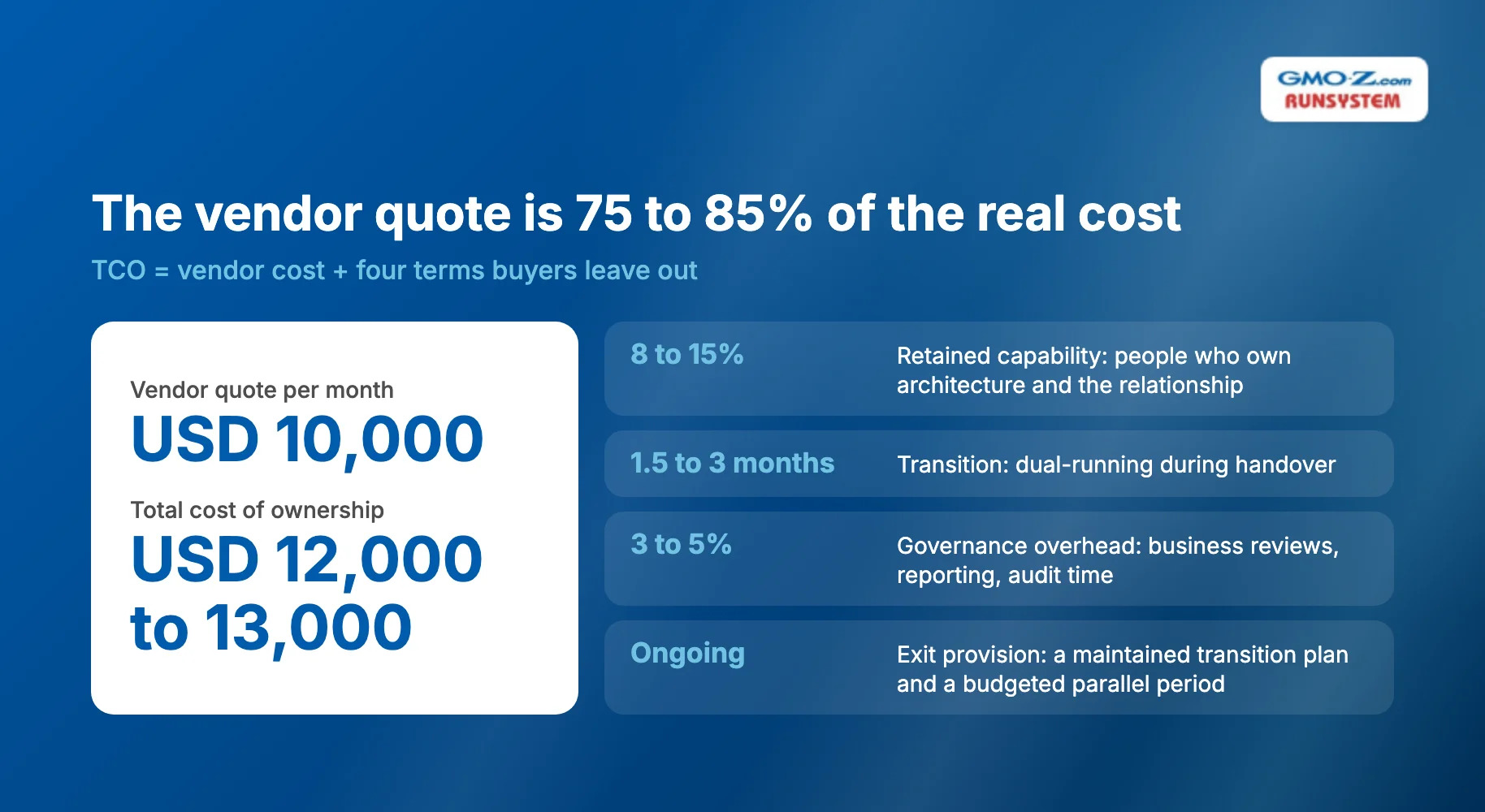
Total cost of ownership (TCO) for an outsourced function is not the vendor quote. It is five terms:
TCO = vendor cost + retained capability + transition + governance overhead + exit provision
Retained capability runs 8-15% of vendor spend: the internal people who own architecture and manage the relationship. Transition runs 1.5-3 months of dual-running during handover. Governance overhead runs 3-5%, covering quarterly business reviews, reporting review and audit time. Exit provision is a documented transition plan maintained continuously plus a budgeted parallel period.
Work the arithmetic and a USD 10,000 per month quote lands closer to USD 12,000-13,000 in total cost of ownership. Vendor cost is 75-85% of the number that matters. The companies surprised by this are the ones that cut retained capability to make the business case approve. That works for about eighteen months, then produces a function nobody internal understands.
Exit provision maintained continuously costs a fraction of exit readiness assembled under pressure, and the pressure version is the only one anyone ever budgets for.
Those price points map to different kinds of vendor. Not every firm covers every layer.
 Back to top
Vietnam has hundreds of IT outsourcing firms and a much shorter list of firms that genuinely cover all four layers. Sorting by headcount or certification will not find them. Sorting by layer coverage will.
Four criteria, each one verified at source. Layer coverage comes from vendor service pages, and marketing claims are ignored. Certifications are checked against issuing bodies. Headcount comes from public statements. Client evidence comes from Clutch, GoodFirms and VINASA recognition.
The list is not ranked. It is grouped by layer coverage, and order within a group carries no judgement.
Disclosure: this article is published by GMO-Z.com RUNSYSTEM, which appears in the full-stack group below on the same criteria and in the same format as every other firm listed.
A reader should be able to eliminate firms with this list. That is the job it does.
Read across the grid once it is compiled and one pattern dominates. Most Vietnamese firms are Build-only. A smaller group covers Build and Run. Very few genuinely cover Process. Buyers who want one vendor across all four layers are shopping in a market a fraction of the size the headline company count suggests, and most full-service claims collapse under a layer-by-layer check.
Each entry below follows the same six-line format. Full-stack group first, because the portfolio argument in this article makes that group the relevant one for a function-level buyer, not because it is the better group.
Firm | Build | Run | Support | Process | Certifications (vendor-stated) | Best fit |
FPT Software | Full | Full | Full | Full | CMMI 5, ISO 27001, ISO 27701, ASPICE 3 | Enterprise, multi-country |
GMO-Z.com RUNSYSTEM | Full | Full | Full | Full | CMMI 3, ISO 9001, ISO/IEC 27001:2022 | Japan-market, multi-layer |
NashTech | Full | Full | Full | Full | ISO 27001 | UK and EU buyers, BPO plus engineering |
CMC Global | Full | Full | Partial | None found | CMMI 5, ISO 27001, ISO 9001 | Cloud migration then cloud operations |
Rikkeisoft | Full | Partial | Partial | Partial | CMMI 3, ISO 27001, ISO 9001 | Japan-market build with infrastructure administration |
TMA Solutions | Full | Full | Full | None found | CMMI 5, ISO 27001, TL 9000 | Telecom, production support at scale |
VMO Holdings | Full | Partial | Partial | None found | CMMI 5, ISO 27001, ISO 9001 | Product build with hosting and maintenance |
KMS Technology | Full | Partial | None found | None found | Not published | Product engineering and test automation |
Luvina Software | Full | Partial | Partial | None found | CMMI 3 (development and services), ISO 27001 | Japanese enterprise systems |
SmartOSC | Full | Partial | Full | None found | ISO 27001, EcoVadis | Commerce platforms, storefront operations |
Founded in Hanoi in 2005 and part of GMO Internet Group since 2011, a group of 89 companies with more than 5,000 staff across 17 countries. Offices in Tokyo since 2007, Ho Chi Minh City since 2008, Da Nang since 2012 and Hue since 2023.
Layers covered: Build, Run, Support and Process, including back-office process operations across two BPO centres in Hue and Hanoi.
Strongest at: multi-layer engagements for Japanese-market clients, where one vendor holds the build roadmap and the operational SLA together. See client case studies.
Not ideal for: buyers wanting a single-layer Build vendor with no operational scope, buyers optimising purely for lowest cost on Support-only engagements, and organisations requiring on-site presence outside Vietnam and Japan.
Certifications: CMMI Level 3 and ISO 9001 since 2012; ISO 27001 since 2014, upgraded to ISO/IEC 27001:2022 in 2025.
Vietnam's largest IT services firm, part of FPT Corporation, delivering from Vietnam, Japan, the US, Europe and Asia Pacific.
Layers covered: all four.
Infrastructure Managed Services with cloud L1 to L3, a multilingual service desk, and data processing including OCR. Strongest at: enterprise multi-country programmes where one vendor holds development and IT operations.
Not ideal for: small engagements, where you will not reach senior attention. Monthly cost: not published.
Certifications: CMMI Level 5, ISO 27001:2013, ISO 27701:2019, ASPICE Level 3.
The IT outsourcing arm of CMC Corporation, founded 2017, over 1,500 staff, delivery centres in Hanoi, Ho Chi Minh City and Da Nang.
Layers covered: Build and Run, Support partial through maintenance contracts. No business process line found on its service pages.
Strongest at: cloud migration followed by cloud operations, on a large AWS-certified bench.
Not ideal for: buyers needing Process work from the same vendor.
Certifications: CMMI Level 5, ISO 27001:2013, ISO 9001:2015.
Part of Nash Squared of London, operating in Vietnam since 2000 with more than 2,000 engineers, and running BPO here since 2002.
Layers covered: all four. Application development, support and maintenance, managed IT services, RPA and business process outsourcing.
Strongest at: UK and European buyers wanting engineering and back-office process under one contract. Not ideal for: buyers wanting a Japan-market delivery culture.
Certifications: ISO 27001:2013.
Founded 2012 in Hanoi, around 1,000 staff, with subsidiaries in Japan and the United States.
Layers covered: Build, plus Run through IT infrastructure administration covering uptime monitoring and issue resolution. Support and Process appear in the service list without published standards.
Strongest at: Japan-market development with infrastructure administration attached. Not ideal for: buyers who need a published SLA structure.
Certifications: CMMI Level 3, ISO 27001, ISO 9001:2015.
Founded 1997 in Ho Chi Minh City, around 4,000 staff, six Vietnamese offices plus six overseas.
Layers covered: Build, Run and Support, through IT managed services and production support. No Process line found.
Strongest at: telecom and long-running production support, where its testing depth shows.
Not ideal for: buyers needing back-office process work.
Certifications: CMMI Level 5, ISO 27001, TL 9000.
Founded 2012, over 1,200 staff, sixteen offices across Vietnam, the US, Japan, Korea and Thailand.
Layers covered: Build, with hosting, support and maintenance attached to what it builds. No standalone managed services or Process offering found.
Strongest at: dedicated offshore teams for AI, IoT and cloud-native product work.
Not ideal for: taking over operation of systems another vendor built.
Certifications: CMMI Level 5, ISO 27001, ISO 9001:2015.
Founded 2009, US-headquartered with Vietnamese delivery, around 1,100 staff across four countries.
Layers covered: Build, with cloud managed services attached to migration work. No service desk or Process line found.
Strongest at: product engineering and test automation, the discipline the firm is built around.
Not ideal for: running an IT function, or work priced per seat or per ticket.
Certifications: none published on its own site at the time of writing.
Founded 2004, delivery centres in Hanoi, Da Nang and Ho Chi Minh City, plus Japan, the US and Singapore.
Layers covered: Build, with maintenance held under a services appraisal. No published SLA and no Process line found.
Strongest at: Japanese enterprise systems, where two decades in that market shows in handover discipline.
Not ideal for: buyers wanting 24/7 infrastructure coverage.
Certifications: CMMI Level 3 in both development and services, ISO 27001.
Founded 2006, 400 to 500 staff, focused on commerce platforms including Adobe Commerce, Shopify Plus and Salesforce Commerce Cloud.
Layers covered: Build and Support within commerce. Managed services covers storefront operation, not general infrastructure.
Strongest at: commerce platform builds and the storefront work that follows them. Not ideal for: anything outside commerce.
Certifications: ISO 27001:2013, EcoVadis.
Every firm has a layer where it is strongest and a layer where it is thin. Choosing a vendor is a month of work. Governing one is the next three years.
Back to topFour risks threaten a continuous service here, and none are the risks discussed during vendor selection: key-person dependency inside the vendor, Tet coverage, attrition, and data residency.
One person at the vendor accumulates the operational knowledge for your environment. Nothing degrades while they are there. Everything degrades within weeks of them leaving.
This risk is specific to Run and Support. Build knowledge sits in code. Run knowledge frequently exists nowhere except in one person's head.
Ask three detection questions quarterly:
Two mitigations: a named backup per critical role in the SOW, and a runbook currency standard with a review date. A runbook nobody has tested is documentation, not continuity.
Team tenure, the leading indicator from Section 7, catches this before the incident does.
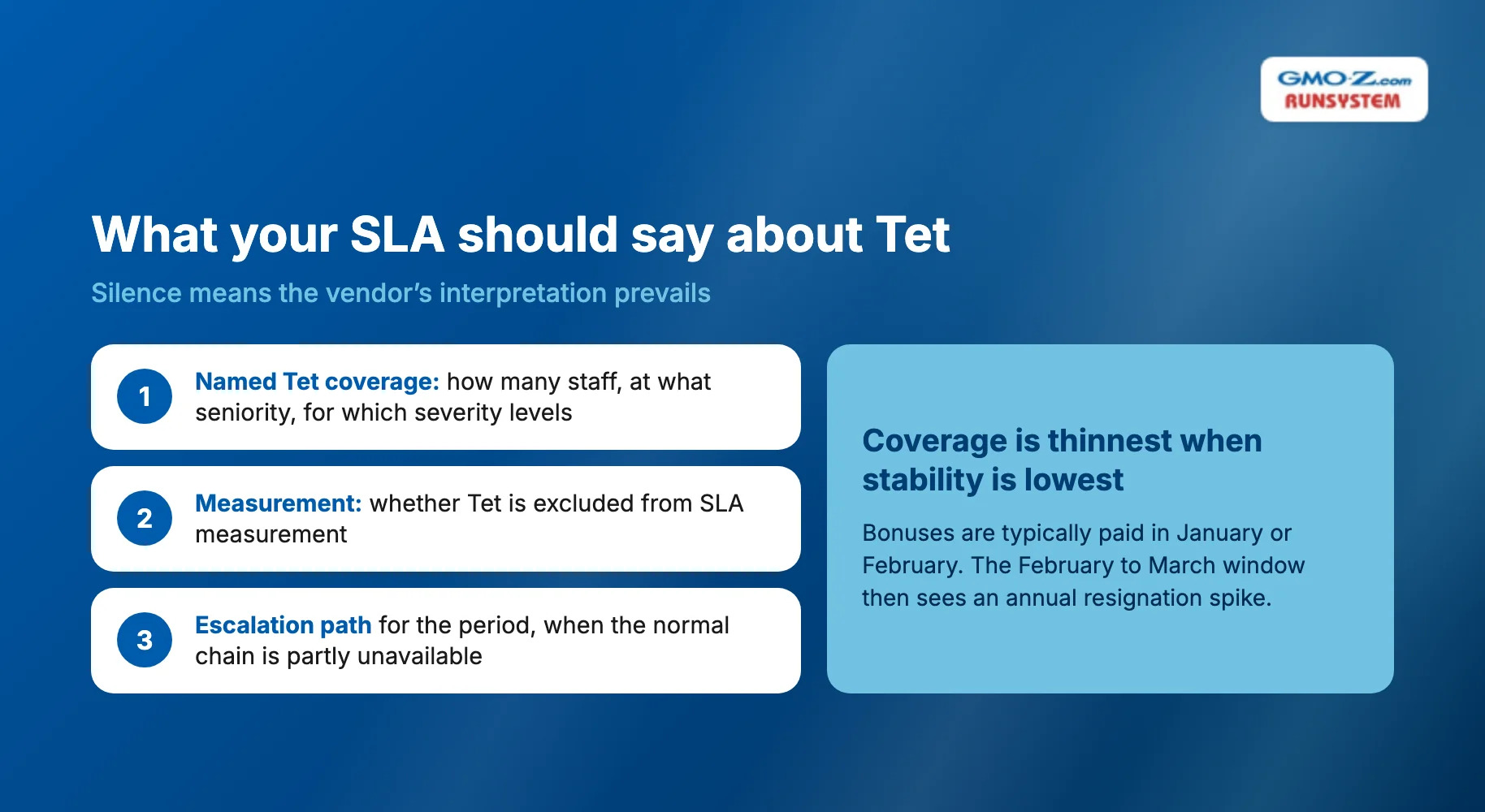
The question to answer before signing is what your SLA says about Tet. Most contracts name public holidays generically without naming Tet or its duration, and most vendors run skeleton coverage without saying so. Silence means the vendor's interpretation prevails.
Three things belong in the contract.
Named Tet coverage: how many staff, at what seniority, for which severity levels.
Whether Tet is excluded from SLA measurement, which many vendors assume and few write down.
The escalation path during the period, since the normal chain will be partly unavailable.
A staffing effect sits on top. The 13th-month salary is standard in Vietnam, bonuses are typically paid in January or February, and the February to March window then sees an annual resignation spike. For a Run engagement, coverage is thinnest exactly when team stability is lowest, and the two compound.
Ask for the previous two years' Tet incident and staffing records. Vendors that ran real coverage have them. This is a planning input, not an argument against Vietnam.
Two sets of numbers describe the same market and they do not agree.
Vendors commonly publish IT turnover below 5%. Those are vendor-sourced, self-reported and unaudited. Independent research differs. Anphabe's 2019 workforce study recorded national turnover reaching 24% against a 10% optimal rate, with IT among the most affected sectors.
One mechanism would explain the gap, and it needs verification first. IT wages in Vietnam are reported to be rising 15-20% annually. At that level, staying in a role costs money, which would explain the divergence.
For a Run engagement, attrition is not a delivery-speed problem. It is a knowledge-loss problem. A departing engineer takes runbook context the replacement rebuilds one incident at a time, over about two quarters.
Two mitigations: require tenure reporting in the monthly report, and set a handover standard for what a departing engineer must document.
Three operational questions matter more than the legal analysis, which needs a lawyer.
Where does the data physically sit, and do you have that in writing? Does your data processing agreement (DPA) set breach notification timelines matching your own obligations? Do you hold an audit right, and have you exercised it?
An unexercised audit right is the same as no audit right. Most companies have a DPA and have never verified where the data actually is.
One point is regularly assumed away: if your product handles EU citizen data, GDPR applies regardless of where the engineering happens, and Vietnam's Personal Data Protection Decree does not replace it. It is also a question about the Tier 3 data centre and digital infrastructure underneath the service.
One of those four risks is structural, and it has a structural answer.
Back to topIT outsourcing in Vietnam is a portfolio you design, not a purchase you make. It comes down to four decisions in order.
Which layers leave the building, from the matrix in Section 3. Which model governs each layer, from the rule in Section 4. Who governs it internally, from Section 7. The answer is never nobody. One vendor or several, from Section 9, decided by spend and where the seam falls.
Get them wrong and no vendor can compensate: the standards were never written down. The contract and the governance structure are what survive when everyone who negotiated the relationship has moved on. We built our operating model on that, which is why GMO-Z.com RUNSYSTEM publishes its certification history and layer coverage.
Back to top